The Most Important Thing Traumatised Children Need Is Not What Most Systems Prioritise
Across my career in out-of-home care, education, and therapeutic practice, I have become increasingly convinced of something uncomfortable:
We consistently underestimate the impact of inconsistency on children.
Not just major inconsistency.
Daily inconsistency.
Relational inconsistency.
The subtle but relentless experience of never quite knowing:
- who this adult will be today,
- how they will respond,
- whether connection is available,
- whether safety is predictable,
- or whether care can actually be trusted.
And the more I have reflected on this over the years, the more I have come to believe:
For many children, inconsistency is not simply part of the problem.
Inconsistency is the problem.
Children Experience Systems Behaviourally, Not Theoretically
As adults, we often organise our systems around models, frameworks, interventions, and programs.
Children do not experience any of those things directly.
Children experience:
- tone of voice,
- emotional availability,
- predictability,
- responses to distress,
- whether adults remain calm,
- whether behaviour is understood or punished,
- and whether relationships feel emotionally safe.
A child can sit inside the most “trauma-informed” organisation in the country and still experience daily relational unpredictability.
Different carers.
Different teachers.
Different thresholds.
Different emotional reactions.
Different consequences.
Different interpretations of behaviour.
Over time, many children adapt to this inconsistency by becoming hypervigilant, defensive, shut down, oppositional, anxious, controlling, or emotionally explosive.
Not because they are “bad.”
But because nervous systems adapt to unpredictability.
We Have Become Intervention-Heavy and Rhythm-Light
This may sound controversial, but I think many helping systems have become increasingly intervention-heavy while losing focus on relational rhythm.
We have become very good at:
- therapeutic language,
- assessments,
- behavioural plans,
- compliance systems,
- incident reporting,
- and intervention frameworks.
But healing rarely happens through isolated therapeutic moments.
Healing happens through repeated experiences of predictable care.
Not dramatic moments.
Repeated moments.
Small moments.
The adult who stays calm again.
The teacher who reconnects again.
The carer who responds with curiosity again.
The worker who remains emotionally available again.
Not perfectly.
But predictably.
That predictability matters more than many systems fully appreciate.
Most Adults Already Know What Good Care Looks Like
This is another thing I have come to believe strongly:
Many carers and teachers do not primarily lack knowledge.
They lack support for sustaining relational consistency under pressure.
Because caregiving is hard.
Teaching is hard.
Remaining emotionally available while managing stress, behaviour, trauma, exhaustion, paperwork, crises, staffing shortages, family systems, and competing demands is extraordinarily difficult.
Especially over time.
And when adults become overwhelmed, reflective capacity shrinks.
We become reactive.
Short-term.
Behaviour-focused.
Task-focused.
Emotionally unavailable without intending to be.
That is not a moral failure.
It is a nervous system reality.
Which means the question becomes:
How do we help adults repeatedly return to relational principles — especially on difficult days?
Why I Built AURA
That question stayed with me for years.
Eventually, I stopped thinking about building another therapeutic framework and started thinking about something much smaller.
What if there were simply a way to gently orient adults back toward consistent relational caregiving every day?
Not through pressure.
Not through surveillance.
Not through performance scoring.
Just through reflection.
That idea became AURA by Secure Start.
And later, Secure Start Classroom AURA for teachers.
The apps are intentionally simple.
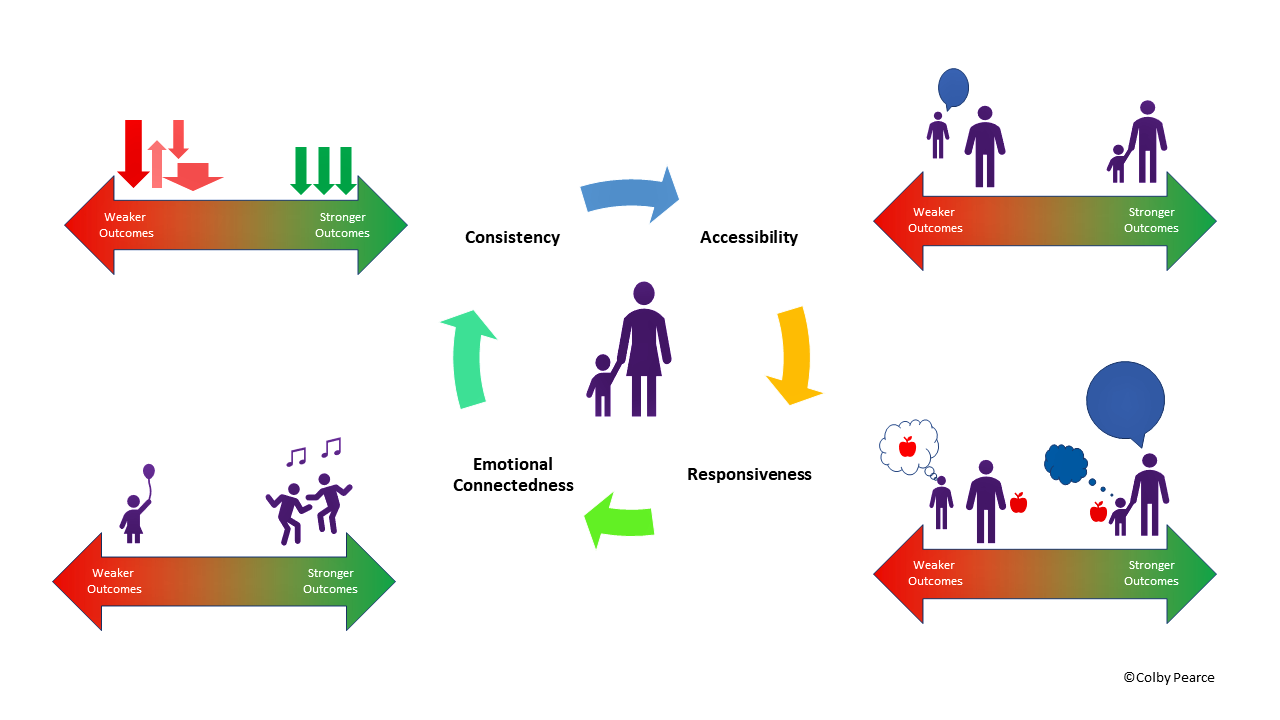
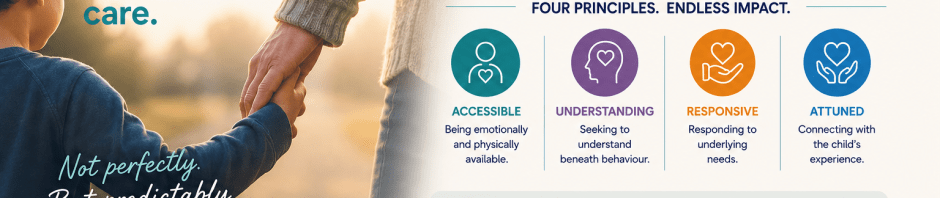
They are built around four principles:
Accessible
Being emotionally and physically available.
Understanding
Seeking to understand beneath behaviour.
Responsive
Responding to underlying needs.
Attuned
Connecting with the child’s experience.
That’s it.
No complicated systems.
No cloud tracking.
No behavioural scoring.
No judgement.
Just a small daily reflective practice designed to support consistency.
Because small moments matter.
And repeated moments matter more.
Why Simplicity Matters
I deliberately did not want AURA to feel like another institutional platform.
The world does not need more overwhelmed professionals trying to maintain another dashboard.
What I wanted was something lightweight enough to actually survive real life.
Something that could fit inside:
- foster care,
- residential care,
- kinship care,
- schools,
- classrooms,
- family support work,
- therapeutic environments,
- and exhausted human systems.
The app takes less than two minutes a day.
That matters.
Because sustainable practice matters more than ideal practice nobody can maintain.
The Goal Is Not Perfection
This is important.
AURA is not about becoming a perfect carer, teacher, or practitioner.
Children do not need perfect adults.
They need adults who repair.
Adults who return.
Adults who remain emotionally available often enough for safety to become believable.
That is a very different goal.
The goal is not flawless caregiving.
The goal is repeated relational orientation.
Again and again.
Especially after hard moments.
Small Moments Change Nervous Systems
I think many of us underestimate how profoundly nervous systems are shaped by repetition.
Not by one conversation.
Not by one intervention.
Not by one insight.
But by repeated experiences over time.
Repeated safety.
Repeated calm.
Repeated curiosity.
Repeated emotional availability.
Repeated attunement.
This is how children slowly begin to believe:
- adults can be safe,
- relationships can stabilise,
- emotions can be survived,
- and connection does not always disappear under stress.
That kind of change rarely looks dramatic.
But it changes lives.
My Vision
My hope for AURA is actually very simple.
A world where children experience adults who return — again and again — to the same relational principles.
Not perfectly.
But predictably.
Because safer, kinder, more consistent care changes lives.
Download the Apps
AURA by Secure Start
For carers and professionals supporting children and young people in care.
Available on the Apple App Store and Google Play.
Secure Start Classroom AURA
For teachers seeking to build safer, more connected classrooms.
Available on the Apple App Store only.