
Compendiums of Attachment-Informed Articles

Dear Visitors to this Site,

I have recently collated a number of blog posts into two “compendiums”, which appear in Menu’s on the right hand side of this site. One compendium includes articles relating to the care, management and treatment of children who have experienced family trauma. This compendium is likely to be of interest to those who care for these children and those who work with them in  education and clinical contexts. The second includes articles about attachment-informed parenting and is likely to be of interest to a broader audience. Tell me what you think of each compendium. 

Colby

Posted in Uncategorized | Tagged , , , , , , , , , , , , | Leave a comment

Eyes are mirrors for a child’s soul

Eyes

Posted in AAA Caregiving, Adoption, Attachment, Favourites, Fostering, Parenting, Resilience | Tagged , , , , , , , , , , , , | 2 Comments

A gentle method for getting children settled to sleep in their own beds

This was a very popular post that has become somewhat buried in this site, so I thought I would reproduce it here. Enjoy! 🙂

Crying baby at night

In my practice one of the more common struggles reported by parents and caregivers is getting children off to sleep in their own bed.  What follows is a simple method to address this issue that I often recommend, and that I used with my own children.

Before I get to the method, I want to advise that there are many and varied reasons why children have difficulty getting off to sleep in their own bed. Time and space do not permit me to go into all possible reasons here. What I would say is that the method presented here is appropriate for many of the reasons why children have this difficulty. It is offered as general advice and is not a substitute for a full assessment and recommendation from an appropriately qualified paediatric sleep specialist.

Firstly, children’s sleep patterns are subject to a sleep-wake cycle, which is physiological in nature but strongly influenced by bed-time and wake-time routines. A stable and consistent bed-time and wake-time are important for establishing a stable sleep-wake cycle. That’s right, a stable wake-time is just as important as a stable bed-time. If your child is having difficulty getting off to sleep, don’t let them sleep in. Wake them up at a consistent time every day, regardless of how long it took them to go to sleep. Their wake-time should usually be approximately twelve hours after their bed-time.

The sleep-wake cycle is also affected by exposure to light and its impact on melatonin production. Melatonin production is implicated in the onset of sleep. Light is thought to suppress melatonin production. So, ensure that your child is in a light-reduced environment for at-least thirty minutes before their bed-time. If your child requires a night light, use an orange one as it has been suggested that orange light does not suppress melatonin production as much as other forms of light.

Now, once it is bed-time, I suggest that you put your child to bed and sit or lay alongside them for approximately twenty minutes. In that time, you should read to them and sing them lullabies. Read first; then sing. As with other aspects of parenting and caregiving, consistency is important here. I suggest rotating through a small number of books and a small number of lullabies across consecutive nights. Children draw comfort from the predictability of the bed-time routine, thus preparing them for the separation involved in going to sleep. After a while, the lullabies are likely to become associated with feelings of sleepiness, with the result that the child begins to feel sleepy when the same lullabies are sung to them.

If your child falls asleep during the above, you are free to leave the room. If they are still awake, you move to the next stage of the method. This involves providing the profound reassurance the child requires to cope with separation and go to sleep. If it works, it will circumvent the child’s effort to engage in proximity-seeking behaviour, such as calling out, getting out of bed, searching for you, complaining of having a tummy ache, asking to go to the toilet, and so on.

After you have read and sung to your child, say to them something like “I am just going to put the light on in the next room and I will be right back. You can stay awake until I come back”. Then, you literally walk out of the room and walk back in almost straight away. You acknowledge that the child is okay and then say “I am just going to put the kettle on and I will be straight back. You can stay awake until I come back”. You then do this and when you return to the child you say something like “I am just going to the toilet and I will be straight back. You can stay awake until I come back”. You then do this and when you return to the child you say something like “I am just going to have my cup of tea and I will be straight back. You can stay awake until I come back”. With each separation, you tell the child that you are doing an activity that takes longer and longer to complete. You keep doing this until, when you return to the child, you find them to be asleep.

Speaking of activities that have temporal (i.e.time) meaning is more easily understood by the child than saying “I’ll be back in a minute”. Choosing longer and longer activities involves exposing children gradually to separations, such that they do not become overly anxious, call out or get out of bed. It is important to return to the child before they call out or get out of bed, because parent-initiated proximity is more reassuring than child-initiated proximity. So adjust the separation as required to ensure that you get back to them before they leave their bed to find you! Telling the child to stay awake is an important way to circumvent potential conflict and associated parental frustration, with the result that the child is calmer and more likely to fall asleep. Put in a different way, this is a useful way of making use of “reverse-psychology”.

Playing relaxing classical music softly in the child’s bedroom is a useful adjunct to the above. Finally, enjoy this special time spent with your child. I did, and  experienced sadness when my youngest said “dad, I don’t need you to stay with me anymore”.

To access a PDF of this article and other resources, click here.

Colby Pearce Resilience

For more information about the theory behind the above methodology, please refer to my book A Short Introduction to Promoting Resilience in Children.

If you found the information in this article useful, please share it using the sharing buttons below.

Please also subscribe to this blog to receive further ideas and guidance when it becomes available.

Join 5,452 other subscribers

For more information about my work visit securestart.com.au.

You can access more information about my programs by clicking the links below:

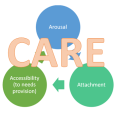
CARE embedded in AAA

Triple-A Model of Therapeutic Care

The CARE Therapeutic Framework

Helping Children and Young People Realise their Potential

Another place to connect with my work is to follow one or more of my pages on Facebook:

Secure Start Therapeutic Care

Secure Start

To Connect with me on LinkedIn or Twitter click below:

LinkedIn

Twitter

Posted in AAA Caregiving, Adoption, Attachment, Fostering, Parenting | Tagged , , , , , , , , , , , , | 4 Comments

Guess how much I love you

Guess_How_Much_I_Love_You_Cover_ArtGuess How Much I love you, by Sam McBratney, was a favourite bedtime story for my youngest son. Such was its impact that the final line “I love you right up to the moon . . . and back” became an oft-repeated expression of the loving connection we shared.

My son is nearly eleven years of age now and long past are the days when I would lay alongside him and read and sing to him until he contentedly fell asleep. We still have our bedtime ritual, incorporating a series of thumb wrestles and rock, paper, scissors; after which he still falls happily asleep.

A few nights ago the Guess How Much I Love You line came up again. This time, instead of responding with the oft-repeated “right up to the moon and back” I told a story from my own childhood of my father’s home brewed beer.

My dad used to brew his own beer. I am not sure where he went wrong, but when he opened the bottle from some batches the beer simply grew! I recall watching as the froth from the beer would continue to grow right over of the top of the glass from which he was drinking, accompanied by excited exclamations for my dad to drink up quickly before it was lost.

I likened my love for my children to this auto-regenerating beer my father brewed. It is always growing, regenerating itself after each sip.

20130804-180027.jpgMy son simply smiled that deeply contented smile of a child who knows they are loved.

Posted in AAA Caregiving, Parenting, Resilience, Uncategorized | Tagged , , , , , , , , , | 2 Comments

Proactive needs provision required to heal child trauma

20130804-180027.jpgPerhaps the most little known and understood aspect of childhood trauma is the impact inadequate needs provision has on the child’s perception of how their basic human needs will be met in future, and their associated actions to satisfy their needs. Yet, over eighty years of psychology research clearly shows that inadequate and inconsistent parental responsiveness will promote an enduring preoccupation with needs and high rate and great persistence in securing needs provision. The same research also shows that simply changing the conditions for needs provision, such that a parent or caregiver responds consistently to the child’s signals regarding unmet needs, is not sufficient to reduce the child’s preoccupation with historically unmet needs or the rate and persistence of their need-seeking behaviours. So long as the parent or caregiver responds to the child’s signals regarding their needs, the child will continue to believe that they themselves are responsible for their needs being met. It is only through responding to the child’s needs proactively (that is, before they do anything to draw attention to their needs) that the child can develop an understanding that their needs are understood and important, and that they can depend on their caregivers to satisfy their needs. The consequences of this change in the child’s perceptions is anxiety reduction and opportunities for mutually-satisfying relationships through the lifespan.

A Tale of Three Mice: An Attachment Story

ConsistencyOnce upon a time there were three mice.

The first mouse lived in a house that contained, along with furniture and other household goods and possessions, a lever and a hole in the wall from which food was delivered. Each time the mouse pressed the lever he would receive a tasty morsel of his favourite food.  The mouse understood that, when he was hungry, all he had to do was press the lever and food would arrive via the hole. The mouse took great comfort in the predictability of his access to food and only pressed the lever when he was hungry.

The second mouse lived in a similar house, also containing a lever and a hole in the wall from which food was delivered. Unfortunately, the lever in his house was faulty and delivered food on an inconsistent basis when he pressed it, such that he might only receive food via the hole on the first, fifth, seventh, or even the eleventh time he pressed the lever. This mouse learnt that he could not always rely on the lever and that he had to press the lever many times, and even when he was not actually hungry, in order to ensure that he would have food. Even after his lever was fixed he found it difficult to stop pressing it frequently and displayed a habit of storing up food.

The third mouse also lived in a similar house, containing a lever and a hole in the wall from which food was to be delivered. However, the lever in his house did not work at all. He soon learnt that he could not rely on the lever and would have to develop other ways of gaining access to food. This belief persisted, even when he moved to a new home with a fully-functioning lever.

Source: Pearce, C. A Short Introduction to Attachment and Attachment Disorder. London: Jessica Kingsley, 2009

Posted in Uncategorized | Leave a comment

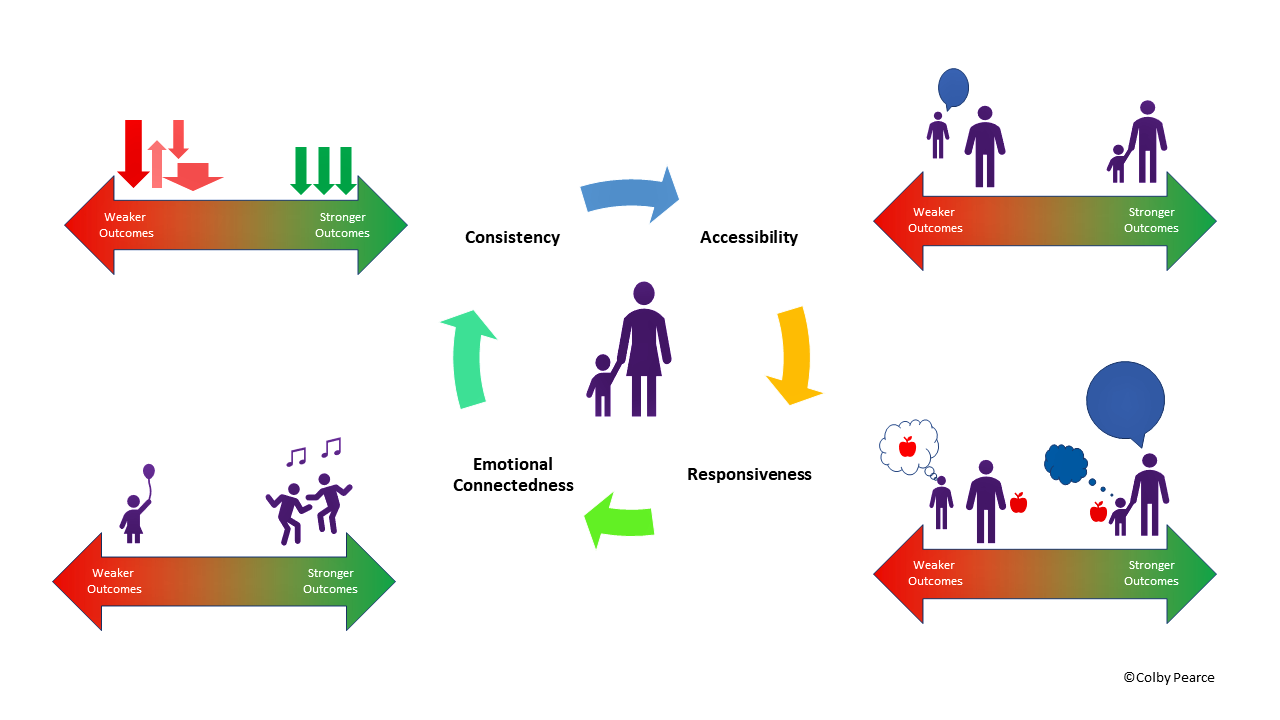
Why consistency in parenting is so important

This is another of my older posts that has become somewhat buried in this site. I thought I might give it a new lease on life as the message is critical to understanding preoccupied and demanding behaviours in children.

20130804-180027.jpgBe consistent is a parenting maxim that is often spoken about. But why is being consistent so important? An answer lies in a series of experiments that informed academic and applied psychology for more than half a century.

During the 1930s, academic Psychologist B. F. Skinner developed an apparatus to study learning in laboratory animals. Referred to as the Skinner Box, this box-like apparatus incorporated a lever or bar, and a feeding chute. Rats and other animals were placed in the Skinner Box and exposed to three learning conditions. In the first condition, a pellet of food was delivered via the chute each time the animal pressed the bar or lever. This condition was referred to as continuous reinforcement. The animals quickly learnt that by pressing the bar or lever they would receive food. In the second condition, a food pellet was delivered inconsistently, such as on the first, third or fourth press of the bar or lever. This condition was referred to as intermittent reinforcement. The animals learnt more slowly that by pressing the bar food would be delivered. In the third condition no food was delivered through the chute, no matter how many times the animals pressed the bar or lever.

Now, here are the important parts. The animals in the continuous and intermittent reinforcement conditions learnt to press the bar or lever in order to gain access to food; though the animals in the continuous reinforcement condition learnt this more quickly. They also learnt (that is, understood) more quickly when conditions changed, such as when food was no longer delivered when the bar or lever was pressed. In addition, research across more than half a century has consistently shown that the animals in the intermittent reinforcement condition press the bar or lever at the highest rate and the most persistently; even after conditions are changed and they receive food consistently or not at all when they press the bar or lever. Animals in the intermittent reinforcement condition are even observed to build up piles of food that is surplus to their requirements at any particular time. In contrast, the animals in the third condition (no food) soon lose interest in the bar or lever.

So what is the relevance of this to parenting? Children develop behaviours that ensure a response to their needs and develop expectations about reliability of needs provision in the same way that the animals did in the above experiments. Children whose needs are met on a consistent basis learn more quickly how to access a response to their needs and are less demanding and preoccupied with their needs. Children whose needs are met inconsistently are slower to learn how to access a response to their needs, exhibit the highest rate of need-seeking behaviour and are the most persistent in their attempts to achieve needs provision. They will even seek a parental response just to reassure themselves that their parent is available and responsive, just as the animals in the above experiments seemed to do when they built up piles of surplus food. They are also slower to learn when the conditions under which their needs are responded to change. Anyone who has fostered or adopted a child in need can attest to this!

So, as far as possible, be consistent in your parenting of your children. Respond to their basic human needs on a reliable and consistent basis. Respond to their reasonable wishes only as often as you can maintain doing so over time.

Posted in Uncategorized | 1 Comment

Shit of a kid

This is a popular post. I am glad readers support the message that words hurt children, notwithstanding our being told “sticks and stones will break my bones . . .”.

colbypearce's avatarAttachment and Resilience

This shit of a kid has been married for more than twenty years.

This shit of a kid has three happy, healthy, confident children.

This shit of a kid was the first member of his paternal family in living memory to attend university.

This shit of a kid has twenty year history of publishing in his areas of specialisation.

This shit of a kidhas maintained a successful independent child and family psychology practice for more than ten years.

This shit of a kid has extensive experience teaching and training the next generation of Clinical Psychologists.

This shit of a kid holds and has held senior appointments in his profession.

Still, some words are not easily forgotten.

Choose your words carefully when speaking to a child.

rainbow

View original post

Posted in Uncategorized | Leave a comment

The importance of empathy

20130804-180027.jpgThis is a reproduction of blog post I wrote approximately two years ago, so it is buried a bit in this site. Thought I would re-post under a new title because the message has been well received and, in my opinion, is important.

Today, my eight year old son drew my attention to his sore knee, which he bruised falling on stairs at our home yesterday. He has a nice purple bruise in the middle of his knee. When distracted, he walks fine and does not complain about the pain. When his attention is on his knee, he complains of pain and walks with a limp.

As it happens, he complained to me about the pain in his knee this morning.  I was tempted to say that it did not look too bad and to remind him that I had seen him walking fine earlier. My intention in making such statements would have been to reassure him that he would be okay. However, I instinctively knew that this would precipitate anger, strong assertions that the pain was significant and further assertions that I was not taking the matter seriously.  I also knew that he would complain and limp until I did take the matter seriously.

So, I advised my son that his knee looked painful and that I would put a bandage on  it. After I had done this, he walked freely and did not complain of pain for the rest of the day.

The moral of the story is that empathy is the most reassuring response a parent can provide to their child.

Posted in AAA Caregiving, Adoption, Book Reviews, Fostering, Parenting, Resilience, Schools, Wellbeing | Tagged , , , , , , , , , | Leave a comment

Shit of a kid

This shit of a kid has been married for more than twenty years.

This shit of a kid has three happy, healthy, confident children.

This shit of a kid was the first member of his paternal family in living memory to attend university.

This shit of a kid has twenty year history of publishing in his areas of specialisation.

This shit of a kid has maintained a successful independent child and family psychology practice for more than ten years.

This shit of a kid has extensive experience teaching and training the next generation of Clinical Psychologists.

This shit of a kid holds and has held senior appointments in his profession.

Still, some words are not easily forgotten.

Choose your words carefully when speaking to a child.

rainbow

Posted in AAA Caregiving, Parenting, Resilience | Tagged , , , , , , , , , , | 1 Comment

Locus of control and youth suicide

In this, the last post for a little while about my historical publications concerning youth suicide and mental health, I want to introduce you to the following paper: Pearce, C.M., & Martin, G. (1993). Locus of Control as an Indicator of Risk for Suicidal Behaviour Among Adolescents. Acta Psychiatrica Scandinavica, 88 : 409-414.

Locus of control represents the extent to which an individual attributes causality for what happens in their life to their own actions (internal) or extraneous factors (external). At the time of writing this article I thought that having a pervasively external locus of control when bad things happen in life would predispose a person to a kind of helplessness depression (Seligman); hence my interest in it’s possible contribution to understanding suicidal feelings and behaviours among adolescents. I now know that wrongly attributing too much responsibility to oneself for bad events that happen in a person’s life can result in depression and associated suicidal feelings. I suspect, however, that in contrast to those with an external locus of control, those with an internal locus of control are more likely to take the view that they can act effectively to change their circumstances without resorting to suicidal acts; hence the effect observed in this study.

The implication for treating suicidal individuals is to assist them to experience a sense of potency and influence over outcomes in their life.

The paper was the first published in Acta Psychiatrica Scandinavica, which I recall was the eighth most widely read psychiatric journal in the world at that time. Google indicates that the article has been cited 58 times in the 20 years since its publication.

If you would like to read the article, click here.

Posted in Resilience, Wellbeing, Youth Suicide | Tagged , , , , , , | Leave a comment