In order to be heard we first need to listen

I think a lot about the concept of validation; and its antithesis, invalidation. In psychological terms, validation incorporates the experience that our thoughts, feelings, perspectives and intentions are understood, accepted and respected by significant others. Conversely, invalidation incorporates the experience that our thoughts, feelings, perspectives and intentions are not understood, accepted and respected by significant others. People who predominantly experience validation of their thoughts, feelings, perspectives and intentions form the belief that they themselves are acceptable; that is, valid. I am often likening validation to an inoculation against depression. Those who do not experience validation on a regular and consistent basis form the belief that they are unacceptable; that is, invalid. Invalidation has a destructive effect on the mental health and wellbeing of people of all ages; particularly children, where the destructive effects of invalidation can be lifelong.

Validation and invalidation are reciprocal processes. We are all more positively disposed towards the thoughts, feelings, perspectives and intentions of those whom we experience as being understanding, accepting and respecting of our own. Conversely, we are less well disposed towards those whom we experience as not understanding, accepting and respecting us. We are less likely to share with these people or listen to their stories. They, in turn, are less likely to listen to us and share with us. Invalidation ends meaningful communication and destroys relationships.

Central to validation is the experience of being heard. We are more likely to be heard when those from whom we are seeking understanding, acceptance and respect have the experience that we have heard them. This is the truth of the old adage “in order to be heard we first need to listen”.

For our own sakes and the sake of all we come into contact with, we need to get better at listening, understanding, accepting and respecting. Only then can we expect to be heard. Only then can we experience validation and its benefits.

Posted in Favourites, Therapy, Wellbeing | Tagged , , , , , , | Leave a comment

Adopting a balanced view

This short article first appeared in the Blog for The Adoption Social on 21/1/14. I am grateful to the administrators of that site for their interest in my work and my views regarding the care of children.

20130804-180027.jpgI was born in January, which is the height of summer here in Adelaide, Australia. As such, I have always thought of myself as a “summer baby” and considered that this is why I enjoy the warmer months as opposed to the cooler months. I have a lifelong aversion to feeling cold and for many, many years I felt below my best during winter. I have questioned many people about this and have discovered that most people prefer either the warmer months or the cooler months. Many of them are just not happy until their preferred season returns.

About three years ago, and with the emergence of joint aches and pains during the colder months, I had the thought that it was a bit of nonsense really to consider myself a “summer baby” and defer happiness until it was warm again. I have always been a keen gardener and have a large hills garden. Looking after my garden is an act of looking after my self. Water is an issue as it is scarce and expensive, my garden is large and summer is hot (As I write this it is the fifth consecutive day of over 40C). So, I bought some rainwater tanks and now I pray for as much ‘bad’ weather as possible during the cooler months. I check the weather radar each day and feel let down if forecast wet and wintry weather blows south or north. I still have my aches and pains and look forward to the warmer months when they trouble me less, but I also look forward to cooler, wetter months now as it is a boon for my efforts to maintain a magnificent garden. And the garden? Well, with the additional water supply it has never looked better.

What has all this got to do with looking after children; particularly those children who experienced significant adversity in the first days, weeks, months and years of their precious lives? Well, it has to do with how we perceive them and the effects of this; both in terms of our own experience of caring for them and their experience of being cared for by us.

I am particularly interested in the idea of “self-fulfilling-prophecies”. In Psychology, these take the following form. I have a thought. My thought induces an emotion. My emotion activates a behavioural response. My behavioural response precipitates a reaction in others. The reaction of others often confirms my original thought.

Let’s try one. Thought: “nobody loves me”. A common feeling associated with this thought: hostility. Common behavioural responses to feelings of hostility: withdrawal and/or aggression. A common reaction to withdrawal and aggression: admonishments. An inevitable result: confirmation of the original thought.

Lets try another. He is damaged by his early experiences. I feel badly for him. I try to heal him. He keeps pushing me away. He is obviously damaged.

And, another: He is such a good artist. I am so proud of him. I support and encourage his interest in art. His skills develop and he is often affirmed for his artistic achievements. He is such a good artist!

Children who have experienced significant adversity at the beginning of their life are commonly referred to as “traumatised”. There is much literature about how early trauma impacts the developing child, including their acquisition of skills and abilities, their emotions, their relationships with others and even their brain. This literature focuses on the damage early trauma does and there is a risk that we, their caregivers, see these children as damaged.

One of my favourite allegories is the one that the author Paulo Coelho tells in his book, The Zahir. Coelho tells the story of two fire-fighters who take a break from fire fighting. One has a clean face and the other has a dirty, sooty face. As they are resting beside a stream, one of the fire-fighters washes his face. The question is posed as to which of the fire-fighters washed his face. The answer is the one whose face was clean, because he looked at the other and thought he was dirty.

The idea of the looking-glass-self (Cooley, 1902), whereby a person’s self-concept is tied to their experience of how others view them, has pervaded my life and my practice since I stumbled across the concept as a university student. Empirical studies have shown that the self-concept of children, in particular, is shaped by their experience of how others view them. In my work, this has created a tension between acknowledging the ill-effects of early trauma and encouraging a more helpful focus among those who interact with so-called ‘traumatised children’ in a caregiving role.

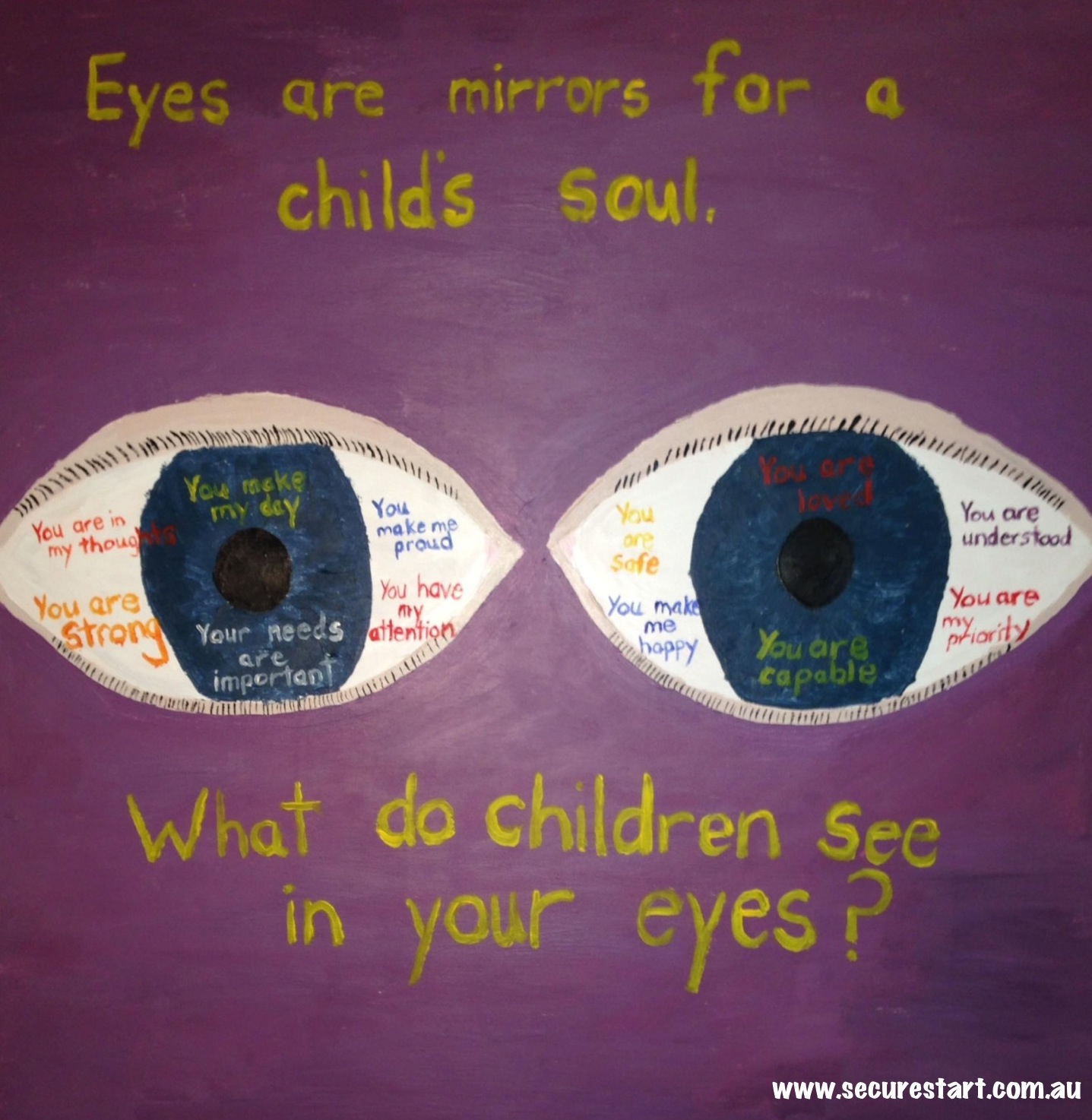
EyesI am just as fallible as the next person, and I do not have all the answers. But as a professional who interacts with these children and their caregivers on a daily basis I strive to find a balance between acknowledging and addressing the ill-effects of early trauma and promoting a more helpful perception of these children. I strive to present opportunities to these children for them to experience themselves as good, lovable and capable; to experience me and other adults in their lives as interested in them, as caring towards them and as delighting in their company; as well as experiences that the world is a safe place where their needs are satisfied. I strive to enhance their experience of living and relating, rather than dwelling on repairing the damage that was done to them. Most of all, I see precious little humans whose potential is still yet to be discovered.

Eyes are mirrors for a child’s soul. What do children see in your eyes?


References

Coelho, P (2005), The Zahir. London. Harper Collins

Cooley, C.H. (1902). Human Nature and the Social Order. New York. NY: Scribner

Publishers
Posted in AAA Caregiving, Adoption, Attachment, Fostering, Parenting, Trauma, Wellbeing | Tagged , , , , , , , , , , , , , | 1 Comment

2013 in review

The WordPress.com stats helper monkeys prepared a 2013 annual report for this blog.

Here’s an excerpt:

The concert hall at the Sydney Opera House holds 2,700 people. This blog was viewed about 15,000 times in 2013. If it were a concert at Sydney Opera House, it would take about 6 sold-out performances for that many people to see it.

Click here to see the complete report.

Posted in Uncategorized | Leave a comment

Toilet Training

Another brief post from the Secure Start Facebook page; this one concerning toilet training.

It has been a day for questions about toilet training. My recommendations: provide an incentive to the child to use the potty; praise and reward (reinforce) success (I prefer social reinforcers, like time spent doing an activity favoured by your child); clean up accidents in a dead pan manner (i.e. no fuss/ no social reinforcement); never punish the child for accidents; and practice toilet timing (i.e. sit on potty each hour for No.1’s and after each meal for No.2’s). One last thing, be persistent with one approach – don’t chop and change; it is counter-productive.


Posted in Uncategorized | Leave a comment

Preparing your child for their first day of school

This is another brief post from the Secure Start Facebook post, which I considered might be of interest to followers here.

At the request of one of our regular visitors to this page, I am going to share some thoughts about preparing children for their first day of school which you may not have seen or heard of elsewhere. I am going to focus particularly on the children who are unsure about attending school for the first time. The first thing I would do is prepare a little calendar, much like an Advent Calendar, incorporating a little countdown to the first day of school and a treat for each passing day (a treat can vary from a sweet to an activity or activities your child would be excited about participating in). This will provide a sense of timing and gradual exposure to the idea of the impending first day, with the anticipated effect that your child does not feel overwhelmed on their first day. Related to this last point, I would visit the school and the school playground prior to the first day so the child has a mental image of the school. You might even take some photos of the school and the playground to attach to your calendar and, if possible, arrange to meet your child’s classroom teacher or, at least, the office staff. I would emphasize the need to acknowledge any particular worries your child has and engage with your child in some simple problem solving about actions they can perform to deal with anxiety-evoking situations (e.g. ask them “what do you think you could do to feel better if that happens” and reinforce the role of the adults at the school to take care of them). Organizing a play date with another child you know (maybe, from Kindy or ELC) who will be starting at the same school on the same day may also be beneficial. Finally, I strongly recommend that you play soothing classical music in your child’s sleeping environment, all night, every night hereafter. This will have the effect of making them less prone to anxiety in the lead-up and on the first day. An old favourite of mine is Dream Children, which was released some years ago by the Adelaide Symphony Orchestra. A more recent favourite with a slightly different (though no less useful) effect is Mozart for Bedtime, which is on iTunes. And, on the day, take lots of tissues for when you return to your car.


Posted in AAA Caregiving, Adoption, Fostering, Parenting, Resilience, Schools, Wellbeing | Tagged , , , , , , , , , , , , , , | Leave a comment

Getting ready for back to school

OK, so there is just under two weeks until the new school year and a common assertion to be heard from parents at this time is “my child is ready to go back to school”. A similar assertion is “I am ready for my child to go back to school”. Whenever I hear these assertions I interpret them as the child and parent are subconsciously craving a return to the stable and consistent routine of school term-time. We all need a bit of change, excitement and surprises in our life, but over the longer term we function better and enjoy greater wellbeing with stable and predictable routines. Many of you will have seen my earlier post about restoring sleeping routines. My suggestion is that you begin to restore other routines, such as mealtimes, personal hygiene rituals and anything else that has become more relaxed during the holiday period. I anticipate that, once re-introduced, a return to “normalcy” will have the effect of reducing minor conflicts and allow parents and children to enjoy what remains of this special time for and with our children.


Posted in AAA Caregiving, Adoption, Children's Behaviour, Fostering, Parenting, Schools, Wellbeing | Tagged , , , , , , , , , , , , , , , , , | Leave a comment

Oral stimulation facilitates feelings of wellbeing

This is another of my posts on the Secure Start Facebook page. Let me know what you think!

From the earliest hours of life, infants experience feelings of emotional wellbeing in association with suckling. As a result, a powerful association develops between oral stimulation and feelings of emotional wellbeing. When anxious or overwhelmed, many children stick something in their mouth; be it a finger or thumb or part of their clothing. This provides tangible evidence of the role of oral stimulation in managing stress and restoring feelings of wellbeing. Knowing this presents an opportunity for assisting children in a proactive manner to remain calm in stress-evoking situations and places, such as on the way to a professional appointment or in a busy, crowded and noisy shopping centre. Offering water in a sports bottle, an ice-block or even a lollipop to suck can be an effective way of inoculating your child to stressful places and situations.


Posted in AAA Caregiving, Adoption, Children's Behaviour, Fostering, Parenting, Resilience, Wellbeing | Tagged , , , , , , , , , , , , , , | Leave a comment

Restoring school-time sleep-wake cycle

This is the first of a series of a short posts that I prepared for my Secure Start Facebook page. For those of you who don’t follow my page, I have included it here for you.

As the return to school approaches, one of the issues that parents often need to address is restoring an earlier bedtime. This can be a source of conflict, replete with children complaining that they cannot sleep in association with their body clock (sleep-wake cycle) having adjusted to the later bedtime that is a common feature of school holidays. Difficulty getting to sleep and associated stress and conflict can be counter-productive to successfully restoring an earlier bedtime. Our recommendation is that parents begin to prepare their child(ren) for an earlier bedtime now by getting them up fifteen minutes earlier each day and putting them in a light-filled environment until you reach the time at which your child(ren) would normally get up on a school day. This might be expected to have the effect of shifting the sleep-wake cycle back to the more normal rhythm of school time, with the result that your child(ren) will begin to feel sleepy at an earlier time. Once your child is getting up at the time they would during school term time, you can expect to encounter fewer difficulties getting them into bed at an earlier time.

Posted in AAA Caregiving, Adoption, Fostering, Parenting, Schools | Tagged , , , , , , , , , , | Leave a comment

The Library Book Series

Dear visitors to, and followers of, this site. The Library Book now has a new home: http://thelibrarybookblog.wordpress.com/ It would be a source of validation to The Library Book if you would come across and visit, like and comment. Thank you in anticipation.

Posted in The Library Book | Tagged , , , , , , | Leave a comment

New thinking and a new approach required with looked-after children

colbypearce's avatarAttachment and Resilience

Colby Pearce Attachment National Psychology ExamYesterday I was visited by a six-year-old boy who has a history of family trauma and is being raised by a relative carer. Upon entering my consulting room he immediately sought my box of assorted animals and rifled through it, looking for a gorilla he has previously identified as “King Kong”. Upon finding King Kong he immediately and enthusiastically began play-acting battles between King Kong and the other animals, where King Kong was always victorious. He confidently asserted that King Kong could take on all-comers and never be defeated in battle. He acknowledged a wish that he could be like King Kong and defeat all of his enemies. He was hopeful of being like King Kong when he is “a teenager”.

Looked-after children who have experienced significant family trauma, whether they be in foster care, adoptive care, kinship care or residential care arrangements, typically share the following characteristics:

  • they consider…

View original post 431 more words

Posted in Uncategorized | Leave a comment