AAA Caregiving in Schools

In A Short Introduction to Attachment and Attachment Disorder I presented a model of therapeutic re-parenting of children who have experienced complex developmental trauma. In A Short Introduction to Promoting Resilience in Children I showed how the same model can be applied to parenting of all children, with the intention of fostering their resilience. In various other publications I refer to this model as AAA Caregiving. Where it makes sense to do so, I use the generic word caregiving instead of the more specific word parenting. My intention in doing so is in recognition that of the fact that caregiving is incorporated into a wide range of roles adults perform in relation to children. Hereafter I will briefly present how a AAA Caregiving approach can be applied by adults who work in schools.

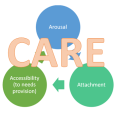
The AAA in AAA Caregiving refers to Attachment, Arousal and Accessibility to needs provision.

Attachment 

The AAA approach to caregiving places importance on promoting and supporting secure attachment representations. Secure attachment representations incorporate core beliefs held by the child that they are capable, deserving, understood and safe, that adults in a caregiving role will be sensitive, understanding and responsive to their needs, and that the world is an exciting place full of possibilities. Secure attachment representations are the foundations for a successful, rich and fulfilling life.

Secure attachment representations are promoted and maintained in schools where children experience adults in a caregiving role (particularly teachers and teacher support staff) as authoritative, accessible, understanding and connected at an emotional level (also referred to as affective attunement). Children benefit from adults in a caregiving role being in charge. Similarly, they benefit from being noticed before they call attention to themselves and from having their thoughts, feelings and intentions acknowledged without having to verbalise them themselves. Moreover, they benefit from the pride and joy in their accomplishments being reflected in their teacher’s face and their sadness and disappointment being responded to empathically.

Arousal

The AAA approach to caregiving recognises the central role arousal plays in the child’s ability to perform at their best and have regular mastery experiences which, in turn, supports a positive self-image and resilience. Arousal refers to the level of activation of the child’s nervous system and is a lot like body temperature, in that there is a sweet spot where we perform and feel at our best. Like body temperature, when arousal is too high or too low, there is a problem. Arousal is implicated in emotional, behavioural and cognitive problems.

Arousal is impacted by a wide range of factors and aspects of the child’s environment. However, optimum arousal is promoted in ordered, structured classroom environments where the teacher is in charge and the children have the experience that their teacher is accessible, understanding and emotionally connected with them. Music can also be used to promote optimal arousal in a group, with as little as twenty minutes exposure to certain types of classical music likely to promote a state of calm alertness and readiness to engage successfully in the school curriculum.

Accessibility

All children thrive in an environment where their needs are responded to consistently. The  AAA approach to caregiving recognises this fact and incorporates strategies to provide children with a profound sense that their needs are understood and will be responded to without them having to go to great lengths to make it so. In turn, the child can confidently go about engaging with and exploring their world without fear, thereby promoting their development and academic and social success.

For more information about the AAA approach to caregiving, please refer to my books, which are written in an accessible style and are suitable for caregivers of all types and professionals who have a caring role with children.

Colby Pearce Resilience

Colby Pearce Attachment

Posted in AAA Caregiving, Attachment, Resilience, Schools | Tagged , , , , , , , , , , , | 3 Comments

The Hawthorne Effect in Schools

The notion of the Hawthorne Effect is derived from a series of experiments conducted in the 1920s and 1930s at the Hawthorne works of the Western Electric Company. In these experiments, the experimenters manipulated aspects of the working conditions of some employees in order to study the effects of these changes on employee productivity and wellbeing. The most famous were the so-called “Illumination Experiments”. In these experiments, productivity improved with successive increases in illumination in a work area, then increased again when the illumination was subsequently reduced. This led to the conclusion that it was not the level of illumination that played a role in worker productivity, but the perception of the worker that management was interested in them and in their working conditions.

Several years ago I was asked to conduct assessments of thirteen children who were of the most concern to staff at a particular school, in terms of their engagement and behaviour. My assessments incorporated interviews of each child, their parent(s), their classroom teacher and senior staff at the school. I prepared a diagnostic report for each child and made recommendations regarding each child’s care and management requirements. I conducted individual feedback sessions with the parents of each child, and with their teacher. I also provided general education to staff of the school about engaging children who are disengaged and who exhibit challenging behaviour in the education setting.

I returned to the school the following year, approximately six months later. Only one of the original thirteen children continued to be of concern to school authorities, in terms of their engagement and behaviour.

Since that time I have observed the same effect in other schools with whom I have an association.  When school authorities and teaching staff take an active interest in those children who are disengaged and presenting a behaviour management challenge in the school, such as by instituting special programs for them, the behaviour and engagement of these young people invariably improves! In contrast, when school authorities rely primarily on suspension and exclusion of the student from school, their engagement and behaviour invariably deteriorate further.

So, take an active interest in the disengaged and those who exhibit challenging behaviour in the school setting. It really is the only viable way forward with these young people!

If you found the information in this article useful, please share it using the sharing buttons below.

Please also subscribe to this blog to receive further ideas and guidance when it becomes available.

Join 5,452 other subscribers

Follow the links below to my two new resources supporting consistency of care and effective communication between home and school for children recovering from a tough start to life:

Click here for more information and to access our resource for carers who are supporting children who are recovering from a tough start to life.
Click here for more information and to access our new resource for teachers who are managing children who are recovering from a tough start to life.

For more information about my work visit securestart.com.au.

You can access more information about my programs by clicking the links below:

CARE embedded in AAA

Triple-A Model of Therapeutic Care

The CARE Therapeutic Framework

Helping Children and Young People Realise their Potential

Another place to connect with my work is to follow one or more of my pages on Facebook:

Secure Start Therapeutic Care

Secure Start

To Connect with me on LinkedIn or Twitter click below:

LinkedIn

Twitter

← Back

Thank you for your response. ✨

Warning
Warning
Warning
Warning
Warning.

Wesite Header R
Posted in Schools, trauma informed practice, Trauma Informed Schools | Tagged , , , | 8 Comments

Attachment in schools who are managing students with complex needs

Colby Pearce AttachmentOne of the challenges when working with children who have complex needs is ensuring that education authorities address their care and management requirements with understanding and sensitivity.

Too often, the primary focus of education authorities is behavioural control and an over-reliance on reward and punishment paradigms.

This approach overlooks the fact that behaviour is a form of communication. For children who have complex needs, behaviour is often a primary form of communication.

Over-reliance on reward and punishment paradigms results in the child having the experience that they are not being heard and that nobody cares about them. This increases the likelihood of maladaptive behaviours, low self-esteem and unhelpful attitudes towards others.

Over-reliance on reward and punishment paradigms neglects the central role of relationships in influencing personal development and behaviour.

I was pleased to discover that education authorities in the UK recognise the importance of attachment in educating children with complex needs (see here). I appreciated the citation and the fact that my own work concerning attachment and children with complex care needs is recognised as a worthwhile resource for educators in the UK, alongside the work of the founding father of Attachment Theory, John Bowlby.

Posted in AAA Caregiving, Attachment, Children's Behaviour, Trauma | Tagged , , , , , , , , , , , | 4 Comments

A Simple Method for Getting Children off to Sleep

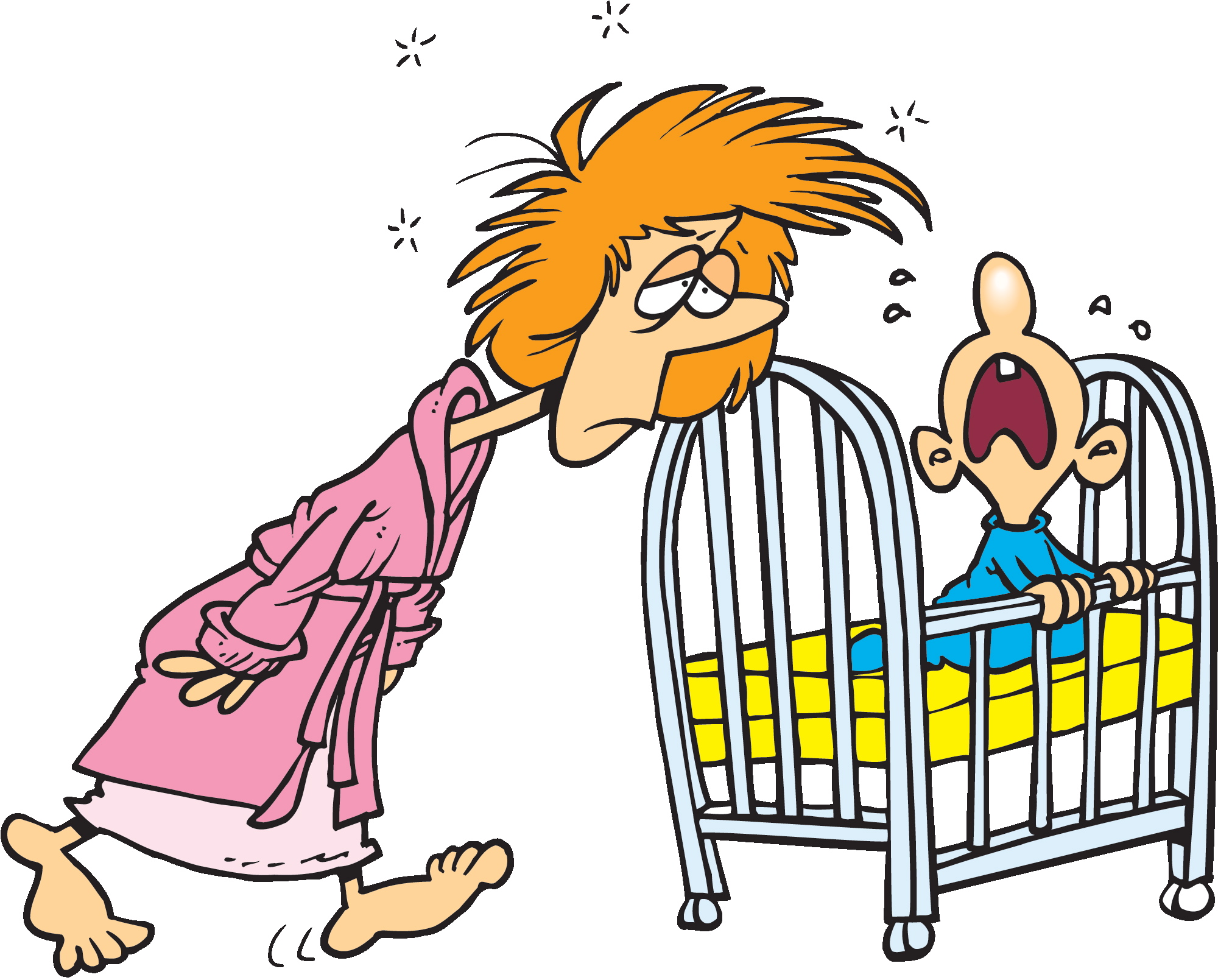
In my practice one of the more common struggles reported by parents and caregivers is getting children off to sleep in their own bed.  What follows is a simple method to address this issue that I often recommend, and that I used with my own children.

Before I get to the method, I want to advise that there are many and varied reasons why children have difficulty getting off to sleep in their own bed. Time and space do not permit me to go into all possible reasons here. What I would say is that the method presented here is appropriate for many of the reasons why children have this difficulty. It is offered as general advice and is not a substitute for a full assessment and recommendation from an appropriately qualified paediatric sleep specialist.

Firstly, children’s sleep patterns are subject to a sleep-wake cycle, which is physiological in nature but strongly influenced by bed-time and wake-time routines. A stable and consistent bed-time and wake-time are important for establishing a stable sleep-wake cycle. That’s right, a stable wake-time is just as important as a stable bed-time. If your child is having difficulty getting off to sleep, don’t let them sleep in. Wake them up at a consistent time every day, regardless of how long it took them to go to sleep. Their wake-time should usually be approximately twelve hours after their bed-time.

The sleep-wake cycle is also affected by exposure to light and its impact on melatonin production. Melatonin production is implicated in the onset of sleep. Light is thought to suppress melatonin production. So, ensure that your child is in a light-reduced environment for at-least thirty minutes before their bed-time. If your child requires a night light, use an orange one as it has been suggested that orange light does not suppress melatonin production as much as other forms of light.

Now, once it is bed-time, I suggest that you put your child to bed and sit or lay alongside them for approximately twenty minutes. In that time, you should read to them and sing them lullabies. Read first; then sing. As with other aspects of parenting and caregiving, consistency is important here. I suggest rotating through a small number of books and a small number of lullabies across consecutive nights. Children draw comfort from the predictability of the bed-time routine, thus preparing them for the separation involved in going to sleep. After a while, the lullabies are likely to become associated with feelings of sleepiness, with the result that the child begins to feel sleepy when the same lullabies are sung to them.

If your child falls asleep during the above, you are free to leave the room. If they are still awake, you move to the next stage of the method. This involves providing the profound reassurance the child requires to cope with separation and go to sleep. If it works, it will circumvent the child’s effort to engage in proximity-seeking behaviour, such as calling out, getting out of bed, searching for you, complaining of having a tummy ache, asking to go to the toilet, and so on.

After you have read and sung to your child, say to them something like “I am just going to put the light on in the next room and I will be right back. You can stay awake until I come back”. Then, you literally walk out of the room and walk back in almost straight away. You acknowledge that the child is okay and then say “I am just going to put the kettle on and I will be straight back. You can stay awake until I come back”. You then do this and when you return to the child you say something like “I am just going to the toilet and I will be straight back. You can stay awake until I come back”. You then do this and when you return to the child you say something like “I am just going to have my cup of tea and I will be straight back. You can stay awake until I come back”. With each separation, you tell the child that you are doing an activity that takes longer and longer to complete. You keep doing this until, when you return to the child, you find them to be asleep.

Speaking of activities that have temporal (i.e.time) meaning is more easily understood by the child than saying “I’ll be back in a minute”. Choosing longer and longer activities involves exposing children gradually to separations, such that they do not become overly anxious, call out or get out of bed. It is important to return to the child before they call out or get out of bed, because parent-initiated proximity is more reassuring than child-initiated proximity. So adjust the separation as required to ensure that you get back to them before they leave their bed to find you! Telling the child to stay awake is an important way to circumvent potential conflict and associated parental frustration, with the result that the child is calmer and more likely to fall asleep. Put in a different way, this is a useful way of making use of “reverse-psychology”.

Playing relaxing classical music softly in the child’s bedroom is a useful adjunct to the above. Finally, enjoy this special time spent with your child. I did, and  experienced sadness when my youngest said “dad, I don’t need you to stay with me anymore”.

To access a PDF of this article and other resources, click here.

Colby Pearce Resilience

For more information about the theory behind the above methodology, please refer to my book A Short Introduction to Promoting Resilience in Children.

If you found the information in this article useful, please share it using the sharing buttons below.

Please also subscribe to this blog to receive further ideas and guidance when it becomes available.

Join 5,452 other subscribers

For more information about my work visit securestart.com.au.

You can access more information about my programs by clicking the links below:

CARE embedded in AAA

Triple-A Model of Therapeutic Care

The CARE Therapeutic Framework

Helping Children and Young People Realise their Potential

Another place to connect with my work is to follow one or more of my pages on Facebook:

Secure Start Therapeutic Care

Secure Start

To Connect with me on LinkedIn or Twitter click below:

LinkedIn

Twitter

Posted in AAA Caregiving, Adoption, Fostering, kinship care, Parenting | Tagged , , , , , , , , , , | 4 Comments

Helicopter Parenting

Today, I have commented on three published articles that carry a similar theme.  The theme is that so-called “helicopter parenting” causes anxiety and impedes the development of resilience in children.

The problem I have with such articles is that they assume all readers will understand what is meant by the term “helicopter parenting”. They do not  precisely describe helicopter parenting in terms relating to overprotectiveness (which, incidentally, is another vague term). In failing to do so, they run the risk of the average reader forming the impression that any form of proactive care and sensitive responsiveness is potentially harmful to children’s development and emotional wellbeing. Such articles typically also fail to acknowledge that the vast majority of parents were “helicopter parents” when their children were infants; that this is a good thing because it promotes attachment security, which underpins future developmental outcomes and resilence; and that children’s self-confidence and resilience is enhanced by parents standing alongside or shoulder to shoulder in times of adversity, such that the child is more likely to experience mastery and less likely to experience overwhelming and disempowering failure.

My message is be there for your children!

For more information I would refer the reader to my earlier blog post concerning helicopter parenting. For more information about promoting resilience in children, please refer to my book A Short Introduction to Promoting Resilience in Children.

Posted in Adoption, Attachment, Children's Behaviour, Fostering, Parenting, Resilience, Wellbeing | Tagged , , , , , | Leave a comment

Attached to the Unattached

John was a superficially charming fourteen-year-old lad with bright red hair and a ready smile. I met John soon after I began my first appointment as a Clinical Psychologist. John was a Ward of the State. He was referred to me because statutory social workers who were responsible for his care were concerned about his volatile and at-risk behaviours. John had made a number of suicidal gestures, was often AWOL from the facility at which he resided and was known to abuse substances.

I had never before met anyone like John and was not entirely sure what to do with him. Though I did not know it at the time, I had received my first referral of an “attachment-disordered” youth. My next step was also my first in a career specialisation in the diagnosis and treatment of attachment-disordered children.

I read a book. It was Richard Delaney’s Fostering Changes. This was my first introduction to the world of the attachment-disordered child, and in particular, their world view. I discovered that attachment-disordered children do not see themselves, others and the world in which we live as we, who were blessed with accessible, understanding, responsive and attuned parents, see the world. Rather, they predominantly see themselves as bad and unlovable, others as mean and uncaring, and the world as a harsh and threatening place.

I then began to wonder about what I had been taught during six years of training at university. I had never heard of attachment disorders in an academic environment dominated by behavioural and cognitive-behavioural theories and models of practice. And then one day it occurred to me that one of the most famous series of experiments in psychology, a series of experiments that informed academic and applied psychology for half a century, was directly relevant to the experience of the attachment-disordered child, and our understanding of them.

Click here to read the complete article, which was published in SEN Magazine in September 2011.

Posted in Adoption, Attachment, Children's Behaviour, Fostering, Trauma | Tagged , , , , , , , , , , | Leave a comment

Promoting Children’s Resilience: What you need to know!

On a sunny autumn day David, who was four years of age, travelled with his parents to a local park for a picnic. Upon their arrival, David and his parents observed a scene replete with the recreational delights of lush grass, shady trees, warm open spaces and . . . . .  an adventure playground. What happened next provides an insight into how David is likely to cope with adversity, and recover from it, throughout his life.  In short, what happened next provides an insight into David’s resilience.

Adversity is a feature of the life of every child. It is present when a child is learning a new skill, on their first day of school, when they are negotiating conflicts and when their ambition exceeds their ability. Some children demonstrate persistence in the face of adverse conditions, whereas others shy away from adversity. Those who persist in their endeavours learn that adversity can be tolerated. Those who tolerate adversity and those who succeed in their endeavours under adverse conditions experience mastery. Mastery experiences are critical in the development of a perception of personal competence and capacity to influence personal outcomes. Mastery experiences under adverse conditions prove the famous words of the nineteenth century philosopher Friedrich Nietzsche: “that which does not kill me makes me stronger”.

Psychological strength, or resilience, is that quality of the child that enables them to persist in the face of adversity and recover from frustration and failure. Resilience strengthens a child and enables them to try new experiences and accept challenges. Resilience sustains a child through hardship and supports the realisation of dreams and aspirations. Resilience is critical to a child’s development and to them leading a productive, successful and satisfying life.

The promotion of resilience is a universal concern of adults with a caring concern for children. However, just as universal is the concern for shielding children from physical and emotional distress that can arise in conditions of adversity. These seemingly competing concerns can be a source of confusion and heartache for those who have the best interests of children at heart and have the potential to cloud their vision of what is in a child’s best interests. In this article I will explain how loving, nurturing and protecting children actually enhances their resilience.

My experience in working with children who have experienced overwhelming adversity in their life, together with my reading of what researchers and other professionals have to say on the matter, has led me to the conclusion that there are three key variables that impact directly on a child’s resilience; arousal, attachment and needs provision.                                                                                                  

Arousal

In simple terms, arousal refers to the level of activity of the body’s nervous systems. Arousal goes up and down during the day, depending on a person’s mood, what they are doing and what is happening in their environment. Arousal generally is lowest when we are asleep and highest when we are in a state of high emotion. Arousal is regulated by the brain. In ordinary circumstances, arousal is thought to go up and down within a regular range, which varies from person to person. Each person’s range of arousal is affected by genetic factors, early exposure to stress, ongoing maintaining factors, and the interaction of these.

Arousal is directly implicated in a child’s capacity to learn and in their performance of daily tasks. When arousal is too low or too high, human beings are physiologically incapable of performing at their best. Mastery experiences are less likely and the child is vulnerable to repeated failure in their efforts to complete daily tasks. The result is that their self-confidence is undermined and their ability to cope with adversity is reduced. In contrast, if we can maintain a child’s arousal within an optimal range they are more likely to perform at their best, to have mastery experiences and to feel capable and competent when faced with adversity. So, in order to promote resilience in children we need to understand the relationship between arousal and performance, and to implement strategies to maintain optimal levels of arousal.

Caregiving that supports optimal levels of arousal strikes a balance between encouraging acceptance of risks and protection from potential harm, such as occurs when a parents stands at the base of the ladder while their child negotiates a slippery slide, or holds their child’s hand while they cross a busy road. Caregivers who support and encourage their children to accept risks and challenges, while protecting them from the debilitating and disempowering effects of prolonged emotional distress and repeated or overwhelming failure, ensure experiences of mastery that are essential to resilience.

Attachment

In order to feel empowered to accept challenges, children need to be able to trust that the world is generally a safe place and that others, particularly adults in a caregiving role, can be trusted and depended upon to assist them when they need it. The expectation that others will be ready and prepared to assist them is profoundly influenced by the quality of the relationships children develop with their caregivers during infancy and early childhood. Referred to as attachment, these relationships also play a significant role in the development of children’s beliefs about their personal competency and worth, and therefore, play a key role in the development of resilience.                                                                                      

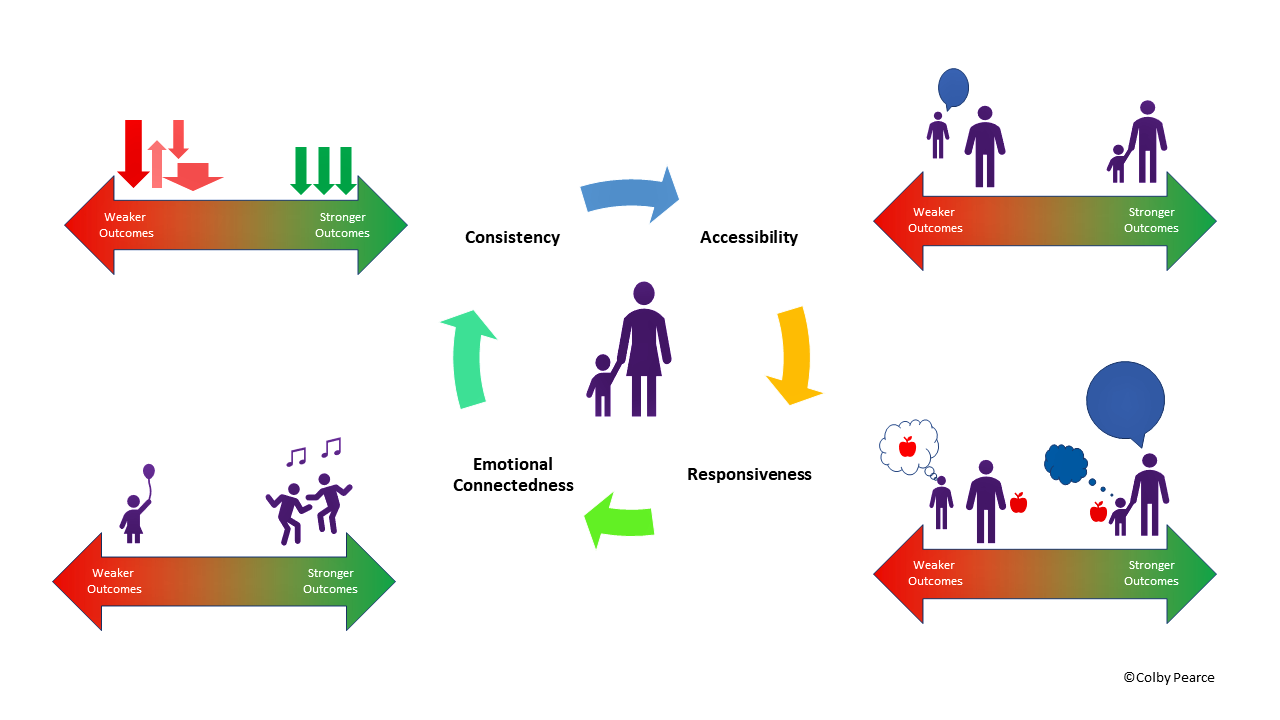
The quality of attachment relationships is influenced by three key aspects of caregiving experienced by the infant: accessibility, sensitive responsiveness and affective attunement. Accessibility refers the extent to which a caregiver is available to the infant in order to provide a caregiving response. Sensitive responsiveness refers to the extent to which the caregiver accurately reads the infants signals regarding needs that require a caregiving response, and responds to those needs. In responding to the infant in a sensitive way, the caregiver ensures that the infant experiences their needs as being understood and important. Affective attunement refers to times when the caregiver expresses the same or very similar emotion to that of the infant, such that the infant experiences an emotional union with the caregiver. Affective attunement is often observed during play and when the infant is distressed. Attunement experiences facilitate the caregiver being able to regulate the infant’s emotions until such time as the infant is able to do this for themselves.

Providing children with consistent experiences of caregiver accessibility, understanding and attunement supports the development and maintenance of positive expectations about self, others and the world in which they live. In turn, these expectations enhance children’s capacity to accept challenges and bounce back from failure. In short, it enhances their resilience. Children are reassured about the accessibility of their caregivers when their caregivers pay them attention and respond to their needs without the child having to go to great lengths to secure these things. That is, proactive caregiving supports positive representations of caregiver accessibility. Speaking out loud what you guess to be the child’s thoughts, feelings and intentions provides them with experiences that their inner world is understood and important. Instead of asking the school-aged child how was their day at school, observe their outward emotional expression and say something like “you look like you had a good day at school” or “you look like you can’t wait to get home”. Similarly, showing pride in a child’s achievements and expressing concern when they feel disappointed ensures that they feel a supportive emotional connection with their caregiver that guards against them feeling overwhelmed in times of trouble.                                                                                                                    

Needs Provision

In order for children to achieve their developmental potential and lead a full and satisfying life, they need to believe that they are able to satisfy needs that are essential to their survival and happiness. The love, care, acceptance and protection of an adult caregiver who is thought of as better able to cope with the world are examples of needs that, when consistently met, ensure that children survive and thrive. Shelter and physical sustenance are also important needs that must be met. In the absence of reliable satisfaction of needs that are essential to their survival and happiness, children become anxious. Their anxiety activates the parts of the brain that control instinctive survival responses and de-activates those parts of the brain that are responsible for logical thinking, planning, and effective action. They become demanding and difficult to reason with. They are typically resistant to having their attention diverted elsewhere. Continued denial of their attempts to secure a response to their needs often results in an escalation of their anxiety. Gaining satisfaction of their needs becomes the most important objective in the child’s life in that moment – an apparent matter of survival, with the result that they display a restricted range of interest and behaviour until such time that their needs are consistently met.

This restricted range of interest and behaviour limits the child’s capacity to lead life to the full and perform daily tasks. This is most obvious among maltreated children who, having been denied consistent access to sensitive and loving care, exhibit a limited range of interests and a propensity to engage in controlling and coercive patterns of relating to others, particularly adults in a caregiving role, in order to reassure themselves that they have access to their needs.

Consistently demonstrating understanding and responding to our children’s real needs, including their need for our love, attention, acceptance and protection, is reassuring to our children. Once reassured that they can rely on us to consistently respond to their needs, our children can get on with exploring all that their world offers without experiencing the debilitating and restricting effects of anxiety. By reducing anxiety and facilitating opportunities for exploration and mastery, reliable and consistent needs provision is a potent resiliency factor.

Finally, children’s perceptions of themselves are very much influenced by their experience of how others, particularly their main caregivers, perceive them. When their caregivers predominantly perceive them to be safe and capable, children generally see themselves the same way. Similarly, when their caregivers predominantly view them as vulnerable and incapable, children will see themselves that way too. So, have positive expectations of your children. It will support their resiliency.

So what about David and his trip to the park with the adventure playground? Well, he had a wonderful time. He confidently swung on the swings, slid on the slippery-slides, toured the tunnels, and flew on the flying fox. Under the watchful gaze of his parents he tried everything and excitedly reported his feats of bravery and accomplishment to them. His parents accompanied him to each item of equipment and warmly acknowledged his efforts. They even tried some of the more difficult items to demonstrate what was possible and remained close by to catch their child if he should fall. Upon leaving the playground he sought acknowledgement from his parents that he could come again another day.

Five ways to have a more resilient child:

  1. Take a balanced approach to exposing your child to challenging situations, encouraging acceptance of risks while protecting them from potential harm.
  2. Be accessible to your child. Anticipate their needs and reasonable wishes and respond to them as often as you are able to consistently manage before your child actively seeks to have their need or wish met. Be a proactive parent!
  3. Ensure that your child experiences their inner world as being understood and important. Observe your child’s nonverbal cues and the situation you are in and say out loud what you believe they are thinking and feeling.
  4. Show delight in your child’s achievements and concern at their distress. In doing so you will maintain a supportive emotional connection with your child that guards against them feeling overwhelmed in times of adversity.
  5. Believe in your child’s competency so that they will do so too.

Posted in Adoption, Children's Behaviour, Fostering, Parenting, Resilience | Tagged , , , , , , , | 1 Comment

New Pages

I have added two new pages to the menu bar above: About this Blog and About Me. Hope you like them!

Posted in Uncategorized | Leave a comment

Who is my audience?

Colby Pearce AttachmentA Short Introduction to Attachment and Attachment Disorder began its life as a notes I wrote for a lecture I gave in 1999. The topic of the lecture was Assessing Attachment and the audience was Masters Degree students in the Clinical Psychology program at the University of South Australia. Between 1999 and 2008 these notes were developed and refined for ongoing use by me in teaching and training prospective Clinical Psychologists in my home town of Adelaide.

In addition, across the period 1999 to 2009 (the publication year of the book) my notes continued to form the basis of teaching and training I was invited to offer to social workers and youth workers who were employed in statutory and caregiving roles with children who had a confirmed history of abuse and neglect, adoptive parents and the professionals who supported adoptive placements, and those who support and teach children who have experienced developmental trauma in schools. My notes were also a key component of psychoeducation I provided to parents and caregivers of children who exhibit complex emotions and behaviours through my independent child and family psychology practice, Secure Start®.

Since the publication of the book, reviews suggest that it’s readership includes those who have experienced complex developmental trauma themselves; residential carers, kinship carers, foster carers, grandparents, parents and others who care for children with trauma histories and complex needs; and professionals who work with such children and their carers in the home, education and residential care contexts. As mentioned in an earlier post, the book has even been selected as recommended reading for the National Psychology Exam that will form a pre-requisite to registration as a Psychologist in Australia. I am also informed that it is used in nursing and social worker education in the UK.

When I made the decision to have my notes published as a book it was my hope that in doing so they would reach and assist the broadest possible audience of people with a caring concern for some of the most vulnerable children in any community. I am content to say that my hope is being realised.

Posted in Adoption, Attachment, Book Reviews, Favourites, Fostering, Parenting, Trauma | Tagged , , , , , , , , | 2 Comments

colbypearce's avatarAttachment and Resilience

Dear Readers,

If you appreciate receiving information presented in this blog, please support me by visiting the website for my child and family psychology practice, Secure Start®. In doing so, you will assist me to continue to support children and families who are experiencing adversity.

Please, click here to visit the Secure Start® website.

Thanks . . . . Colby

View original post

Posted in Uncategorized | Leave a comment