Promoting Children’s Resilience: What you need to know!

On a sunny autumn day David, who was four years of age, travelled with his parents to a local park for a picnic. Upon their arrival, David and his parents observed a scene replete with the recreational delights of lush grass, shady trees, warm open spaces and . . . . .  an adventure playground. What happened next provides an insight into how David is likely to cope with adversity, and recover from it, throughout his life.  In short, what happened next provides an insight into David’s resilience.

Adversity is a feature of the life of every child. It is present when a child is learning a new skill, on their first day of school, when they are negotiating conflicts and when their ambition exceeds their ability. Some children demonstrate persistence in the face of adverse conditions, whereas others shy away from adversity. Those who persist in their endeavours learn that adversity can be tolerated. Those who tolerate adversity and those who succeed in their endeavours under adverse conditions experience mastery. Mastery experiences are critical in the development of a perception of personal competence and capacity to influence personal outcomes. Mastery experiences under adverse conditions prove the famous words of the nineteenth century philosopher Friedrich Nietzsche: “that which does not kill me makes me stronger”.

Psychological strength, or resilience, is that quality of the child that enables them to persist in the face of adversity and recover from frustration and failure. Resilience strengthens a child and enables them to try new experiences and accept challenges. Resilience sustains a child through hardship and supports the realisation of dreams and aspirations. Resilience is critical to a child’s development and to them leading a productive, successful and satisfying life.

The promotion of resilience is a universal concern of adults with a caring concern for children. However, just as universal is the concern for shielding children from physical and emotional distress that can arise in conditions of adversity. These seemingly competing concerns can be a source of confusion and heartache for those who have the best interests of children at heart and have the potential to cloud their vision of what is in a child’s best interests. In this article I will explain how loving, nurturing and protecting children actually enhances their resilience.

My experience in working with children who have experienced overwhelming adversity in their life, together with my reading of what researchers and other professionals have to say on the matter, has led me to the conclusion that there are three key variables that impact directly on a child’s resilience; arousal, attachment and needs provision.                                                                                                  

Arousal

In simple terms, arousal refers to the level of activity of the body’s nervous systems. Arousal goes up and down during the day, depending on a person’s mood, what they are doing and what is happening in their environment. Arousal generally is lowest when we are asleep and highest when we are in a state of high emotion. Arousal is regulated by the brain. In ordinary circumstances, arousal is thought to go up and down within a regular range, which varies from person to person. Each person’s range of arousal is affected by genetic factors, early exposure to stress, ongoing maintaining factors, and the interaction of these.

Arousal is directly implicated in a child’s capacity to learn and in their performance of daily tasks. When arousal is too low or too high, human beings are physiologically incapable of performing at their best. Mastery experiences are less likely and the child is vulnerable to repeated failure in their efforts to complete daily tasks. The result is that their self-confidence is undermined and their ability to cope with adversity is reduced. In contrast, if we can maintain a child’s arousal within an optimal range they are more likely to perform at their best, to have mastery experiences and to feel capable and competent when faced with adversity. So, in order to promote resilience in children we need to understand the relationship between arousal and performance, and to implement strategies to maintain optimal levels of arousal.

Caregiving that supports optimal levels of arousal strikes a balance between encouraging acceptance of risks and protection from potential harm, such as occurs when a parents stands at the base of the ladder while their child negotiates a slippery slide, or holds their child’s hand while they cross a busy road. Caregivers who support and encourage their children to accept risks and challenges, while protecting them from the debilitating and disempowering effects of prolonged emotional distress and repeated or overwhelming failure, ensure experiences of mastery that are essential to resilience.

Attachment

In order to feel empowered to accept challenges, children need to be able to trust that the world is generally a safe place and that others, particularly adults in a caregiving role, can be trusted and depended upon to assist them when they need it. The expectation that others will be ready and prepared to assist them is profoundly influenced by the quality of the relationships children develop with their caregivers during infancy and early childhood. Referred to as attachment, these relationships also play a significant role in the development of children’s beliefs about their personal competency and worth, and therefore, play a key role in the development of resilience.                                                                                      

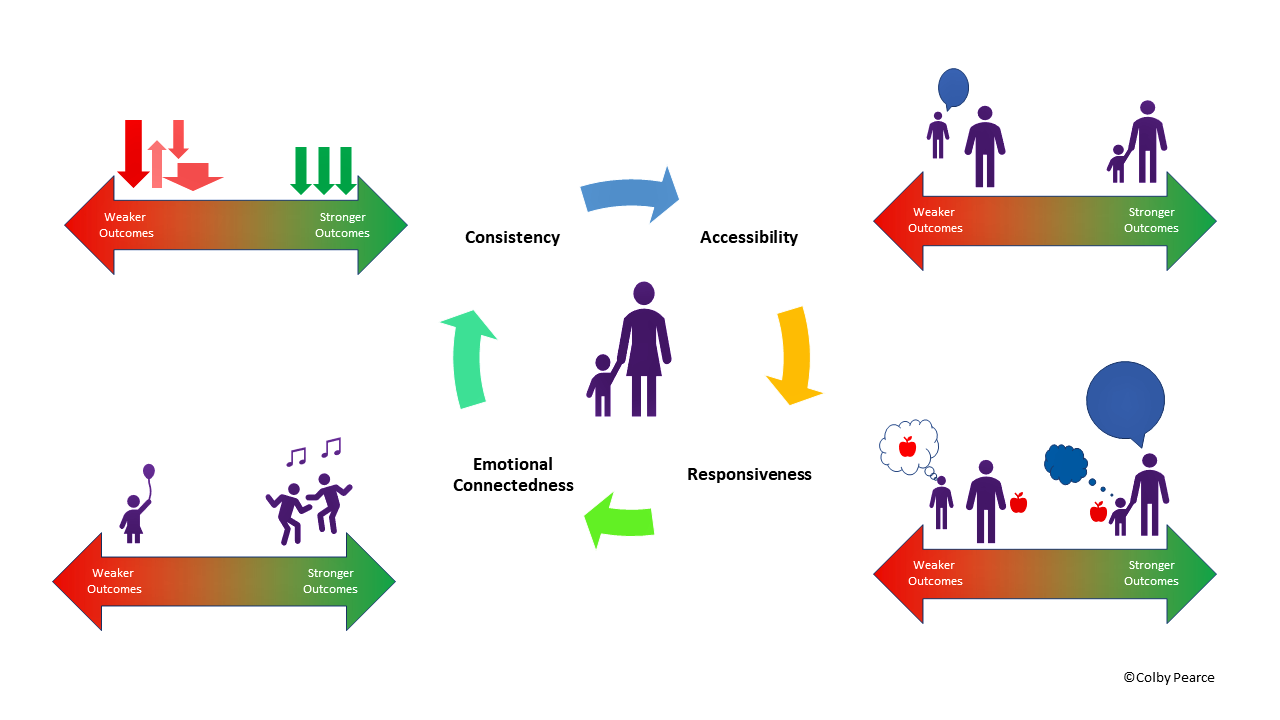
The quality of attachment relationships is influenced by three key aspects of caregiving experienced by the infant: accessibility, sensitive responsiveness and affective attunement. Accessibility refers the extent to which a caregiver is available to the infant in order to provide a caregiving response. Sensitive responsiveness refers to the extent to which the caregiver accurately reads the infants signals regarding needs that require a caregiving response, and responds to those needs. In responding to the infant in a sensitive way, the caregiver ensures that the infant experiences their needs as being understood and important. Affective attunement refers to times when the caregiver expresses the same or very similar emotion to that of the infant, such that the infant experiences an emotional union with the caregiver. Affective attunement is often observed during play and when the infant is distressed. Attunement experiences facilitate the caregiver being able to regulate the infant’s emotions until such time as the infant is able to do this for themselves.

Providing children with consistent experiences of caregiver accessibility, understanding and attunement supports the development and maintenance of positive expectations about self, others and the world in which they live. In turn, these expectations enhance children’s capacity to accept challenges and bounce back from failure. In short, it enhances their resilience. Children are reassured about the accessibility of their caregivers when their caregivers pay them attention and respond to their needs without the child having to go to great lengths to secure these things. That is, proactive caregiving supports positive representations of caregiver accessibility. Speaking out loud what you guess to be the child’s thoughts, feelings and intentions provides them with experiences that their inner world is understood and important. Instead of asking the school-aged child how was their day at school, observe their outward emotional expression and say something like “you look like you had a good day at school” or “you look like you can’t wait to get home”. Similarly, showing pride in a child’s achievements and expressing concern when they feel disappointed ensures that they feel a supportive emotional connection with their caregiver that guards against them feeling overwhelmed in times of trouble.                                                                                                                    

Needs Provision

In order for children to achieve their developmental potential and lead a full and satisfying life, they need to believe that they are able to satisfy needs that are essential to their survival and happiness. The love, care, acceptance and protection of an adult caregiver who is thought of as better able to cope with the world are examples of needs that, when consistently met, ensure that children survive and thrive. Shelter and physical sustenance are also important needs that must be met. In the absence of reliable satisfaction of needs that are essential to their survival and happiness, children become anxious. Their anxiety activates the parts of the brain that control instinctive survival responses and de-activates those parts of the brain that are responsible for logical thinking, planning, and effective action. They become demanding and difficult to reason with. They are typically resistant to having their attention diverted elsewhere. Continued denial of their attempts to secure a response to their needs often results in an escalation of their anxiety. Gaining satisfaction of their needs becomes the most important objective in the child’s life in that moment – an apparent matter of survival, with the result that they display a restricted range of interest and behaviour until such time that their needs are consistently met.

This restricted range of interest and behaviour limits the child’s capacity to lead life to the full and perform daily tasks. This is most obvious among maltreated children who, having been denied consistent access to sensitive and loving care, exhibit a limited range of interests and a propensity to engage in controlling and coercive patterns of relating to others, particularly adults in a caregiving role, in order to reassure themselves that they have access to their needs.

Consistently demonstrating understanding and responding to our children’s real needs, including their need for our love, attention, acceptance and protection, is reassuring to our children. Once reassured that they can rely on us to consistently respond to their needs, our children can get on with exploring all that their world offers without experiencing the debilitating and restricting effects of anxiety. By reducing anxiety and facilitating opportunities for exploration and mastery, reliable and consistent needs provision is a potent resiliency factor.

Finally, children’s perceptions of themselves are very much influenced by their experience of how others, particularly their main caregivers, perceive them. When their caregivers predominantly perceive them to be safe and capable, children generally see themselves the same way. Similarly, when their caregivers predominantly view them as vulnerable and incapable, children will see themselves that way too. So, have positive expectations of your children. It will support their resiliency.

So what about David and his trip to the park with the adventure playground? Well, he had a wonderful time. He confidently swung on the swings, slid on the slippery-slides, toured the tunnels, and flew on the flying fox. Under the watchful gaze of his parents he tried everything and excitedly reported his feats of bravery and accomplishment to them. His parents accompanied him to each item of equipment and warmly acknowledged his efforts. They even tried some of the more difficult items to demonstrate what was possible and remained close by to catch their child if he should fall. Upon leaving the playground he sought acknowledgement from his parents that he could come again another day.

Five ways to have a more resilient child:

  1. Take a balanced approach to exposing your child to challenging situations, encouraging acceptance of risks while protecting them from potential harm.
  2. Be accessible to your child. Anticipate their needs and reasonable wishes and respond to them as often as you are able to consistently manage before your child actively seeks to have their need or wish met. Be a proactive parent!
  3. Ensure that your child experiences their inner world as being understood and important. Observe your child’s nonverbal cues and the situation you are in and say out loud what you believe they are thinking and feeling.
  4. Show delight in your child’s achievements and concern at their distress. In doing so you will maintain a supportive emotional connection with your child that guards against them feeling overwhelmed in times of adversity.
  5. Believe in your child’s competency so that they will do so too.

Posted in Adoption, Children's Behaviour, Fostering, Parenting, Resilience | Tagged , , , , , , , | 1 Comment

New Pages

I have added two new pages to the menu bar above: About this Blog and About Me. Hope you like them!

Posted in Uncategorized | Leave a comment

Who is my audience?

Colby Pearce AttachmentA Short Introduction to Attachment and Attachment Disorder began its life as a notes I wrote for a lecture I gave in 1999. The topic of the lecture was Assessing Attachment and the audience was Masters Degree students in the Clinical Psychology program at the University of South Australia. Between 1999 and 2008 these notes were developed and refined for ongoing use by me in teaching and training prospective Clinical Psychologists in my home town of Adelaide.

In addition, across the period 1999 to 2009 (the publication year of the book) my notes continued to form the basis of teaching and training I was invited to offer to social workers and youth workers who were employed in statutory and caregiving roles with children who had a confirmed history of abuse and neglect, adoptive parents and the professionals who supported adoptive placements, and those who support and teach children who have experienced developmental trauma in schools. My notes were also a key component of psychoeducation I provided to parents and caregivers of children who exhibit complex emotions and behaviours through my independent child and family psychology practice, Secure Start®.

Since the publication of the book, reviews suggest that it’s readership includes those who have experienced complex developmental trauma themselves; residential carers, kinship carers, foster carers, grandparents, parents and others who care for children with trauma histories and complex needs; and professionals who work with such children and their carers in the home, education and residential care contexts. As mentioned in an earlier post, the book has even been selected as recommended reading for the National Psychology Exam that will form a pre-requisite to registration as a Psychologist in Australia. I am also informed that it is used in nursing and social worker education in the UK.

When I made the decision to have my notes published as a book it was my hope that in doing so they would reach and assist the broadest possible audience of people with a caring concern for some of the most vulnerable children in any community. I am content to say that my hope is being realised.

Posted in Adoption, Attachment, Book Reviews, Favourites, Fostering, Parenting, Trauma | Tagged , , , , , , , , | 2 Comments

colbypearce's avatarAttachment and Resilience

Dear Readers,

If you appreciate receiving information presented in this blog, please support me by visiting the website for my child and family psychology practice, Secure Start®. In doing so, you will assist me to continue to support children and families who are experiencing adversity.

Please, click here to visit the Secure Start® website.

Thanks . . . . Colby

View original post

Posted in Uncategorized | Leave a comment

Recommended Reading for National Psychology Exam

My book, A Short Introduction to Attachment and Attachment Disorder, has been selected for the list of recommended readings for Provisional Psychologists who are to sit the National Psychology Exam as a prerequisite for registration as a Psychologist in Australia!

Follow the link to see the list : Psychology-Board—Reading-List—National-Psychology-Examination-Recommended-Readings—July-2012

Posted in Attachment, Book Reviews, Favourites | Tagged , , , , , , , , , , , , , , , , , , | Leave a comment

Support Secure Start

Child Psychologists

Dear Readers,

If you appreciate receiving information presented in this blog, please support me by visiting the website for my child and family psychology practice, Secure Start®. In doing so, you will assist me to continue to support children and families who are experiencing adversity.

Please, click here to visit the Secure Start® website.

Thanks . . . . Colby

Posted in Attachment, Parenting, Therapy | Tagged , , , , , , , , , , , , , , , | 1 Comment

Review of A Short Introduction to Attachment and Attachment Disorder

I recently came across the following review of my book A Short Introduction to Attachment and Attachment Disorder. The review was written by Philippa Kelly, a Social Work Consultant who works with foster parents. It appeared in the Journal of Mental Health (2011, 20(5), p.504).

The reason I am posting this review to my blog, apart from it being positive and good for the ego(!), is that it encapsulates what was my intention when writing the book.

Having read A Short Introduction to Attachment Disorder from cover to cover on a number of occasions, I believe this book would be of great interest to any professional who works with children from foster carers, social workers to Clinical Nurse Specialists, but particularly those working with children and young people who have emotional or mental health difficulties or children who are being looked after. It gives a good insight into the difficulties faced when caring for or supporting children who have attachment disorders or difficulties. It is well organised and is surprisingly jargon free.

I found that Pearce has written an easy to read but comprehensive description of attachment disorders and the implications of attachment disorders for children and the person caring for them. There is a clear explanation as to how attachment disorders develop, the differing types of attachment disorders and the presentation of these. The book then proceeds to inform the reader of practical ways to parent and support children who have these difficulties. It highlights both in written and pictorial form the issues of children who have experience early life adversity. The ideas that Pearce presents with regard to parenting children with these difficulties are straight forward, ensuring the read believes that they have the skills to make a difference to the children.

The case study at the end of each chapter brings to life the theory and ideas that Pearce has presented, highlighting how they can be observed or used in practice. There is a clear summary following this which enables the reader to reflect on the main points.

The usefulness of this book, for any professional working with children and young people who have any kind of attachment difficult cannot be over stated. For those who have a limited knowledge, it is accessible, informative and practical, for those who have a greater knowledge, it highlights in jargon free language the importance of understanding attachment, but also gives the practical advice on how we can begin to affect change for children with attachment disorders.


Posted in Book Reviews, Favourites | Tagged , , , , , , , , , , , , , , , | 1 Comment

Attachment therapy for children who have experienced family trauma

I am frequently asked by other professionals about what I do and what to do when referred a child who has experienced family trauma. What follows is a brief description of my work with these children. It is written with professionals in mind and assumes a basic knowledge of Attachment Theory and psychological approaches to treatment.

Children who have experienced gross deficiencies in care during their early formative years (preschool) are increasingly spoken about as having suffered from complex developmental trauma. Gross deficiencies in care incorporate physical, emotional and/or sexual abuse of the child and/or a persistent failure or inability of the child’s main caregiver or caregivers to consistently offer physical and emotional comfort in times of distress, such that the child is frequently left in a state of prolonged and severe physical and emotional distress. The developmental aspect incorporates the impact complex trauma has on developmental processes and outcomes for the child, which is increasingly being tied to impacts on the developing brain. However, the very nature of the aetiology of complex developmental trauma allocates a central role to the child’s primary attachment relationships and their impact on attachment security.

Children who have experienced complex developmental trauma frequently exhibit insecurity. Many are diagnosed with Reactive Attachment Disorder (RAD). Children diagnosed with RAD typically exhibit gross disturbances in social and emotional relatedness and behaviour. These disturbances are considered to stem from maladaptive beliefs about self, other and the world (attachment representations), hyperarousal (and associated arousal dysregulation), and a pervasive and enduring preoccupation with access to core needs provision (including the need to feel safe, accepted and to be physically nourished).

Psychological interventions for complex developmental trauma, and its common associate Reactive Attachment Disorder, are often grouped under the general heading Attachment Therapies. As the name suggests, Attachment Therapies typically seek to repair the traumatised child’s attachment relationships and/or promote attachment security. The provision of reparative attachment experiences in therapy has a central role. With references often being made to such terms as transference and counter-transference, Attachment Therapies are often placed in the psychoanalytic tradition.

My own approach to Attachment Therapy focuses on promoting adaptive beliefs about self, other and the world (secure attachment representations), lower and improved regulation of arousal, and reduced preoccupation with access to basic needs. Therapy is experiential, just as early attachment relationships are formed through experiences. Children referred to me are offered sustained, consistent and intense experiences of structure, direction, guidance, mastery, deep understanding of their inner world, emotional connectedness and access to needs provision. This is achieved through therapeutic activities (e.g. Theraplay) and a stream of interpretations of the child’s thoughts, feelings, perspectives and intentions (i.e. verbalising understanding – a.k.a. validation).

As to what psychotherapy school or tradition my approach to Attachment Therapy sits in, it is possible to argue one way or another. There is no doubt that I am managing transference and counter-transference to achieve desired therapeutic outcomes for traumatised, attachment disordered children on a daily basis. However, it is also my practice to explore and name the child’s maladaptive beliefs about self, other and the world and take the child on a journey whereby they experience themselves, others and the world in a different, more helpful way. In doing so, my intent is to reorganise and restructure attachment representations and expose the traumatised, attachment disordered child in a systematic and sustained manner to the very source of their trauma: the dependency relationship. Desired outcomes include cognitive change and lowered arousal through habituation to the trauma stimulus; although arousal management techniques are also an important component of intervention. Hence, my therapeutic approach sits easily in the cognitive-behavioural tradition.

In addition, successful outcomes for traumatised, attachment disordered children rest in no small way on the promotion of a supportive care environment outside of the therapy setting. Engagement with the child’s caregivers in the home and educational contexts is an important aspect of the intervention process. Successful caregiver psychoeducation rests on the therapists ability to achieve understanding and acceptance of required approaches to the care and management of the traumatised, attachment disordered child. Wholesale changes in care and management approach are rarely accepted and implemented in a consistent and sustained manner; if at all. Even if they were implemented, the potential effectiveness of wholesale changes are likely to be quickly dismissed as traumatised, attachment disordered children are highly reactive to changes in caregiving practices. More subtle changes to care and management practices are more likely to be accepted, by the child and his or her caregivers alike. My own practice is to identify those aspects of common caregiving that facilitate the child’s experience of their caregiver as being accessible, understanding and emotionally-connected; such as is the infant’s experience when he or she is forming their first (secure) attachment relationships. As caregivers can rightfully assert “I do that anyway” they feel validated for the positive contribution they are making to the remediation of the child’s trauma and attachment difficulties and, having been made aware of what caregiving practices help, might be expected to do them more often.

For the reader who requires additional information about Attachment Theory, Attachment Disorder, trauma-informed practice and my therapy approach , please refer to my book:

13754277_10207024040505557_6258179799568697908_nPearce, C. (2016). A Short Introduction to Attachment and Attachment Disorder (Second Edition).  London: Jessica Kingsley

If you found the information in this article useful, please share it using the sharing buttons below.

Please also subscribe to this blog to receive further ideas and guidance when it becomes available. Click “Follow” in the side bar.

For more information about my work visit securestart.com.au.

You can access more information about my programs by clicking the links below:

CARE embedded in AAATriple-A Model of Therapeutic Care

The CARE Therapeutic Framework

Helping Children and Young People Realise their Potential

Another place to connect with my work is to follow one or more of my pages on Facebook:

Secure Start Therapeutic Care

Secure Start

To Connect with me on LinkedIn or Twitter click below:

LinkedIn

Twitter

Wesite Header R

Posted in Adoption, Attachment, Favourites, Fostering, Parenting, Resilience, Therapy, Trauma, Wellbeing | Tagged , , , , , , , , , , , , | 5 Comments

A tale of four children and their trip to the adventure playground: A resilience story

Colby Pearce Resilience

This following story represents an allegory for the approach to promoting resilience in children as found in the prologue to:

Pearce, C. A Short Introduction to Promoting Resilience in Children. London: Jessica Kingsley, 2011

Once upon a time there were four children. On a warm and sunny day the parents of each child took them to an adventure playground for a play.

The first child had a wonderful time at the playground. He confidently swung on the swings, slid on the slippery-slides, toured the tunnels, and flew on the flying fox. Under the watchful gaze of his parents he tried everything and excitedly reported his feats of bravery and accomplishment to them. His parents accompanied him to each item of equipment and warmly acknowledged his efforts. They even tried some of the more difficult items to demonstrate what was possible and remained close by to catch their child if he should fall. Upon leaving the playground this child sought acknowledgement from his parents that he could come again another day.

The second child bounded from his parents’ car and eagerly entered the adventure playground, not noticing that his parents remained in the car. Observing many children at the giant slippery slide he excitedly approached it to give it a go. He was unconcerned that the other children at the slippery slide were much older than him and that the slippery slide was very high and very fast. He did not notice, nor did anyone tell him, that the slide was better suited for older children. He flew off the bottom of the slide and cannoned into the ground, hurting his arm. Shock and pain turned to tearful distress as he could not immediately find his parents for soothing of his hurts. When his parents belatedly arrived to attend to him he was difficult to soothe and angrily refused to try any other equipment. His anger and distress quickly escalated and he was carried, screaming, from the playground.

The third child approached the playground much more cautiously, preferring to remain close to his parents, holding hands. His parents guided him to the quietest corner of the playground, where the smallest and safest equipment could be found. They held his hand or carried him in their lap on the swings and the slide. When he gazed wistfully at the other children his age who were re-enacting tales of bravery and heroism in the fort, his parents encouraged him to remain with them in the sand-pit. His parents delighted in his company, and he in theirs, and he readily agreed that the fort looked dangerous and the other children played too rough.

The fourth child never made it to the adventure playground as his parents could not afford to buy fuel for their car. He spent the day alternately demanding to be taken to the playground and sulking about not being able to go.

Colby Pearce Resilience

Source: Pearce, C. A Short Introduction to Promoting Resilience in Children. London: Jessica Kingsley, 2011

If you found the information in this article useful, please share it using the sharing buttons below.

Please also subscribe to this blog to receive further ideas and guidance when it becomes available.

Join 5,447 other subscribers

For more information about my work visit securestart.com.au.

You can access more information about my programs by clicking the links below:

CARE embedded in AAA

Triple-A Model of Therapeutic Care

The CARE Therapeutic Framework

Helping Children and Young People Realise their Potential

Another place to connect with my work is to follow one or more of my pages on Facebook:

Secure Start Therapeutic Care

Secure Start

To Connect with me on LinkedIn or Twitter click below:

LinkedIn

Twitter

← Back

Thank you for your response. ✨

Wesite Header R
Posted in AAA Caregiving, Adoption, Attachment, Children's Behaviour, Fostering, kinship care, Parenting, Resilience, Trauma, trauma informed, trauma informed care, trauma informed practice, Trauma Informed Schools, Wellbeing | Tagged , , , | 5 Comments

A Tale of Three Mice: An Attachment Story

Once upon a time there were three mice.

The first mouse lived in a house that contained, along with furniture and other household goods and possessions, a lever and a hole in the wall from which food was delivered. Each time the mouse pressed the lever he would receive a tasty morsel of his favourite food.  The mouse understood that, when he was hungry, all he had to do was press the lever and food would arrive via the hole. The mouse took great comfort in the predictability of his access to food and only pressed the lever when he was hungry.

The second mouse lived in a similar house, also containing a lever and a hole in the wall from which food was delivered. Unfortunately, the lever in his house was faulty and delivered food on an inconsistent basis when he pressed it, such that he might only receive food via the hole on the first, fifth, seventh, or even the eleventh time he pressed the lever. This mouse learnt that he could not always rely on the lever and that he had to press the lever many times, and even when he was not actually hungry, in order to ensure that he would have food. Even after his lever was fixed he found it difficult to stop pressing it frequently and displayed a habit of storing up food.

The third mouse also lived in a similar house, containing a lever and a hole in the wall from which food was to be delivered. However, the lever in his house did not work at all. He soon learnt that he could not rely on the lever and would have to develop other ways of gaining access to food. This belief persisted, even when he moved to a new home with a fully-functioning lever.

Source: Pearce, C. A Short Introduction to Attachment and Attachment Disorder. London: Jessica Kingsley, 2009

13754277_10207024040505557_6258179799568697908_n

An updated version of this allegory – A Tale of Four Mice – can be found in the Second Edition of A Short Introduction to Attachment and Attachment Disorder.

This allegory has been very popular and meaningful for many readers. Here is an example:

From Carr, S. (2013). Attachment in Sport, Exercise and Wellness. Routledge: London and New York (pp 1-2)

Colby Pearce Attachment National Psychology Exam

Some months ago a graduate student came to my office visibly excited after reading the prologue section in Colby Pearce’s (2009) text A Short Introduction to Attachment and Attachment Disorder. The student felt that although he had been studying attachment theory for a number of years he was so intensely focused upon its numerous intricacies and nuances that he had failed to recognise the striking simplicity that underpins this complexity. With Pearce’s permission, I make no apologies for paraphrasing his excellent example below. I agree with my graduate student’s initial interpretation.

Pearce (2009) recites a story about three mice. The first mouse resided in a comfortable house that was furnished and supplied with modern conveniences. Inside the house was a button and a hole in the wall and the mouse was able to press the button to receive tasty food through the hole. The mechanism worked well and the mouse appreciated that when he was hungry he would be able to press the button and consistently receive his food. It was comforting to have this knowledge and the mouse liked the predictable nature of his button, only tending to press it when he really needed food.

In contrast, the second mouse (who lived in an identical house) had the misfortune of dealing with a faulty button mechanism. That is, pressing his button only resulted in food being delivered some of the time. There was no predictability to the button mechanism and on some occasions he would receive food immediately on pressing the button whereas on others he would be required to press it 10 or 20 times. At other times it seemed that no matter how often he pressed it nothing was ever going to happen. His distrust of the button led him to be preoccupied with pressing it, even when he was not actually hungry. He would press it many, many times in order to ensure he would have food when he did grow hungry. When the button was fixed he found it hard to trust that it was now in good working order and spent much time storing up food for a rainy day.

Finally, the third mouse lived in a house with a button that consistently failed to work. In short, he never received any food from his button. He quickly came to the understanding that access to food would require him to employ other means and had no belief in the utility of the button. Even when he moved home and found a house with an effectively functioning button his lack of faith in buttons persisted and he continued to find food the way he always had.

The above story highlights how attachment theory can be seen to be grounded in simple assumptions that retain remarkable logical sense even when talk of mice and food is substituted for young children, emotional care, and security. Pearce (2009) has cleverly recognised this in his prologue. However, although there are some simple logical principles at the core of attachment theory, the fact that Bowlby (1969/1982, 1973, 1980) required close to 1000 pages to articulate his ideas suggests that there are complexities, assumptions, and arguments that cannot be overlooked if one is to begin to develop a fuller understanding of Bowlby’s position. Furthermore, given that attachment theory has been intuitively appealing to researchers whose ideas are allied to contrasting paradigmatic approaches (e.g. Pearce’s example seems couched in behaviourist principles – but attachment theory also reflects ideas that resemble other schools of thought) and from various disciplines it is unsurprising that further methodological and conceptual intricacies have arisen as the ideas have been nurtured  and developed according to the assumptions of differing schools of thought.

If you found the content of this article interesting and/or useful, please share it using the sharing buttons below.

Please subscribe to this blog to receive further articles when they become available.

Join 5,447 other subscribers

You can access more information about my programs by clicking the links below:

CARE embedded in AAA

Triple-A Model of Therapeutic Care

The CARE Therapeutic Framework

Helping Children and Young People Realise their Potential

Another place way to connect with my work is to follow one or more of my pages on Facebook:

Secure Start Therapeutic Care

Secure Start

To Connect with me on LinkedIn or Twitter click below:

LinkedIn

Twitter

← Back

Thank you for your response. ✨

Wesite Header R
Posted in AAA Caregiving, Adoption, Attachment, Fostering, kinship care, Parenting, Trauma, trauma informed, trauma informed care, trauma informed practice | Tagged , , , , , , , , , , , , | 2 Comments