Respond to the need as well as the behaviour

Much is being written about empathic care and being in-tune with the needs of children. Below is an excerpt from my book A Short Introduction to Promoting Resilience in Children (London: Jessica Kingsley, 2011), which, itself, is based on material I originally published in A Short Introduction to Attachment and Attachment Disorder (London: Jessica Kingsley, 2009).

Colby Pearce Resilience

Colby Pearce Attachment National Psychology Exam

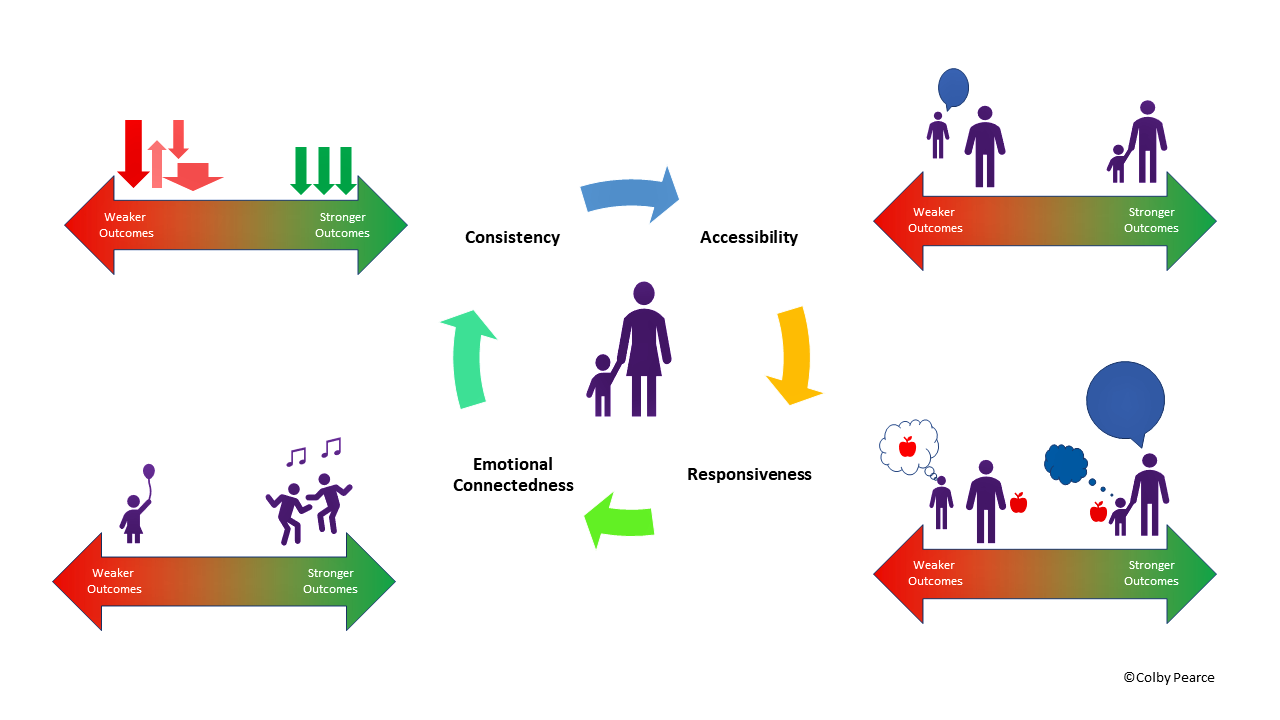
To respond with understanding protects against reinforcing unhelpful beliefs about oneself and adults in a caregiving role. Responding to the need as well as the behaviour is one method by which an adult in a caregiving role can respond with understanding. Nearly all human behaviour has a function and purpose and children rarely misbehave for misbehaviour’s sake. Among other things, misbehaviour can serve as an emotional release (such as when children are tired and over aroused) or as a strategy to draw attention to an unmet need. Maladjusted and pre-verbal children are typically unable or unwilling to express their needs directly/verbally and do so through controlling and manipulative behaviours. From their first day, infants draw attention to their needs through affective displays that might later come to be viewed as developmentally inappropriate and socially unacceptable. Nevertheless, they have learnt that crying and screaming is an effective way to draw parental attention. It is not surprising that this broadens to other unacceptable behaviours among toddlers, such as throwing objects, banging doors, turning the TV and lights off and on, and so on. Naughty behaviour typically attracts more attention than good behaviour. When a child is misbehaving it is important to try and work out what unexpressed need might be giving rise to the behaviour rather than simply responding to the behaviour alone. Thereafter, it is important to respond to the need as well as the behaviour. Responding to the need as well as the behaviour is soothing for the child, it reinforces for the child that their caregiver is understanding and responsive, and it is helpful in preserving and promoting secure attachment representations. This process of responding to the need as well as the behaviour is exemplified in the table below (click on link). 

Respond to the need as well as the behaviour


Posted in AAA Caregiving, Adoption, Attachment, Children's Behaviour, Fostering, Parenting, Resilience, Schools, Trauma | Tagged , , , , , , , , , | 1 Comment

Proactive Needs Provision Required to Heal Trauma Hurts

Perhaps the most little known and understood aspect of childhood trauma is the impact inadequate needs provision has on the child’s perception of how their basic human needs will be met in future, and their associated actions to satisfy their needs. Yet, over eighty years of psychology research clearly shows that inadequate and inconsistent parental responsiveness will promote an enduring preoccupation with needs and high rate and great persistence in securing needs provision. The same research also shows that simply changing the conditions for needs provision, such that a parent or caregiver responds consistently to the child’s signals regarding unmet needs, is not sufficient to reduce the child’s preoccupation with historically unmet needs or the rate and persistence of their need-seeking behaviours. So long as the parent or caregiver responds to the child’s signals regarding their needs, the child will continue to believe that they themselves are responsible for their needs being met. It is only through responding to the child’s needs proactively (that is, before they do anything to draw attention to their needs) that the child can develop an understanding that their needs are understood and important, and that they can depend on their caregivers to satisfy their needs. The consequences of this change in the child’s perceptions is anxiety reduction and opportunities for mutually-satisfying relationships through the lifespan.

A Tale of Three Mice: An Attachment Story

ConsistencyOnce upon a time there were three mice.

The first mouse lived in a house that contained, along with furniture and other household goods and possessions, a lever and a hole in the wall from which food was delivered. Each time the mouse pressed the lever he would receive a tasty morsel of his favourite food.  The mouse understood that, when he was hungry, all he had to do was press the lever and food would arrive via the hole. The mouse took great comfort in the predictability of his access to food and only pressed the lever when he was hungry.

The second mouse lived in a similar house, also containing a lever and a hole in the wall from which food was delivered. Unfortunately, the lever in his house was faulty and delivered food on an inconsistent basis when he pressed it, such that he might only receive food via the hole on the first, fifth, seventh, or even the eleventh time he pressed the lever. This mouse learnt that he could not always rely on the lever and that he had to press the lever many times, and even when he was not actually hungry, in order to ensure that he would have food. Even after his lever was fixed he found it difficult to stop pressing it frequently and displayed a habit of storing up food.

The third mouse also lived in a similar house, containing a lever and a hole in the wall from which food was to be delivered. However, the lever in his house did not work at all. He soon learnt that he could not rely on the lever and would have to develop other ways of gaining access to food. This belief persisted, even when he moved to a new home with a fully-functioning lever.

Source: Pearce, C. A Short Introduction to Attachment and Attachment Disorder. London: Jessica Kingsley, 2009

If you like this post, please subscribe to this blog to receive an email notification when other practical ideas and guidance is published.

Join 5,447 other subscribers

You can access more information about my therapeutic parenting programs by clicking the links below:

CARE embedded in AAA

Triple-A Model of Therapeutic Care

The CARE Therapeutic Framework

Helping Children and Young People Realise their Potential

Another place to connect with my work is to follow one or more of my pages on Facebook:

Secure Start Therapeutic Care

Secure Start

To Connect with me on LinkedIn or Twitter click below:

LinkedIn

Twitter

If you would like to comment directly to Colby, please feel free to use the form below:

← Back

Thank you for your response. ✨

Posted in AAA Caregiving, Adoption, Attachment, Fostering, Parenting, Trauma, trauma informed, trauma informed care | Tagged , , , , , , , , , , , , , , | 7 Comments

Attachment Trauma

If you looking for easy-to-read, high quality information about the effects of trauma in primary attachment relationships (hereafter referred to as attachment trauma), and what can be done to treat its effects during childhood, please visit my new page at securestart.com.au.Secure Start

I prepared this page in order to consolidate three significant articles I have written about children who have experienced trauma in their primary attachment relationships in one location. It is suitable for readers who work with these children in a professional capacity.

I use the term Attachment Trauma to signify that all major schools of thought concerning complex developmental trauma in childhood are deeply embedded in attachment theory, with remediation approaches being similarly embedded in attachment concepts and attachment relationships. It seems a little unfashionable to refer to attachment in the context of child trauma these days, but even subscribers to the neurobiology of trauma literature will find that it relies heavily on attachment theory and attachment relationships for answers about how to remediate the effects of developmental trauma.

While I have your attention, I might also advise that I am in discussion with my publishers, Jessica Kingsley, about writing a book for professionals who work with children who have experienced attachment trauma. Depending on the outcome of these discussions, there may be fewer posts on this site this year.

Before you go, please click here to view my new page at securestart.com.au!

Posted in AAA Caregiving, Adoption, Attachment, Fostering, Parenting, Therapy, Trauma | Tagged , , , , , , , , , | 3 Comments

Parenting “First Principles”

When considering how to foster your child’s capacity to cope better with life’s challenges, to be happy, and to conform to society’s expectations about behaviour, it is useful to consider the conditions under which you grow a happy, healthy, well-adjusted baby.

Happy, healthy, well-adjusted babies develop in association with having a caregiver (or caregivers) who is with them, that is accessible to baby, who understands their cries and responds accurately to their needs, and who keeps them safe from harm and educates them about how to behave.

Children who are brought to see a psychologist are typically emotional, often exhibit problematic behaviour and are sometimes very controlling or demanding. Usually, they are this way because the perceive themselves to be bad and they think others don’t understand, don’t care and don’t respond.

So, keeping this in mind, caregiving that improves your child’s capacity to cope with life’s challenges, to be happy, and to conform to society’s expectations about behaviour, involves re-educating them about:

  • Caregiver accessibility
  • Caregiver understanding
  • Caregiver protection and direction

Caregiving practices that achieve this incorporate:

  • Engaging in Emotional Refuelling
  • Verbalising understanding of thoughts, feelings, needs and wishes
  • Increasing parental influence and awesomeness

Emotional refuelling involves checking in on your child when they are otherwise occupied so they have the experience that your are aware of them and thinking of them, even when they are not seeking or demanding your attention in some way. Verbalising understanding involves observing children’s behaviour, the context in which it occurs and saying what you think the child is thinking or feeling. Increasing parental influence involves directing, rather than asking, and avoiding engaging battles with your child.

Further information about these ideas are found in the following titles:

Colby Pearce Attachment

Colby Pearce Resilience

Posted in AAA Caregiving, Adoption, Attachment, Fostering, Parenting | Tagged , , , , , , , , , , , , , , , | Leave a comment

Daily Therapeutic Management Guidelines for Educators

In an earlier post I introduced the AAA approach to caregiving that I recommend to educators and which I consider to be vital to promoting academic and interpersonal success in the education environment; particularly for children who have a history of developmental trauma and those whose capacity to cope with adversity (aka resilience) is low. While I was sorting out some old documents today I came across a handout I distributed at a workshop I offered to education staff here in Adelaide, and I thought I would share it with you. The handout presents practical caregiving behaviours that educators can incorporate into their daily routine when interacting with children in their classroom.

1. To facilitate regular experiences for children of being understood, valued and validated, thereby promoting a positive sense of self and other, verbalise out loud what you think the child is thinking, feeling, wanting, wishing for, or why they did what they did.

Instead of:   How are you going?

Why did you do that?

What do you want?

Say (e.g.):   I can see you are happy. You must enjoy doing that . . .

I am doing something you don’t like (when the child is cross or

disengages) . . . .

You just wish there were no rules and you could do anything you want . .  .

I can tell you want to be left alone right now . . .

2. To reassure the child that adults are aware of them, thinking of them and prepared to respond to them and their needs without them having to control and influence adults all the time, check in with them when they are independently occupied at-least once per day.

Say:   “Hey there. Would you like some help with that?”

“You’re doing a good job!”

Also, whenever possible, respond to a need/reasonable wish the child would normally ask for before they call attention to the need/reasonable wish.

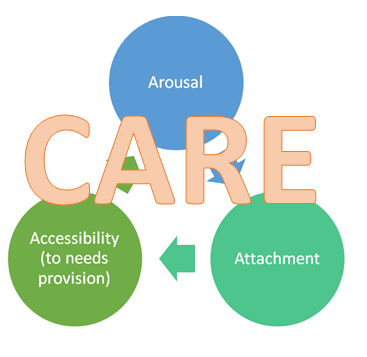
3. To lower the child’s arousal levels, thereby reducing problematic behaviour and increasing their positive engagement in their learning, do the above and maintain routines and consistent boundaries and consequences for misdemeanours.


I appreciate that the handout is very brief – it was meant to represent a minimum standard and be a quick reference guide and was offered in the context of a 1.5 day workshop incorporating information that is accessible in the following books:

Colby Pearce Resilience

Colby Pearce Attachment

Posted in AAA Caregiving, Adoption, Children's Behaviour, Fostering, Parenting, Resilience, Schools, Trauma | Tagged , , , , , , , , , , , | Leave a comment

2012 in review

The WordPress.com stats helper monkeys prepared a 2012 annual report for this blog.

Here’s an excerpt:

600 people reached the top of Mt. Everest in 2012. This blog got about 12,000 views in 2012. If every person who reached the top of Mt. Everest viewed this blog, it would have taken 20 years to get that many views.

Click here to see the complete report.

Posted in Uncategorized | Leave a comment

Attachment Therapy Revisited

Handprint-logoBack in July I published a post about attachment therapy for children who have experienced family trauma. This has been a popular post and resulted in my fielding a request to prepare a more detailed account of my approach to attachment therapy with children who have experienced complex family [a.k.a. developmental] trauma. This more detailed article was first published this month in the British Association for Counselling and Psychotherapy journal, BACP Children and Young People. Click here to read the full article.

I would like to take this opportunity to thank the journal editor, Eleanor Patrick, for the opportunity to expand upon my ideas about therapy with deeply hurt and traumatized children in the journal she edits.

Posted in AAA Caregiving, Adoption, Attachment, Fostering, Therapy, Trauma | Tagged , , , , , , , , , | Leave a comment

Ditto the previous post!

colbypearce's avatarAttachment and Resilience

In Part One of this series, I refer to the fact that the management of severe tantrums and meltdowns in children is an arousal management issue, rather than a behaviour management issue. In this second part of the series, I will provide some tips about how to lower your child’s arousal levels as strategy for reducing the likelihood and frequency of severe tantrums and meltdowns. I will also provide some tips about what to do to lower your child’s arousal in the midst of a severe tantrum or meltdown.

As I mentioned in Part One, severe tantrums and meltdowns occur when a child’s nervous system is highly activated; that is, highly aroused. The more highly aroused the child’s nervous system is, the less reasonable they become. There is a threshold, beyond which children are incapable of thinking and acting in a reasonable manner. As a result of genetic, historical…

View original post 975 more words

Posted in Uncategorized | Leave a comment

We’re all getting tired at this time of the year, including our children. Trusting that this information helps . . .

colbypearce's avatarAttachment and Resilience

In my practice one of the more common presenting problems is severe tantrums, or meltdowns, in children. Common reactions among adults who care for these children include frustration, embarrassment, desperation and helplessness. Typically, these otherwise competent parents have tried a range of strategies without finding a strategy or strategies that consistently work. They invariably pose one simple question: what do we do when our child is having a severe tantrum or meltdown? What they really want to know is, what works?

The first answer I provide is that there is no known universally effective strategy for managing severe tantrums and meltdowns. If there was, someone would have written about it by now and made a lot of money! The second answer I offer is that effective management of children’s severe tantrums and meltdowns begins with developing an understanding of what is actually going on in the nervous system of a…

View original post 1,053 more words

Posted in Uncategorized | Leave a comment

Reblogging as school holidays are approaching here in Australia!

colbypearce's avatarAttachment and Resilience

Stress is a major cause of demanding and unsettled behaviour in children.

Under stress, the brains of children are hard-wired to set off behaviours associated with the fight-flight-freeze response:

  • Fight:     Controlling, aggressive, destructive and demanding behaviour, hyperactivity
  • Flight:    Running off, hiding, hyperactivity
  • Freeze:  Reduced responsiveness to the environment (e.g. not listening, daydreaming)

Routines provide structure and order to people’s lives, which is reassuring. The absence of routines is stressful.

Variety is the spice of life. But too much variety and too many choices can be overwhelming for children. Limit the number of choices of activity a child is given at any one time.

If your child is consistently misbehaving day after day, it is probably because they are used to following routines and being occupied throughout the day, as occurs during school term. Planning activities for your children on a day-to-day basis assists with structuring their…

View original post 65 more words

Posted in Uncategorized | Leave a comment