We need to distinguish between attachment relationship, and attachment style.
Attachment relationships are the dependency relationships a child develops toward a caregiving adult. Primary attachment relationships reflect the child’s experience of care and protection from that adult. Attachment relationships that come after reflect the child’s experience of care and protection from other adults. These attachment relationships reflect the child’s experience of care and protection from that adult, but are also influenced by the child’s experience of prior attachment relationships; especially primary attachment relationships. It is worth noting that each attachment relationship can can differ along the dimension of attachment security.
Attachment style reflects the child’s overall approach to life and relationships, based on past and contemporary attachment relationships. It reflects their relative security when navigating their world and relationships.
When attachment relationships have gone awry, the child needs other attachment relationships to be especially good, and/or many positive attachment relationships, to support an overall secure attachment style.
In consideration of this, the role and importance of birth parent attachments requires new thinking in the child protection sector. Relational repair with birth parents may represent the best chance for children and young people to approach life and relationships in a secure manner.
This widely-held axiom might be seen to contrast with representations of Attachment Theory as a white, western, middle-class theory of the mother-infant relationship.
Is it right, then, to reject Attachment Theory in favour of theories that represent the role and importance of a collective of adults who raise a child to maturity?
I am not so quick to do so. The fact is, there is a problem with the way in which Attachment Theory is understood and practiced, particularly in the child protection arena, rather than with the Theory itself.
Consider this. In western child protection jurisdictions “secure attachment” is represented as a desirable goal for protection and care endeavours (and therapeutic ones, too). Yet, the population prevalence of secure attachment relationships with mum and/or dad in western countries is estimated at 60%. Forty percent of children are estimated to not have a secure attachment to mum and/or dad. What is the significance of this, especially in consideration of the reason for removing a child from the care of their parents, and for not returning them?
We need to make a distinction between “attachment relationship” and “attachment style”. Attachment style is based on diverse relationships and relational influences; not just those with mum and/or dad, or the child’s primary caregivers. We must also acknowledge that, though their first attachment relationships are very important, the child will make many attachments, perhaps across the lifespan.
In consideration of this, one can consider attachment theory to be aligned to the idea that “it takes a village to raise a child”.
Now, in a society based on the idea of the nuclear family, the relationship a child has with their parents exerts a pervasive and lifelong influence over their experience of, and approach to, life and relationships. This is just as true for children and young people growing up in out-of-home care. Though we might support their relationship with alternate caregivers, their relationship with their mother and father remains a powerful influence.
In fact, I would say that the relationship with mum and dad is the most healing relationship a child or young person recovering from a tough start to life might have.
So, as Bowlby once articulated, if we value our children we must cherish their parents.
Who is an expert in their field of endeavour? One theory is the 10,000 hour rule. First proposed by Psychologist Anders Ericsson, the 10,000 rule became popularised by Malcolm Gladwell in his 2008 book Outliers, in which Gladwell articulates the idea that you can achieve world class skill in a certain endeavour by practicing it for 10,000 hours. Gladwell’s version of the 10,000 rule is not without its critics, including Anders Ericsson, who distinguishes between three different forms of “practice”, and expresses that it is “deliberate” practice (which is goal oriented and regularly reviewed) that is needed in order for the 10,000 rule to approach validity.
I have worked primarily with children and young people recovering from a tough start to life for 29 years. A conservative estimate of the number of hours I have spent in conversation with this client population is 25,000 hours (based on number of client contact hours per day, week, year). According to the 10,000 hour rule, I might consider claiming expertise about children and young people recovering from a tough start to life. However, it is possible to practice in a repetitive fashion, applying psychological techniques to treat a presenting problem or diagnosable condition. If this is all that I have done, I might claim to have some expertise in the delivery of certain techniques.
Rather, I have always chosen a different path; of treating the person as well as the problem. To treat the person you need to connect deeply with them, entering into their experience. Though commonalities exist, each child or young person treated is a unique person. Though I have not treated 25,000 children and young people, I have had approximately that number of conversations about their experience of life and relationships, including their relationship with themselves and how they see the world.
In these circumstances, I might claim to have a good understanding of the experience of children and young people recovering from a tough start to life. However, I might only consider that idea if I have spent considerable time reflecting on my practice, my goals and methods, and the experience of each young person. This, I have done too, and have encapsulated insights gathered in the books, programs, articles, and videos I have made along the way.
Across 29 years I might also have spent more than 10,000 hours in conversation with adult stakeholders in the lives of children and young people recovering from a tough start to life. And, I don’t intend to stop soon.
If you are interested in what I have learnt, check out my books, articles, and more can be accessed via my website and this site, and my YouTube channel. If you are interested in engaging me as a supervisor for yourself or your team, do get in touch.
In this audio, drawn from one of my supervision sessions with a local organisation, I lead the group through a reflective process considering the question – why are some children unsettled after birth parent contact? The audio is intended to be of most interest to those who interact with children and young people who are recovering from a tough start to life in professional roles.
Disclaimer: While great care is taken to ensure that the information in this audio/video is applicable to childhood trauma and based on sound psychological science, it may not suit the individual circumstances of all viewers. If you have any concerns about applicability to your circumstances, please consult a qualified professional near to you.
Transcript:
So, just looking at my notes from last time, we had a couple of topics that people wanted to talk about. One of them was managing conversations about taking responsibility without invoking shame. And the other one was about managing unsettled behaviour after birth, parent contact.
I’ve got quite a bit to say about managing unsettled behaviour after contact. But probably before I launch into that, and directly relevant to that, I would want you to think about what is the experience of a child, either of birth parent contact and or after birth parent contact. What’s a child’s experience likely to be? We know that all children pay very, even from early infancy, pay very close attention to the face of adults.
And we also know that their own internal state is the homeostasis that their body works to maintain homeostasis. But it does that in a way that is not relevant to or appropriate to the external conditions in which the body is. Yeah.
So, basically, if the parent is anxious, the child will feel anxious. Yeah. Not necessarily, not just because of attunement or emotional connectedness, but also because if the parent is anxious, the child is interpreting this as there’s a threat somewhere.
Yeah. The child’s nervous system is, and it needs to mobilise its threat managing response, which is fight, flight, freeze. What else do you think is the experience of children of contact and the end of contact? So, the carer’s experience is relevant as well.
You’re saying the child will orient to their carer’s face as well. And then there’ll be a response. The nervous system will respond to how it thinks the carer is presenting, or the experience of the carer.
So, if the carer doesn’t like, the carer is anxious about the children going to contact, then the child comes back to the carer, primed, I guess, not so much primed, but will be triggered by the carer, by the carer’s own anxiety or dislike, worry, the feelings that the carer has. But I think it’s, when thinking about this question about managing the unsettled behaviour that the children often exhibit, or at least they’re reported to exhibit and their out-of-home carers report, I think the first place to start is always with the question, well, what is the experience of the child? What’s going on for them? And there’s probably lots of things, they may actually be triggered by their parents as well. The experiences that the children have had with their birth parents triggers a response in them.
Okay. So, just sticking with that, what do you think then, what would the child’s history with their birth parent trigger for the child? What sort of concerns or emotions would contact with their birth parents evoke that we haven’t already mentioned about grief and loss and sadness, pressure? What might the children be worried about as a result of contact? I think I mentioned this to you guys last time. I’ve been talking to people variously about this.
I’m just going to put this in here because I think it’s an interesting place to put it. I’m connected with a lot of care leavers directly through my work and also online. So, on platforms like LinkedIn, there’s the hashtag CEP, which is care experience person.
And there are certain care leavers that are quite prominent, not only through the platforms that they’re on, but they are quite prominent in their work, in their location. And I find it really interesting that care leavers, I’ve rarely if ever seen care leavers blame their parents for their adverse childhood experiences. They seem to be always targeting or the target of their concern is the system, is the way their life was managed by the system growing up, which implies that notwithstanding what happened in their life, well, I think it doesn’t necessarily imply, but it follows that they love their parents.
They often really, really love their parents, notwithstanding their parents’ faults. They want to be good enough, lovable enough, acceptable enough for their parents to be able to take on their care as well. So, children too much, what they internalize from being away from their parents is that there was something wrong with them, not that there was something wrong with their parents, so to speak.
I really think, as I said, I think with all about the aspects of the management of children out of home care, I think the most important question to lead off with is always what’s the experience of child? What’s going on for the child? In my pie shot, my pie thing is what’s really going on? How do we respond to what’s really going on and how do we know that we’ve made a difference? I think they’re the three key questions. The first two, what’s really going on here? How do we respond therapeutically to what’s really going on here? I think children’s experience of contact is variable, but heightened emotion is likely to be pretty common. Heightened emotion, so a dysregulated adult can’t come with dysregulated child, that’s one of those kind of poster statements that you see in this space, but it’s true.
The child will, if their care, return to their care and the carer is highly anxious about, worried about, upset about, angry about the child having gone to contact and now they’re left with picking up the pieces, which is a common thing that they’ll say. Child will is likely to be only further heightened. I think that one of the things that, correct me if I’m wrong, and I think you guys would do it in those families that you’re involved with.
I really don’t know if foster carers and kinship carers fully have a really good understanding of why family contact occurs, birth parent contact occurs. I don’t know that anyone, I’m more than happy to be told that no, it does happen, but my suspicion is that, based on my own interactions with foster and kinship carers, that no one really sits them down and talks to them about why birth parent contact is really important. I think that also would be what comes through from the department having been in the throes of an adversarial court process, or at the beginning, early on in the piece, an adversarial court process where, of course, you’re making an argument.
The workers are party to making an argument that children are not safe with these people. Then the foster parents or the out-of-home carers are sending the children to have contact with unsafe people. No matter how well it’s supervised, I mean, who’d send their own children to go and spend time with unsafe people? I wouldn’t.
I think there’s a response for foster carers to be concerned about contact. I don’t think that it is a sign of a character problem with foster parents. I think that concern about sending the children back off to have contact with unsafe people, I don’t know anyone who cares about their children to not be concerned about that.
I think the natural response for foster carers is to be really concerned about family contact. We’ve primed them to be worried when the children return. What is the impact of this? What are the pieces I’m going to have to pick up? And as I said, I don’t know if it happens.
My suspicion is it doesn’t, partly because what I just said, that we’ve just gone through a process. There was originally a process that really focused in on the faults of the parents to support an argument that children weren’t safe to live with them. It’s antithetical, in a sense, to then turn one’s mind to the enduring importance of birth parents to children, whether the children are living with them or not.
Again, I don’t know how much staff within the agency really understand the importance of birth parent contact. Again, it’s an agency that focuses on risk and risk mitigation. So contact is antithetical to that.
We’ve deviated a little bit, but as you know, I differentiate between attachment relationship and attachment style. Attachment relationship is the dependency relationship that a child forms towards an attachment figure, a significant adult in their life. And that relationship can be secure, or it can be insecure, or it can be disorganized.
And there’s two types of insecure in most classification. That’s an attachment relationship, but it’s not necessarily attachment style. So a child might have a secure attachment to mum, or what looks like a secure attachment to mum.
And remembering that it’s not a yes or no, there are grades of security as such, but it seems like a child has more so a secure attachment to mum and a disorganized attachment to dad. Because dad, and I’m not picking on fellas in this way, but this is more often than not the way it is, because dad not only has been a source of care, but also a source of fear. So in those circumstances, the child exhibits contradictory responses to the adult, okay, and which we call a disorganized attachment.
On the spectrum of attachment, disorganized attachment is at the other end of the spectrum to secure attachment. So what is the child’s attachment style? So the attachment style is their overall insecurity, security, insecurity, or disorganization in the way they approach life and relationships. So we’ve got one secure or semi-secure attachment to mum and a disorganized attachment to dad.
What’s their attachment style likely to be? So you’ve got to think about how is a child likely to approach life and relationships and how are they likely to approach new adults that they interact with, including foster parents or kinship parents, kinship carers. I’m determined to call family carers. I’ve got to get that down pat.
Does anyone think that the child’s overall attachment style would be secure in those circumstances where the two main figures in their life, that the child has a completely different experience of uncertain, unsure, I call them unsure children. Those children often then test new adults, test them and see if they’re going to be more like mum or more like dad. Hands up if you like being tested by children in that way.
Are you going to be mean and nasty or are you going to be kind and caring? Of course, I’m going to be kind and caring. Why would you think I’m not going to be kind and caring? So adults don’t like teachers, out-of-home carers don’t like being tested in this way. So you get this build-up to the child of negative experiences of relatedness to adults.
What’s their attachment style likely to be? I’m not secure. It’s going the other way. It seems to me that there’s a belief that is maintained that as long as we can facilitate the best possible connection with the out-of-home carer, whether that’s kinship or foster or even with key relationships in the residential care placement, that that somehow will neutralise or get rid of the influence of earlier toxic relationships.
The truth is it does a bit and bit by bit. If the children have more and more positive attachment experiences, then it’s going back towards the securing. But as I said, I haven’t heard and I wouldn’t just blame our system here in South Australia.
I think the area of attachment theory around multiple attachment relationships and associated attachment style is not very well looked at. It’s kind of everyone acknowledges that, yeah, yeah, yeah. But at least last time I looked, there’s not a lot of explanation and not a lot of awareness and understanding of the difference between attachment relationship and attachment style.
So there’s not a good understanding of the importance of contact. So people probably only look, as you know and I know, only look at it as a bad thing because the children come back unsettled and the attribution is made that this must be a fear response or an anxiety response or all of these things. Probably not so much grief and loss are imputed or feelings of abandonment.
I try to think about it from my perspective. I haven’t been a child for a long time. I do try to think about what it would be like to be a child who can only visit their parents once a month, knowing that that is their parent, going to school with other children whose parents pick them up at the gate, mum or dad, and drop them off in the morning.
What would it be like for that child? It would be pretty bruising and brutal, I think, in most instances, most instances where it’s deemed safe enough for contact to occur. I think it would be hard on the children. I mean, if the parent is outright terrible and the children have an absolute fear response in relation to the parent, then the contact is unlikely to occur anyway.
So that’s interesting then. So we’ve already, there’s a judgment that has been made that the parents are not that bad. They’re okay enough to have contact with the children.
And I think if they’re okay enough to have contact with the children, then the children are likely to have had a different experience of them prior to removal. Less bad, perhaps. I think at least we should be turning our mind to that.
And sometimes, I was just going to say, my observation would be and understanding would be that sometimes statutory authorities don’t even think about any of these things. They just know that there’s a court order that says that contact has to be arranged every week or every fortnight or every month, and they’re just kind of going through the motions with that. So what’s the experience of the child of having had and having to say goodbye to, having had contact with and say goodbye to their birth parents and go back to their foster placement or their kinship placement or their residential placement? I think that self-doubt is another one.
Am I lovable enough? Does anyone listen to me? Does anyone understand what is my experience of having this contact? Does anyone know what I would like? The children I speak to chronically feel like no one really even considered their point of view. I think to the extent that they’re triggered, there would be children that have some sort of conditioned response. I think the conditioned response is less likely to be fear, but more likely to be, am I loved? Am I lovable enough? Is anyone listening to me? Does anyone care for me? I think that’s more likely to be.
My observation would be that that’s more likely to be the triggered response. It bothers me that children would be turning their minds to what will be the reaction of the adults to what I say. That bothers me a great deal.
How do I manage my relationship with this adult? How do I manage the emotional response, the feelings of this adult? What do I have to say in relation to that? That’s not how the developmental process that ultimately leads to self-regulation and socio-emotional reciprocity works. That developmental process is entirely based around and built upon adults being sensitive and responsive to the experience of children, not the other way around. The child who has contact with parents and is perhaps triggered into thinking, are my views not important enough? Am I not important enough? Am I not lovable enough? They’ll go back to their placement and their carers.
We’re definitely triggered into operating, I think, under this kind of belief system or mindset. I think it’s really important that the experience of the child upon return to their placement makes it really hard for the child to hold on to those ideas about themselves and about arrangements that exist. So the children will act out what they can’t say or won’t say.
And of course, as we all know, if they’re acting out then that contact must be bad and needs to be minimised or eliminated. But what it may be is is that the child will… So for example, a child will just… If they’re coming back anxious and heightened, they’re going to be prone to tensions and meltdowns. Of course they are.
If a child comes back self-doubting, then they’ll act without care for themselves or for their relationships with people around them. Doesn’t matter. Why do you care? That’s what they say.
If I wish I had a dollar. If they come back in grief, contact’s a bad thing because it just makes them feel so uncertain about themselves and so sad. It’s a bit like we don’t look enough at… We don’t look enough at… And we’ve talked about it.
We don’t look enough at the reasons why contact’s important. We just over-focus on all the negatives that come from contact. So yeah, I think, what did I say? Behaviour is the language of the… Well, I wrote that, the attachment disordered child.
I wrote that a long time ago. I wouldn’t call any child attachment disordered anymore. You know how language changes over time.
Let’s say behaviour is the language of the traumatised child. It’s just about as bad calling them traumatised, I think. Behaviour is the language of the child.
They never had the opportunity to fully develop their language and their capacity to express what’s going on for them because their parents were finding life really hard and were often distracted from the task of parenting them, including sitting with them, speaking their mind, saying what the child might have been feeling or what their intentions or motivations, what their experience was, encouraging them to use their words, all of those things. It’s probably, you know, the language of the traumatised child. You lose so much.
You lose so much detail in that. Those sorts of statements rely on a lot of background knowledge, I think, but they’re good to get people to start thinking about what’s going on for the children. So, how do we respond to a child who is anxious, is self-doubting, is experiencing grief, loss, sadness, feelings of abandonment, feelings of not being good enough? How do we respond to that? The children come back having experienced something, and that’s what we’ve been talking about so far.
They come back and they’re experiencing something. They need to express themselves in some way. They end up expressing themselves through their behaviour more often than we would like because they don’t necessarily have the words that they can put to their experience.
So, they need adults to do that. So, they need the adult whose care they’re returning to, to be able to acknowledge that it’s really sad not being able to live with Mummy and Daddy. Sometimes we think that we’ve done the wrong thing, and that’s why we can’t live with Mummy and Daddy.
But Mummy and Daddy just find life really, really hard and aren’t able to care for you at this time. You love going to see Mummy and Daddy. You get lots of presents.
You have an awesome time. It’s hard to know when you’ll see them again. Mum and Dad are your favourite people in the world. I use that a lot. I often acknowledge that birth parents are the children’s favourite, and I’ve never had one say no.
In this video I address the issue of what you need to know about the therapeutic care and management of children and young people diagnosed with ASD and/or ADHD, where there is a trauma overlay. The video is intended to be of most interest to those who interact with children and young people who are recovering from a tough start to life in care and professional roles.
Disclaimer: While great care is taken to ensure that the information in this audio/video is applicable to childhood trauma and based on sound psychological science, it may not suit the individual circumstances of all viewers. If you have any concerns about applicability to your circumstances, please consult a qualified professional near to you.
Transcript:
Just on the issue of children being diagnosed with Attention Deficit Hyperactivity Disorder and or Autism Spectrum Disorder, where these children also they’re in a statutory kinship care placement, so there’s been some concerns that have meant that they couldn’t safely be cared for at home with their mum and or their dad, so they’re living with other family and so that creates another layer to their experience. Okay, so in the out-of-home care space, though a child or young person may be diagnosed with Autism Spectrum Disorder or Attention Deficit Hyperactivity Disorder or both, there is also a trauma overlay which derives from their prior experience when they could not be safely cared for at home with mum and or dad and I believe this also applies to children who are removed at birth. Their trauma derives from antenatal factors but more importantly, I think, from their experience and the meaning they make of not being able to live with mum and or dad.
Anyway, it’s important to recognise and acknowledge the trauma overlay because it influences how we work with these children and young people, especially in consideration that a trauma-informed approach, which is necessary when there is a trauma overlay, requires us to look beyond the presenting behaviours of concern and to respond therapeutically to the reasons for them. This is highlighted in this slide. I’ve chosen a number of common behaviours of concern here and as you can see, it is my contention that we see these behaviours, whether the child is diagnosed with a neurodevelopmental disorder like ASD or ADHD or has a history of developmental trauma.
In fact, I could add a fourth column, one for children and young people who have no diagnosis or trauma history. They exhibit these behaviours too. However, there are two further considerations here.
One, that normality and abnormality are differentiated by frequency, intensity and duration. So, kids with ASD or ADHD and a trauma history exhibit these behaviours at a greater frequency, intensity and duration such that it impacts adversely on their approach to life and relationships. The second consideration has to do with the reasons why these behaviours occur that are often different for ASD versus ADHD versus trauma.
If the reason for the behaviour is different, our approach to responding therapeutically to them is often different. This is reflected in this slide where I present the reasons why we see these behaviours in children with ASD, ADHD and those who have experienced developmental trauma. As you can see, there are similarities and differences.
If we are to respond therapeutically to the behaviour, we need to address all of the reasons for it. Which brings me to this slide. In this slide, I present what a therapeutic response looks like for each of the reasons for these common behaviours.
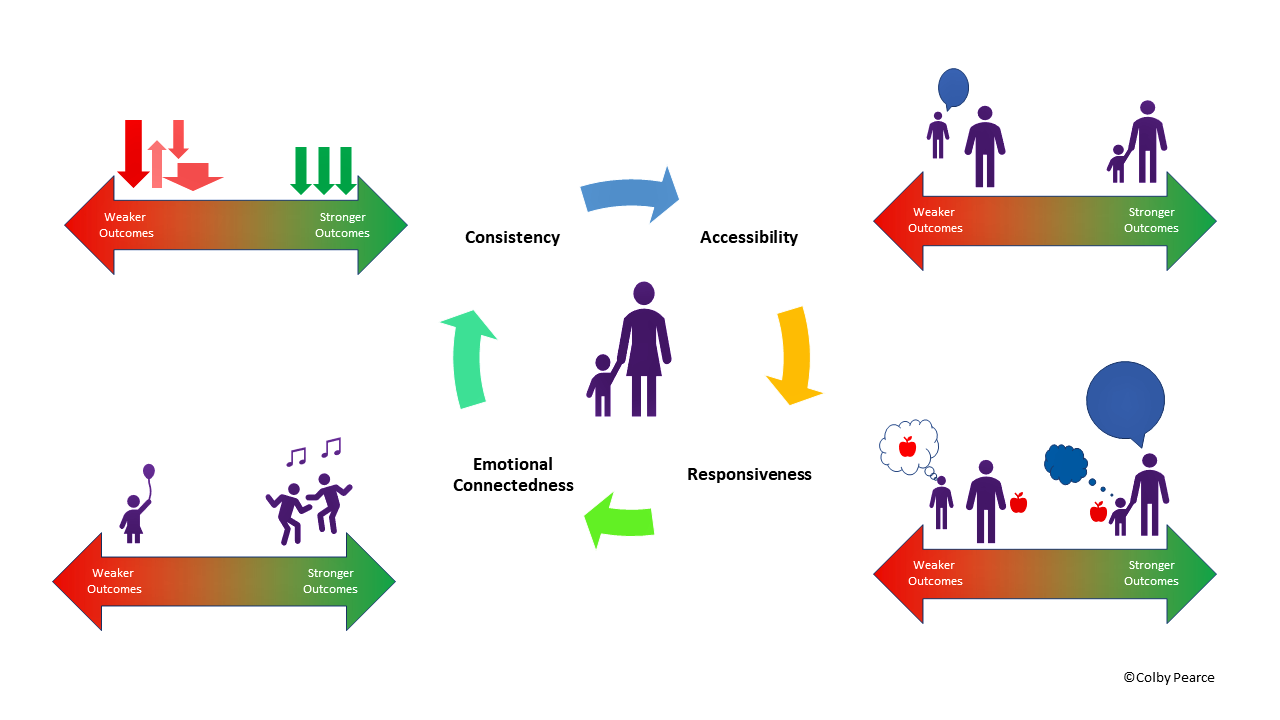
As you can see, there are similarities and differences. This seems quite complex until we map the care model onto the same slide. Where care involves enriching a child’s experience of consistency, the accessibility of adults in their life who have a caring concern for them, the responsiveness of those adults and the emotional connectedness of those adults. When we map the care model onto these reasons, for each of these behaviours that we see in autism spectrum disorder, attention deficit hyperactivity disorder and or where there is a history of developmental trauma, there is a care strategy to address the reasons for the behaviour, notwithstanding diagnosis or trauma history.
In this video I respond to a question raised in supervision, recently, about my thoughts about children and young people who light fires. This led to a wide-ranging conversation, a portion of which is shared here. The video is intended to be of most interest to those who interact with children and young people who are recovering from a tough start to life in care and professional roles.
Disclaimer: While great care is taken to ensure that the information in this audio/video is applicable to childhood trauma and based on sound psychological science, it may not suit the individual circumstances of all viewers. If you have any concerns about applicability to your circumstances, please consult a qualified professional near to you.
Transcript:
With kids, I mean, you’ve got, it’s really about separating out what is, what’s a normal interest in fire lighting, or in fire, I guess, and what’s a problematic interest. I mean, I think, you know, probably a lot of, this kind of goes back, I think, to a story that I’ve told before where I put a, I was delivering a workshop to 180 clinical psychologists at the Clinical College Benefit about 13 years ago now, and I put up on the slide a whole bunch of behaviours that we commonly see in children and young people, and I asked them to consider what diagnostic formulations that they would come up with based on, you know, if they had a child who was exhibiting I think I said two thirds or three quarters of those behaviours, and I got all sorts of diagnostic formulations, but no one said no diagnosis. My point was normality and abnormality differentiated by frequency, intensity, and duration, so a lot of behaviours that we, that kids, that a lot of the behaviours of concerns we see in children that we’re concerned about, you see those behaviours in the normal population anyway.
Children, you know, perhaps particularly boys, have a bit of a fascination with bonfires, and playing with fire, and so on, but it’s when it’s, so you’ve, I think what you’ve got to do then is just think about, well, why are they doing it? Is this just a normal interest and fascination that perhaps boys, I’ve had girls who are fire lighters as well, that’s probably a bit of a, I haven’t got data to support it, but that reminds me a little bit of a publication back in 1993, a very long time ago, of a study we did looking into music preference amongst teenagers and suicidality, and what we found is that, and things change all the time, but what we found an interesting effect where girls who had very much a less common interest, music interest, you know, like a particular style of music, at that time it was rock and heavy metal, it was heavy metal music, they were the ones who were more likely to be exhibiting suicidality, point being that girl, you know, to the extent that probably an interest in fire is more common in boys, if girls are messing with fire, they, that would be, I would see that as probably a less common interest, and perhaps a bit more, a bit more interesting than just, you know, dismissing it as normal childhood behaviour as such. The things that I would, so if, but if a behaviour is relatively common, but children and young people, but certain children and young people are quite worried about it, then I think it really, it goes to frequency, intensity and duration, which I’ve talked about, but also the reason, is the reason they’re doing it different. I think fire lighters, probably displaced anger, a lot of anger, and powerlessness, they’re the two, I guess they’re the two, I probably could think of some more reasons, but my first, I guess, protocol would be around anger, displaced anger, so anger and hurt, and feelings of powerlessness, perhaps attention, the attention that it gets, you know, feeling of being invisible, certainly adult offenders, fire lighter offenders, but, you know, not, not being noticed, being, not being important, not feeling important to people.
It’s the sort of behaviour that, that outside of just playing with a, with a bonfire, it’s likely to garner significant concern and attention, so you, in those circumstances, I’d be thinking about what, what sort of, what’s a typical experience of concern and attention. So there’s, yeah, so I’ve added to the tally, I think, you know, definitely anger, which comes out, that can come out through destructiveness, yeah, powerlessness, feeling unimportant, feeling a lack of care and concern, that’s five now. That would be my hypothesis.
So to the extent that, that it might be an uncommon interest in girls, or less common interest in girls, it might be a flag that there’s more going on for that girl. So anyway, the point being that normality and abnormality are differentiated by frequency, intensity and duration, but I would also say you’ve got to consider the reason. Is this just normal interest and exploratory behaviour, or is there something else going on? And as I said, there’s something else going on, would be anger, power, attention, feeling invisible, yeah, lack of care and concern.
So yeah, so in terms of working with children, like young people, I think everyone, you know, would be, there would be plenty of practitioners who would see the fire lighting as the problem. Yeah, well, it is a problem. So amongst the responses to that would be to admonish the young person, to sanction them in some way.
And the problem with that, of course, is that it runs the risk of only exacerbating certain reasons for why they do it. So you end up in that scenario where what are you going to do? Try and scare them straight, which is a common system response, you know, you’re going to go, you’ll end up hurting someone, you’ll end up, you might hurt yourself, you’ll end up going to jail, you know, no, you’ll end up with words that reflect that, you know, people won’t like you or love you, and you’ll be an outsider in society, you know, there’ll be words around that, all of which probably, you know, confirms and exacerbates the underlying stuff that’s giving rise to the behaviour. So I think my view about these things is a lot of the trauma, I was responding to something only this morning, but a lot of the trauma-informed commentary and content out there, in my experience, really says, you know, you’ve got to respond to the underlying reason, which I agree with, but I think you’ve got to do both, you’ve got to respond to the behaviour and the reason for the behaviour.
Otherwise, people will look at you, this was my experience of talking about responding to the reason for the behaviour over a period of time, people just looked at me like I was mad, like I was, because it’s so foreign to not also address the behaviour. So I think young people need to know that the behaviour is not acceptable, but they also need to know that we understand and will respond to the reasons why they’re or they need to experience us understanding and responding to those reasons. And authorities, including referring authorities, including parents and so on, really need to know that we also take the behaviour seriously, otherwise they’ll pull their children out, you know, or they’ll pull the children out, take them somewhere where the therapeutic service is taking the behaviour seriously, and such.
In this video I share my thoughts about the need to broaden the much used maxim in out-of-home care circles, from “respond to the need” to “respond to the reason for the behaviour”. My views are shaped by my observation that adults with a caring concern for children and young people who cannot safely be cared for at home often struggle to identify the “need” that gives rise to the behaviour. A better approach, in my opinion, is to have a good explanatory model that guides therapeutic responses.
The video is intended to be of most interest to those who interact with children and young people who are recovering from a tough start to life in care and professional roles. For more information about other aspects of my work, I refer you to the links below and, in particular, the self-paced learning modules on the Secure Start website.
Disclaimer: While great care is taken to ensure that the information in this audio/video is applicable to childhood trauma and based on sound psychological science, it may not suit the individual circumstances of all viewers. If you have any concerns about applicability to your circumstances, please consult a qualified professional near to you.
See transcript below.
Transcript:
Responding to the need instead of the behaviour has long been a maxim of our work with children and young people who cannot be safely cared for at home and are recovering from a tough start to life. But I also think that we need to be turning our minds to the reasons for the behaviour. So those of you who are familiar with my work would know that I use the following statement, which is trauma-informed practice is less about devising strategies to address behaviours of concern and more about responding to the reasons for them.
I found that people sometimes struggle, caregivers in various roles who have a caring interest in our children and young people, have at times struggled with identifying what is the need that gives rise to the behaviour. As they also do with identifying triggers, what was the trigger for the behaviour. But in terms of responding to the reason for the behaviour, I think that that process can be assisted by having a good conceptual and theoretical model that provides a good explanation for what is driving behaviours of concern that we see in this group of children and young people.
Again, people who are familiar with my work would know that I use the AAA model, a model that was first published 15, 16 years ago, 15 years ago. AAA model is a model that I developed in reflecting upon my experience of working in the child protection and out-of-home care sectors and particularly working with children and young people who couldn’t safely be cared for at home. The three A’s refer to attachment, arousal and accessibility to needs provision.
So, people who are probably watching this video would know what I’m talking about when I talk about attachment. But in terms of the AAA model, what I’m particularly talking about is the working model or what I refer to as attachment representations. These are beliefs often held subconsciously or typically held subconsciously about self, other and the world.
They play a really important role and have a significant influence over the way in which a the reasons behind behaviours of concern. The second A refers to arousal and this really refers to how fast or how activated their nervous system is, how fast their motor runs. And the combination of attachment representation and arousal.
So, what we often see in our children is negative beliefs about self, other and world combined with high levels of arousal, which is a clear recipe for anxiety and anxiety-based responding. So, the fight, flight, freeze response, controlling, aggressive, destructive, running, hiding, hyperactive, withdrawing, shutting down, avoiding type behaviours. So, in terms of responding to the reason for the behaviour, what we will be doing is responding to those anxiety-based behaviours by reducing anxiety, for example.
The third A refers to accessibility to needs provision and that is what I call it that because what I’m referring to there is what has a child or young person learned about how to get their needs met, including about the accessibility and responsiveness of adults in a caregiving role. So, our children are typically very demanding, but they can also take matters relating to needs provision into their own hands inordinately. And so, what is of concern here is their prior learning and that is often maintained, but they’re learning about how you get your needs met.
And their learning tends to be you cannot always rely on adults in a caregiving role to respond to your needs. You need to control and regulate those adults or control and regulate access to needs provision. So, if we’re going to respond to the reasons for the behaviour as well as the behaviour, we need to be responding to that prior learning.
So, what we need to be doing is making it really hard for children and young people to maintain those internal working models or attachment beliefs, attachment representations that they are bad and unlovable, that adults are mean and nasty and uncaring and that the world is an inherently unsafe and threatening place. We need to be slowing their motor. We need to be calming them down.
And with those two things together, we need to be turning our mind to how we reduce their anxiety and we need to be facilitating new learning that their needs are understood and important and will be responded to by adults in a caregiving role through conventional approaches to parenting and relating. So, based on the AAA model, a useful reflective process to go through is to ask yourself, if the child could or would, how would they describe themselves, other people and their world? Your answer to those questions should inform the actions that you take. We need to deploy relational connection and relational behaviours that make it really hard for our children and young people to continue to maintain very negative beliefs about themselves, other people and their world.
You also should reflect on how fast their motor is running or might be running, how activated their nervous system is and be turning your mind to ways to calm their nervous system. And you should finally also be turning your mind to what has the child learned about access to needs provision and the accessibility and responsiveness to their needs of adults in a caregiving role. And you need to be turning your mind to what you can do to facilitate more positive learnings and understandings for the child and make it really hard for them to maintain their prior learning, high arousal levels and disordered attachment beliefs going forwards.
Just finally, those of you who are familiar with my work would be familiar with the care curricula, which encapsulates not only content and theory that helps people understand the experience of children and young people who are recovering from a tough start to life and cannot safely be cared for at home for a period of time. But it also includes a range of strategies that can be deployed in the home or in the classroom that address these three critical impacts of early trauma for children and young people, these impacts on attachment, on central nervous system functioning and arousal levels and their learning about access to needs provision.
In this short video, drawn from an interview I participated in for Therapeutic Residential and Foster Care for Traumatised Children, I address the question of what I think should be the focus of our work in child protection and social care work. Click on the video below to see my answer. If you wish to see the whole interview, click here.
In this short video, extracted from a recent interview I gave to Therapeutic Residential and Foster care, I respond to the question about what one piece of advice I would give to people (considering) working in child protection and social care. Click on the video below to see my answer. If you wish to see the whole interview, click here.
In this video, I explain why children recovering from developmental trauma, in particular, react so extremely the word “no”, and suggest some ways to respond therapeutically to this.
The video is intended to be of most interest to those who interact with children and young people who are recovering from a tough start to life in care and professional roles.
If you take something useful from it, please consider liking the video and subscribing to my YouTube channel.
Disclaimer: While great care is taken to ensure that the advice on this site is widely applicable and based on sound psychological science, it may not suit the individual circumstances of all visitors. If you have any concerns about applicability to your circumstances, please consult a qualified professional near to you.
Join 5,452 other subscribers
Colby Pearce
Search this site
Supporting consistent Therapeutic Caregiving
Companion App for Therapeutic Classrooms and alignment with home.









 Attachment and Resilience