Toilet Training

Another brief post from the Secure Start Facebook page; this one concerning toilet training.

It has been a day for questions about toilet training. My recommendations: provide an incentive to the child to use the potty; praise and reward (reinforce) success (I prefer social reinforcers, like time spent doing an activity favoured by your child); clean up accidents in a dead pan manner (i.e. no fuss/ no social reinforcement); never punish the child for accidents; and practice toilet timing (i.e. sit on potty each hour for No.1’s and after each meal for No.2’s). One last thing, be persistent with one approach – don’t chop and change; it is counter-productive.


Posted in Uncategorized | Leave a comment

Preparing your child for their first day of school

This is another brief post from the Secure Start Facebook post, which I considered might be of interest to followers here.

At the request of one of our regular visitors to this page, I am going to share some thoughts about preparing children for their first day of school which you may not have seen or heard of elsewhere. I am going to focus particularly on the children who are unsure about attending school for the first time. The first thing I would do is prepare a little calendar, much like an Advent Calendar, incorporating a little countdown to the first day of school and a treat for each passing day (a treat can vary from a sweet to an activity or activities your child would be excited about participating in). This will provide a sense of timing and gradual exposure to the idea of the impending first day, with the anticipated effect that your child does not feel overwhelmed on their first day. Related to this last point, I would visit the school and the school playground prior to the first day so the child has a mental image of the school. You might even take some photos of the school and the playground to attach to your calendar and, if possible, arrange to meet your child’s classroom teacher or, at least, the office staff. I would emphasize the need to acknowledge any particular worries your child has and engage with your child in some simple problem solving about actions they can perform to deal with anxiety-evoking situations (e.g. ask them “what do you think you could do to feel better if that happens” and reinforce the role of the adults at the school to take care of them). Organizing a play date with another child you know (maybe, from Kindy or ELC) who will be starting at the same school on the same day may also be beneficial. Finally, I strongly recommend that you play soothing classical music in your child’s sleeping environment, all night, every night hereafter. This will have the effect of making them less prone to anxiety in the lead-up and on the first day. An old favourite of mine is Dream Children, which was released some years ago by the Adelaide Symphony Orchestra. A more recent favourite with a slightly different (though no less useful) effect is Mozart for Bedtime, which is on iTunes. And, on the day, take lots of tissues for when you return to your car.
 

Posted in AAA Caregiving, Adoption, Fostering, Parenting, Resilience, Schools, Wellbeing | Tagged , , , , , , , , , , , , , , | Leave a comment

Getting ready for back to school

OK, so there is just under two weeks until the new school year and a common assertion to be heard from parents at this time is “my child is ready to go back to school”. A similar assertion is “I am ready for my child to go back to school”. Whenever I hear these assertions I interpret them as the child and parent are subconsciously craving a return to the stable and consistent routine of school term-time. We all need a bit of change, excitement and surprises in our life, but over the longer term we function better and enjoy greater wellbeing with stable and predictable routines. Many of you will have seen my earlier post about restoring sleeping routines. My suggestion is that you begin to restore other routines, such as mealtimes, personal hygiene rituals and anything else that has become more relaxed during the holiday period. I anticipate that, once re-introduced, a return to “normalcy” will have the effect of reducing minor conflicts and allow parents and children to enjoy what remains of this special time for and with our children.


Posted in AAA Caregiving, Adoption, Children's Behaviour, Fostering, Parenting, Schools, Wellbeing | Tagged , , , , , , , , , , , , , , , , , | Leave a comment

Oral stimulation facilitates feelings of wellbeing

This is another of my posts on the Secure Start Facebook page. Let me know what you think!

From the earliest hours of life, infants experience feelings of emotional wellbeing in association with suckling. As a result, a powerful association develops between oral stimulation and feelings of emotional wellbeing. When anxious or overwhelmed, many children stick something in their mouth; be it a finger or thumb or part of their clothing. This provides tangible evidence of the role of oral stimulation in managing stress and restoring feelings of wellbeing. Knowing this presents an opportunity for assisting children in a proactive manner to remain calm in stress-evoking situations and places, such as on the way to a professional appointment or in a busy, crowded and noisy shopping centre. Offering water in a sports bottle, an ice-block or even a lollipop to suck can be an effective way of inoculating your child to stressful places and situations.


Posted in AAA Caregiving, Adoption, Children's Behaviour, Fostering, Parenting, Resilience, Wellbeing | Tagged , , , , , , , , , , , , , , | Leave a comment

Restoring school-time sleep-wake cycle

This is the first of a series of a short posts that I prepared for my Secure Start Facebook page. For those of you who don’t follow my page, I have included it here for you.

As the return to school approaches, one of the issues that parents often need to address is restoring an earlier bedtime. This can be a source of conflict, replete with children complaining that they cannot sleep in association with their body clock (sleep-wake cycle) having adjusted to the later bedtime that is a common feature of school holidays. Difficulty getting to sleep and associated stress and conflict can be counter-productive to successfully restoring an earlier bedtime. Our recommendation is that parents begin to prepare their child(ren) for an earlier bedtime now by getting them up fifteen minutes earlier each day and putting them in a light-filled environment until you reach the time at which your child(ren) would normally get up on a school day. This might be expected to have the effect of shifting the sleep-wake cycle back to the more normal rhythm of school time, with the result that your child(ren) will begin to feel sleepy at an earlier time. Once your child is getting up at the time they would during school term time, you can expect to encounter fewer difficulties getting them into bed at an earlier time.

Posted in AAA Caregiving, Adoption, Fostering, Parenting, Schools | Tagged , , , , , , , , , , | Leave a comment

The Library Book Series

Dear visitors to, and followers of, this site. The Library Book now has a new home: http://thelibrarybookblog.wordpress.com/ It would be a source of validation to The Library Book if you would come across and visit, like and comment. Thank you in anticipation.

Posted in The Library Book | Tagged , , , , , , | Leave a comment

New thinking and a new approach required with looked-after children

colbypearce's avatarAttachment and Resilience

Colby Pearce Attachment National Psychology ExamYesterday I was visited by a six-year-old boy who has a history of family trauma and is being raised by a relative carer. Upon entering my consulting room he immediately sought my box of assorted animals and rifled through it, looking for a gorilla he has previously identified as “King Kong”. Upon finding King Kong he immediately and enthusiastically began play-acting battles between King Kong and the other animals, where King Kong was always victorious. He confidently asserted that King Kong could take on all-comers and never be defeated in battle. He acknowledged a wish that he could be like King Kong and defeat all of his enemies. He was hopeful of being like King Kong when he is “a teenager”.

Looked-after children who have experienced significant family trauma, whether they be in foster care, adoptive care, kinship care or residential care arrangements, typically share the following characteristics:

  • they consider…

View original post 431 more words

Posted in Uncategorized | Leave a comment

More than positive thinking and a resilient mindset

colbypearce's avatarAttachment and Resilience

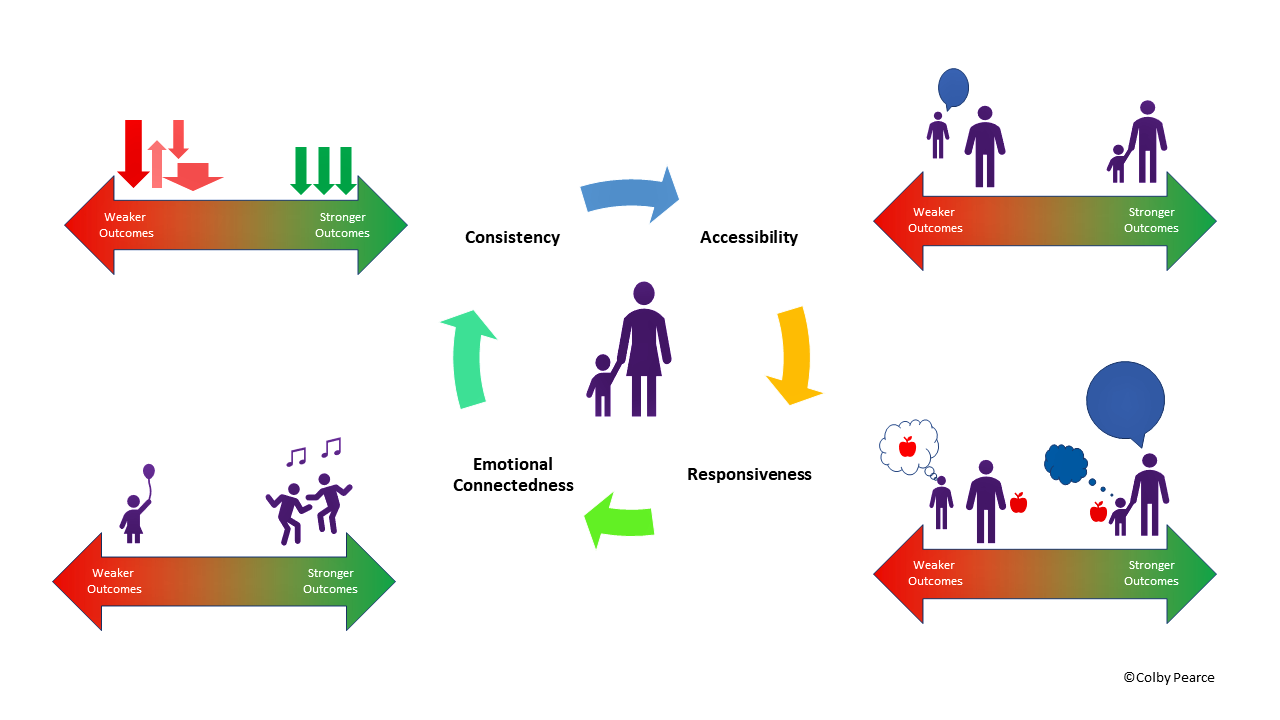
Colby Pearce ResilienceA child’s resilience requires more than just a “resilient mindset” or “positive thinking”. It requires deeply-held and profound beliefs, formed during infancy and early childhood, that they are a good and capable and deserving person, that adults in a care and management role will be accessible, understanding, responsive and emotionally-connected, and that the world is a safe and nurturing place full of many exciting possibilities. It also requires optimal levels of physiological arousal, such that the child is better able to perform at their best and experience success and mastery. Moreover, it requires a preparedness to explore the world unencumbered by a concern with accessing unmet or inconsistently met universal human needs. These are the core premises of A Short Introduction to Promoting Resilience in Children.

View original post

Posted in Uncategorized | Leave a comment

More than positive thinking and a resilient mindset

Colby Pearce ResilienceA child’s resilience requires more than just a “resilient mindset” or “positive thinking”. It requires deeply-held and profound beliefs, formed during infancy and early childhood, that they are a good and capable and deserving person, that adults in a care and management role will be accessible, understanding, responsive and emotionally-connected, and that the world is a safe and nurturing place full of many exciting possibilities. It also requires optimal levels of physiological arousal, such that the child is better able to perform at their best and experience success and mastery. Moreover, it requires a preparedness to explore the world unencumbered by a concern with accessing unmet or inconsistently met universal human needs. These are the core premises of A Short Introduction to Promoting Resilience in Children.

Posted in AAA Caregiving, Attachment, Fostering, Parenting, Resilience, Schools, Wellbeing | Tagged , , , , , | 2 Comments

New thinking and a new approach required with looked-after children

Colby Pearce Attachment National Psychology ExamYesterday I was visited by a six-year-old boy who has a history of family trauma and is being raised by a relative carer. Upon entering my consulting room he immediately sought my box of assorted animals and rifled through it, looking for a gorilla he has previously identified as “King Kong”. Upon finding King Kong he immediately and enthusiastically began play-acting battles between King Kong and the other animals, where King Kong was always victorious. He confidently asserted that King Kong could take on all-comers and never be defeated in battle. He acknowledged a wish that he could be like King Kong and defeat all of his enemies. He was hopeful of being like King Kong when he is “a teenager”.

Looked-after children who have experienced significant family trauma, whether they be in foster care, adoptive care, kinship care or residential care arrangements, typically share the following characteristics:

  • they consider themselves to be misunderstood, vulnerable and powerless;
  • they consider others to be malevolent in intent towards them; and
  • they consider the world to be a harsh, unfair and potentially dangerous place.

As a consequence of these beliefs, originally developed in an environment of deprivation and pain, their predominant emotional response when interacting with others is anxiety. Behavioural sequelae of anxiety include:

  • An intense compulsion to control all people and situations;
  • Aggression towards people and property;
  • Hyperactivity;
  • Avoidance; and
  • Physical and emotional withdrawal.

The role and function of these behaviours is to neutralise a perceived threat and achieve feelings of physical and emotional safety.

In short, looked-after children often feel unsafe and engage in very predictable behaviours in order to achieve feelings of safety.

Unfortunately, in most instances these behaviours are maladaptive to context, in that the person with whom they are interacting does not pose a real threat.  They are also self-defeating, in that the person with whom they are interacting is more likely to respond with annoyance and anger in association with the behaviour.

Adults who care for and manage looked-after children often respond in a predictable manner to the anxiety-driven behaviours of these children. In various ways, they seek to control and discipline the child. In doing so, they confirm the child’s maladaptive beliefs, referred to above, about self, other and world. They perpetuate these beliefs, the child’s anxiety and the associated maladaptive, antisocial behaviour.

Looked-after children who have a history of family trauma require new thinking and a new approach to their care and management. They need for adults in a care and management role to understand that these children feel unsafe and anxious a lot of the time. They need for adults in a care and management role to understand that the maladaptive and antisocial behaviours exhibited by these children is a consequence of them feeling unsafe. They need for adults in a care and management role to help them feel safe.

Once they feel safe, looked-after children who have a history of family trauma begin to form trusting relationships with others. Once they feel safe,  looked-after children with a history of family trauma become concerned about remaining on good terms with those they trust. In association with this concern,  looked-after children begin to conform to conventional expectations and standards of behaviour.

It is the relationship an adult has with a child that is the strongest form of influence they have over the child’s behaviour. 

A final thought: Attempting to control a person is a symptom of fear. Engaging with acceptance and empathy is a sign of strength.

Posted in Adoption, Attachment, Children's Behaviour, Fostering, Parenting, Schools, Trauma | Tagged , , , , , , , , , , , , , , | 5 Comments