The notion of the Hawthorne Effect is derived from a series of experiments conducted in the 1920s and 1930s at the Hawthorne works of the Western Electric Company. In these experiments, the experimenters manipulated aspects of the working conditions of some employees in order to study the effects of these changes on employee productivity and wellbeing. The most famous were the so-called “Illumination Experiments”. In these experiments, productivity improved with successive increases in illumination in a work area, then increased again when the illumination was subsequently reduced. This led to the conclusion that it was not the level of illumination that played a role in worker productivity, but the perception of the worker that management was interested in them and in their working conditions.
Several years ago I was asked to conduct assessments of thirteen children who were of the most concern to staff at a particular school, in terms of their engagement and behaviour. My assessments incorporated interviews of each child, their parent(s), their classroom teacher and senior staff at the school. I prepared a diagnostic report for each child and made recommendations regarding each child’s care and management requirements. I conducted individual feedback sessions with the parents of each child, and with their teacher. I also provided general education to staff of the school about engaging children who are disengaged and who exhibit challenging behaviour in the education setting.
I returned to the school the following year, approximately six months later. Only one of the original thirteen children continued to be of concern to school authorities, in terms of their engagement and behaviour.
Since that time I have observed the same effect in other schools with whom I have an association. When school authorities and teaching staff take an active interest in those children who are disengaged and presenting a behaviour management challenge in the school, such as by instituting special programs for them, the behaviour and engagement of these young people invariably improves! In contrast, when school authorities rely primarily on suspension and exclusion of the student from school, their engagement and behaviour invariably deteriorate further.
So, take an active interest in the disengaged and those who exhibit challenging behaviour in the school setting. It really is the only viable way forward with these young people!
If you found the information in this article useful, please share it using the sharing buttons below.
Please also subscribeto this blog to receive further ideas and guidance when it becomes available.
Follow the links below to my two new resources supporting consistency of care and effective communication between home and school for children recovering from a tough start to life:
The notion of the Hawthorne Effect is derived from a series of experiments conducted in the 1920s and 1930s at the Hawthorne works of the Western Electric Company. In these experiments, the experimenters manipulated aspects of the working conditions of some employees in order to study the effects of these changes on employee productivity and wellbeing. The most famous were the so-called “Illumination Experiments”. In these experiments, productivity improved with successive increases in illumination in a work area, then increased again when the illumination was subsequently reduced. This led to the conclusion that it was not the level of illumination that played a role in worker productivity, but the perception of the worker that management was interested in them and in their working conditions.
Several years ago I was asked to conduct assessments of thirteen children who were of the most concern to staff at a particular school, in terms of their engagement and behaviour. My assessments incorporated interviews of…
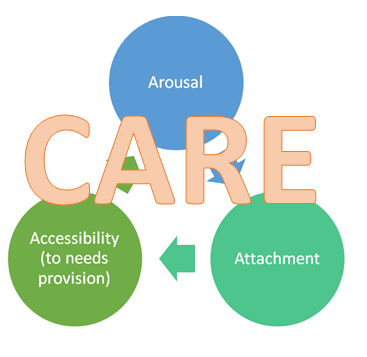
In A Short Introduction to Attachment and Attachment Disorder I presented a model of therapeutic re-parenting of children who have experienced complex developmental trauma. In A Short Introduction to Promoting Resilience in Children I showed how the same model can be applied to parenting of all children, with the intention of fostering their resilience. In various other publications I refer to this model as AAA Caregiving. Where it makes sense to do so, I use the generic word caregiving instead of the more specific word parenting. My intention in doing so is in recognition that of the fact that caregiving is incorporated into a wide range of roles adults perform in relation to children. Hereafter I will briefly present how a AAA Caregiving approach can be applied by adults who work in schools.
The AAA in AAA Caregiving refers to Attachment, Arousal and Accessibility to needs provision.
In my practice I am regularly asked the following question: What can I do to help my child? In the context of a child, adolescent and family psychology practice, the question is best understood as what can I do to promote my child’s wellbeing?
There are many perspectives and recommendations in the parenting and psychology literature about what parents can and should do to promote their child’s wellbeing. It can, quite literally, be overwhelming for parents to know what is best for their child. Keeping this in mind, I have reflected long and hard about fundamental aspects of good parenting and practical strategies for implementing them.
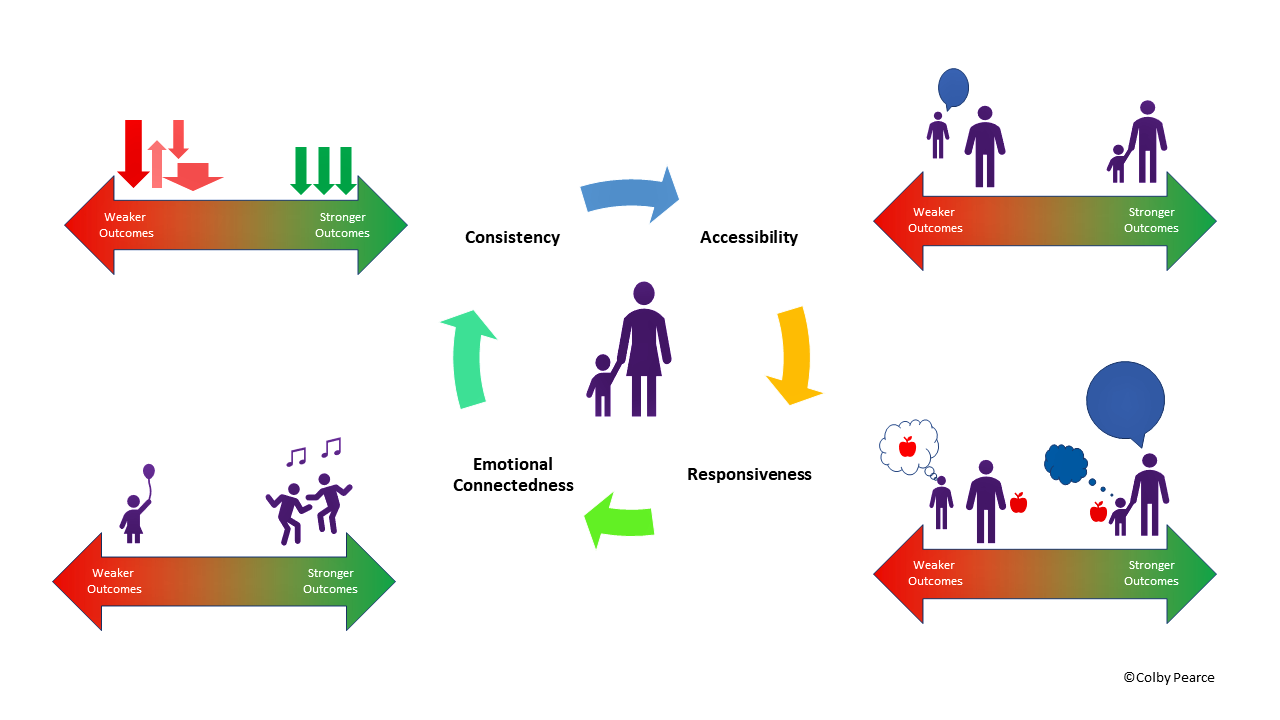
I believe that a lifetime of happiness and fulfillment stems from children developing a secure attachment to their primary caregiver(s) during their preschool years. Secure attachment relationships stem from the infant and young child experiencing their primary caregiver(s) as:
Perhaps the most little known and understood aspect of childhood trauma is the impact inadequate needs provision has on the child’s perception of how their basic human needs will be met in future, and their associated actions to satisfy their needs. Yet, over eighty years of psychology research clearly shows that inadequate and inconsistent parental responsiveness will promote an enduring preoccupation with needs and high rate and great persistence in securing needs provision. The same research also shows that simply changing the conditions for needs provision, such that a parent or caregiver responds consistently to the child’s signals regarding unmet needs, is not sufficient to reduce the child’s preoccupation with historically unmet needs or the rate and persistence of their need-seeking behaviours. So long as the parent or caregiver responds to the child’s signals regarding their needs, the child will continue to believe that they themselves are responsible for their…
Much is being written about empathic care and being in-tune with the needs of children. Below is an excerpt from my book A Short Introduction to Promoting Resilience in Children (London: Jessica Kingsley, 2011), which, itself, is based on material I originally published in A Short Introduction to Attachment and Attachment Disorder (London: Jessica Kingsley, 2009).
To respond with understanding protects against reinforcing unhelpful beliefs about oneself and adults in a caregiving role. Responding to the need as well as the behaviour is one method by which an adult in a caregiving role can respond with understanding. Nearly all human behaviour has a function and purpose and children rarely misbehave for misbehaviour’s sake. Among other things, misbehaviour can serve as an emotional release (such as when children are tired and over aroused) or as a strategy to draw attention to an unmet need. Maladjusted and pre-verbal children are typically unable…
I am often reading and hearing about the frustrations of parents and carers of children with special needs when interfacing with their children’s school. What follows is my attempt to open dialogue with a school that has otherwise proved resistant to accepting and implementing specialist advice about the individual care and management requirements of some of my clients. I am hoping that it creates the possibility for conversation between the school and I. As it happens, the model and strategies I refer to is what I would recommend anyway for the children I see who have experienced family trauma. Let me know what you think.
I am writing to touch base with you in association with my professional involvement with a number of your students.
I anticipate that you field regular requests for special consideration regarding the care and management of individual children at school. I understand that it is often not possible or appropriate to implement special considerations for all children for whom they are sought.
This email is not about my views about what special considerations should be put in place regarding the care and management of the children with whom I am involved.
Rather, I wanted to convey to you my views about school-wide management strategies that are important in building resilience amongst the children at your school.
The fundamental premise of my views about building resilience is the idea that all children have within them the capacity to be resilient.
Resilience stems from regular and repeated experiences of overcoming challenges and achieving feelings of mastery. Feelings of mastery, in turn, promote a resilient mindset.
Children are more likely to accept challenges and experience feelings of mastery, thus developing a resilient mindset, when three important preconditions are met. These are:
That they are calmly alert;
That they trust that there are adults present who understand and support them; and
That they are confident that their needs will be consistently met.
Achieving calm alertness requires that children have a structured day that also incorporates routines, boundaries and regular opportunities for short bursts of vigorous physical activity. Calm alertness is also achieved by exposing children to specific types of auditory input during the day, such as exposing the children to Mozart piano concertos after breaks and prior to the completion of graded work.
Trust is achieved in association with children having the experience that their inner world is understood and important. Children experience their inner world as being understood and important when adults reframe questions as statements about what the child might be thinking or feeling, or what their attitudes and motivations were.
Children’s confidence that their needs will be consistently met is promoted by adults addressing their needs proactively. When a child asks, the child learns important lessons about adult responsiveness. But when an adult responds to the child’s need before they ask, such as attending to the child and offering assistance before the child asks, the child learns learns that their needs are understood and important, and that they can rely on others to respond to their needs without having to go to extraordinary lengths to draw attention to them.
As it happens, I have written a book about promoting resilience in children, which is published in the UK and USA and sold worldwide. The details of the book are as follows:
Pearce, C. (2011). A Short Introduction to Promoting Resilience in Children. London: Jessica Kingsley Publishers.
There is more information about promoting resilience on my website: www.securestart.com.au
Please do not hesitate to contact me if I can be of any further assistance to you or the school in building resilience amongst the children who attend there.

Today, my eight year old son drew my attention to his sore knee, which he bruised falling on stairs at our home yesterday. He has a nice purple bruise in the middle of his knee. When distracted, he walks fine and does not complain about the pain. When his attention is on his knee, he complains of pain and walks with a limp.
As it happens, he complained to me about the pain in his knee this morning. I was tempted to say that it did not look too bad and to remind him that I had seen him walking fine earlier. My intention in making such statements would have been to reassure him that he would be okay. However, I instinctively knew that this would precipitate anger, strong assertions that the pain was significant and further assertions that I was not taking the matter seriously. I also knew that…
Much is being written about empathic care and being in-tune with the needs of children. Below is an excerpt from my book A Short Introduction to Promoting Resilience in Children (London: Jessica Kingsley, 2011), which, itself, is based on material I originally published in A Short Introduction to Attachment and Attachment Disorder (London: Jessica Kingsley, 2009).
To respond with understanding protects against reinforcing unhelpful beliefs about oneself and adults in a caregiving role. Responding to the need as well as the behaviour is one method by which an adult in a caregiving role can respond with understanding. Nearly all human behaviour has a function and purpose and children rarely misbehave for misbehaviour’s sake. Among other things, misbehaviour can serve as an emotional release (such as when children are tired and over aroused) or as a strategy to draw attention to an unmet need. Maladjusted and pre-verbal children are typically unable or unwilling to express their needs directly/verbally and do so through controlling and manipulative behaviours. From their first day, infants draw attention to their needs through affective displays that might later come to be viewed as developmentally inappropriate and socially unacceptable. Nevertheless, they have learnt that crying and screaming is an effective way to draw parental attention. It is not surprising that this broadens to other unacceptable behaviours among toddlers, such as throwing objects, banging doors, turning the TV and lights off and on, and so on. Naughty behaviour typically attracts more attention than good behaviour. When a child is misbehaving it is important to try and work out what unexpressed need might be giving rise to the behaviour rather than simply responding to the behaviour alone. Thereafter, it is important to respond to the need as well as the behaviour. Responding to the need as well as the behaviour is soothing for the child, it reinforces for the child that their caregiver is understanding and responsive, and it is helpful in preserving and promoting secure attachment representations. This process of responding to the need as well as the behaviour is exemplified in the table below (click on link).
Perhaps the most little known and understood aspect of childhood trauma is the impact inadequate needs provision has on the child’s perception of how their basic human needs will be met in future, and their associated actions to satisfy their needs. Yet, over eighty years of psychology research clearly shows that inadequate and inconsistent parental responsiveness will promote an enduring preoccupation with needs and high rate and great persistence in securing needs provision. The same research also shows that simply changing the conditions for needs provision, such that a parent or caregiver responds consistently to the child’s signals regarding unmet needs, is not sufficient to reduce the child’s preoccupation with historically unmet needs or the rate and persistence of their need-seeking behaviours. So long as the parent or caregiver responds to the child’s signals regarding their needs, the child will continue to believe that they themselves are responsible for their needs being met. It is only through responding to the child’s needs proactively (that is, before they do anything to draw attention to their needs) that the child can develop an understanding that their needs are understood and important, and that they can depend on their caregivers to satisfy their needs. The consequences of this change in the child’s perceptions is anxiety reduction and opportunities for mutually-satisfying relationships through the lifespan.
A Tale of Three Mice: An Attachment Story
Once upon a time there were three mice.
The first mouse lived in a house that contained, along with furniture and other household goods and possessions, a lever and a hole in the wall from which food was delivered. Each time the mouse pressed the lever he would receive a tasty morsel of his favourite food. The mouse understood that, when he was hungry, all he had to do was press the lever and food would arrive via the hole. The mouse took great comfort in the predictability of his access to food and only pressed the lever when he was hungry.
The second mouse lived in a similar house, also containing a lever and a hole in the wall from which food was delivered. Unfortunately, the lever in his house was faulty and delivered food on an inconsistent basis when he pressed it, such that he might only receive food via the hole on the first, fifth, seventh, or even the eleventh time he pressed the lever. This mouse learnt that he could not always rely on the lever and that he had to press the lever many times, and even when he was not actually hungry, in order to ensure that he would have food. Even after his lever was fixed he found it difficult to stop pressing it frequently and displayed a habit of storing up food.
The third mouse also lived in a similar house, containing a lever and a hole in the wall from which food was to be delivered. However, the lever in his house did not work at all. He soon learnt that he could not rely on the lever and would have to develop other ways of gaining access to food. This belief persisted, even when he moved to a new home with a fully-functioning lever.
Source: Pearce, C. A Short Introduction to Attachment and Attachment Disorder. London: Jessica Kingsley, 2009
If you like this post, please subscribe to this blog to receive an email notification when other practical ideas and guidance is published.
Join 5,452 other subscribers
You can access more information about my therapeutic parenting programs by clicking the links below:
If you looking for easy-to-read, high quality information about the effects of trauma in primary attachment relationships (hereafter referred to as attachment trauma), and what can be done to treat its effects during childhood, please visit my new page at securestart.com.au.
I prepared this page in order to consolidate three significant articles I have written about children who have experienced trauma in their primary attachment relationships in one location. It is suitable for readers who work with these children in a professional capacity.
I use the term Attachment Trauma to signify that all major schools of thought concerning complex developmental trauma in childhood are deeply embedded in attachment theory, with remediation approaches being similarly embedded in attachment concepts and attachment relationships. It seems a little unfashionable to refer to attachment in the context of child trauma these days, but even subscribers to the neurobiology of trauma literature will find that it relies heavily on attachment theory and attachment relationships for answers about how to remediate the effects of developmental trauma.
While I have your attention, I might also advise that I am in discussion with my publishers, Jessica Kingsley, about writing a book for professionals who work with children who have experienced attachment trauma. Depending on the outcome of these discussions, there may be fewer posts on this site this year.
Before you go, please click here to view my new page at securestart.com.au!
Disclaimer: While great care is taken to ensure that the advice on this site is widely applicable and based on sound psychological science, it may not suit the individual circumstances of all visitors. If you have any concerns about applicability to your circumstances, please consult a qualified professional near to you.