-
Disclaimer: While great care is taken to ensure that the advice on this site is widely applicable and based on sound psychological science, it may not suit the individual circumstances of all visitors. If you have any concerns about applicability to your circumstances, please consult a qualified professional near to you.
-
Join 5,452 other subscribers
Colby Pearce
Search this site
-
Colby on YouTube A practical guide to Attachment & Attachment Disorder

Resilient Kids

-
-
Secure Start – Trauma Informed

Self-Paced Learning Modules

The CARE Curriculum

-

Sister Site
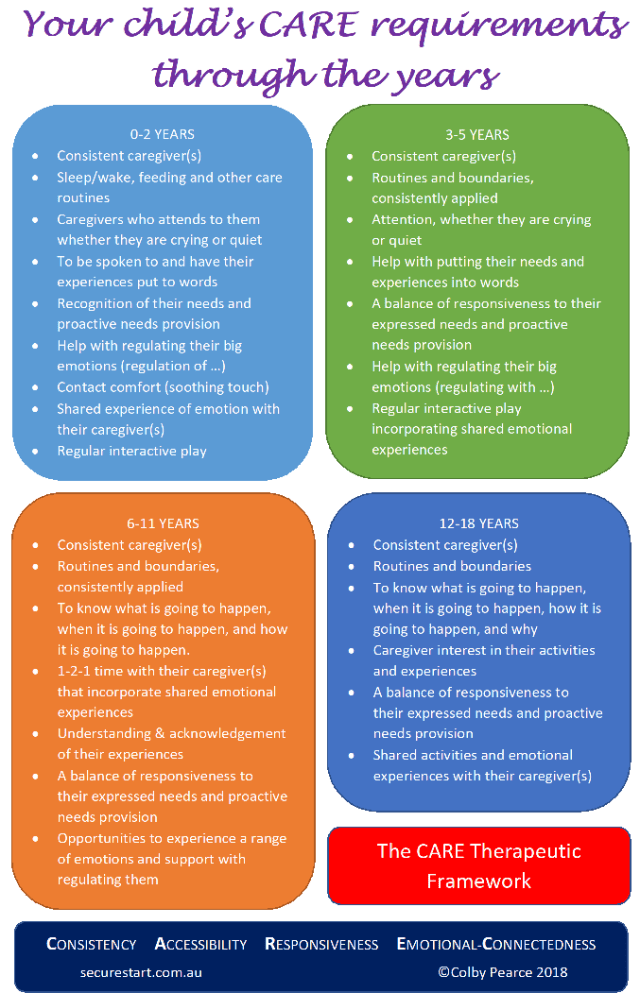
Your child’s CARE requirements through the years
Posted in AAA Caregiving, Adoption, Fostering, Parenting, Uncategorized
|
Tagged adoption, attachment, child development, development, fostercare, kinshipcare, learning, parenting, psychology, relationships, resilience, wellbeing
|
Leave a comment
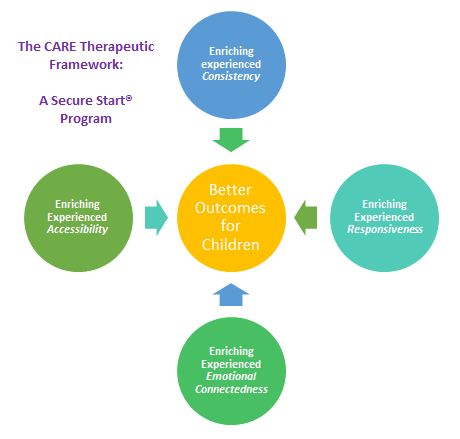
The CARE Therapeutic Framework
Posted in Uncategorized
|
Tagged attachment, development, fostercare, kinshipcare, learning, mentalhealth, parenting, psychology, resilience, socialcare
|
Leave a comment
Triple-A Model of Therapeutic Care
Posted in Uncategorized
|
Tagged attachment, fostercare, kinshipcare, parenting, resilience, socialcare
|
Leave a comment
Four Essential Enrichment Activities to Promote Recovery at School from Interpersonal Trauma
- Greet the child before they do anything to initiate engagement with you.
Greeting children in this way offers them the experience that they are in your thoughts, that they are worthy and that you are accessible. This is necessary as children who have experienced interpersonal trauma have learnt that they cannot rely on others to attend to them and their needs. They also have a low opinion of their worth. Promoting their sense of self-worth and the worth of relationships with others underpins all endeavours to promote recovery from interpersonal trauma. Check in with them proactively throughout the day.
- Tune into the child’s emotions and restore calm.
When the child is happy, allow yourself to feel and project happiness in your interactions with them. When the child is sad or frustrated, show a little of those emotions as well. In doing so you and the child will be connected at an emotional level. Then restore calm. They will remain connected and return to calm themselves. These experiences of emotional connection offer the child experiences that their feelings matter; that they matter; that they are worthy. It also promotes tolerance of, and a return to calm from, a range of emotions.
- Say what is in their head and in their heart.
Observe the child and the situation/activity. Say what you think is their experience of the situation/activity. Make it a statement. Say it with congruent feeling. Speak their mind. Communicating in this way offers the child an enriched experience that they are understood, that their experience matters, and that they matter. Do not ask questions, as questions communicate that you do not know them.
- Develop a ritual involving one-to-one time.
Plan to spend five minutes per day of one-to-one time with the child. Do it in a routine and predictable way, such as at a certain time of the day. This satisfies a number of important needs the child has, including their needs for attention and order. Help them with a task or play a simple card game with them. Tune into their emotions and say what is in their head and in their heart (enrichment activities 2 and 3). If you play a game of Uno, play their hand. Match your emotions and your words to their experience of the game.
For more information about the thinking behind these enrichment activities visit securestart.com.au or email Colby at colby@securestart.com.au.
Posted in Uncategorized
|
Tagged AAA caregiving, adelaide child psychologist, adoption, attachment, Attachment Disorder, behaviour management, behaviour problems, child psychologist, child psychologist Adelaide, child trauma, Education, educator, fostercare, fostering, mental health, parenting, post adoption suppprt, resilience, schools, Social Care, therapeutic foster care, wellbeing
|
Leave a comment
Therapeutic caregiving – why conventional is vital
We know that . . .
We do that . . .
These are all-too-familiar responses to endeavours to promote conventional aspects of caregiving and relating as part of a therapeutic approach to the care of children who are experiencing, or who have experienced, adverse life events and adversity.
So why recommend conventional approaches to caregiving and relating as part of a therapeutic approach to care?
In my opinion, recommending conventional approaches to caregiving and relating represents our best chance of promoting a common language and understanding among adults in a care and management role across environments (eg home and school) and consistency in their implementation across time.
Consistency is vital to the care of children recovering from adverse life events and adversity*. Consistency of care experiences represents the optimal condition for new learning; including learning that they are good, capable and deserving, that adults are reliable and dependable, and that the world is predictable and safe place. Inconsistency mimics the circumstances under which adverse life events and adversity occurs, thus perpetuating their negative impacts on the developing child.
Recommending conventional approaches to caregiving and relating that are therapeutic reassures caregivers that they are a person of worth and that their efforts on behalf of the child are worthwhile. Not only is it intended to be validating, but a process is facilitated whereby the caregiver becomes more aware of those occasions when they exhibit the therapeutic caregiving or relational behaviour and, in turn the response of the child. Therapeutic caregiving and relational behaviours are anticipated to promote a positive response in the child, which is rewarding and reinforcing of the behaviour. Rewarded behaviour remains in the caregivers repertoire, thus promoting consistency in the child’s experience of care, and facilitating conscious adherence to a therapeutic care approach.
Recommending conventional approaches to caregiving and relating that are therapeutic for children promotes feelings of self-efficacy and wellbeing for caregivers, which are vital to the longevity of their endeavours. As these therapeutic aspects of caregiving and relating are rewarded both intrinsically (the caregivers experience) and extrinsically (the child’s reaction), they become consistent and predictable aspects of the child’s experience of care.
Recommending conventional approaches to caregiving and relating that are therapeutic for children enriches their lives, and those of their caregivers.
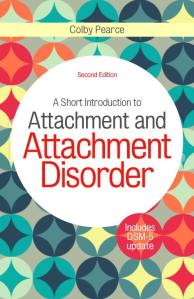
*Pearce, C. (2016), A Short Introduction to Attachment and Attachment Disorder (Second Edition), London & New York: Jessica Kingsley Publishers
Posted in AAA Caregiving, Adoption, Attachment, Fostering, Parenting, Schools, Trauma, Wellbeing
|
Tagged AAA caregiving, AAA parenting, adoption, attachment, Attachment Disorder, child psychologist Adelaide, childrens behaviour, foster care, fostercare, fostering, kinship care, parenting, residential care, Social Care, therapeutic foster care, trauma
|
Leave a comment
Parental CARE: Implications for Attachment Security and Disorders
A webinar with Colby Pearce
Saturday 20 May 2017, 10.00am – 1.00pm, London, UK time
In the same way that an infant’s attachments develop in association with their experience of who cares for them, the type of attachment relationship or attachment style is dependent on the type of care they receive. At this practical and engaging webinar, we carefully examine the inextricable linkages between quality of caregiving and developmental pathways for both attachment security and attachment disorders. Colby Pearce helps us conceptualize these linkages by using a descriptive model that refers to the consistency, accessibility, responsiveness and emotional connectedness (CARE) of caregiving experiences and explains how each of these aspects impact not just developmental pathways, self-conceptualization, social relatedness and adversity resilience; but also aid our understanding of the two main forms of attachment disorders according to DSM-5: Reactive Attachment Disorder (RAD) and Disinhibited Social Engagement Disorder (DSED).
Through case vignettes and interactive discussions, the webinar helps us comprehend:
- how deficits in the CARE model can explain the development of attachment disorders
- why we observe compulsive re-enactment of maladaptive interactions when care arrangements change
- in therapeutic settings, how we can interpret the exhibition of controlling, manipulative and / or deceptive and deceitful behaviours
- the situations where caregivers can experience feelings of revulsion and loathing towards the attachment-disordered careseeker
- when grossly deficient CARE may be the best explanation for disturbed presentations (RAD and DSED)
- how the tenets of CARE can be built into our therapeutic engagements
The webinar will be especially useful for psychotherapists, psychologists and counsellors who are interested in learning how to integrate specific attachment-related interventions in their work with clients.
Colby Pearce is an Australian Clinical Psychologist, author and consultant. Across a career spanning more than twenty-five years he has made important contributions to professional endeavours in the fields of child and adolescent mental health research, child protection and therapeutic child care. He is the author of two books and a number of periodical articles, though he considers that the recently-released second edition of A Short Introduction to Attachment and Attachment Disorder (Jessica Kingsley Publishers) should count as a third book; such is the extent to which the first edition has been revised and updated. He consults in Australia and in Ireland and has extensive experience in teaching and training professional audiences. He is the author of the Triple-A Model of Therapeutic Care, which is currently being implemented in Donegal, Ireland, as part of a three-year programme of support for foster carers.
Webinar Schedule:
9.45am: Online Registration
10.00am: Session 1: Parental CARE, Attachment Security and Attachment Disorders
- The basic tenets of the CARE model
- Developmental pathway implications
- What do Attachment Disorders look like?
- CARE and Attachment
- CARE and Arousal
- CARE and Learning
11:30am: Break
11:45am: Session 2: Enriched CARE for better outcomes
- Maladjustment and the role of promoting Attachment Security
- Holding appropriate developmental expectations
- Proactive needs provision
- The prerequisites for Attachment Oriented Therapy
- Illustrative case examples and discussion
1:00pm: Close
To register, visit: http://www.nscience.co.uk/20-may-2017-webinar.html
Posted in Adoption, Attachment, Fostering, Parenting
|
Tagged adelaide child psychologist, adoption, attachment, Attachment Disorder, attachment therapy, child psychologist, child psychologist Adelaide, child trauma, fostercare, fostering, kinship care, parenting, psychology, residential care, resilience, therapeutic care, therapeutic foster care, therapeutic fostering, wellbeing
|
Leave a comment
CARERS must CARE – Lessons on attachment from Colby Pearce
It was such a privilege to be asked recently to write a review for Colby Pearce’s second edition of a ‘Short Introduction to Attachment and Attachment Disorder’.
Colby Pearce is one of the leading experts in attachment and as a clinical psychologist, he has interacted with hundreds of children over his long career. His writing is informed by his considerable experience and he has a huge amount of empathy with children who have experienced early childhood trauma.
I want to summarise just a few of the core insights on attachment from this latest guide.
- Attachment is the term used to describe the dependency relationship children develop towards their primary caregivers.
- An attachment figure is someone who provides physical and emotional care, has continuity and consistency in the child’s life, and is emotionally invested in the child.
- Human infants are not born with attachments already in place with their primary caregivers. This special relationship emerges over time.
- Attachment theory was developed by John Bowlby and colleagues to describe the relational variables in the development of the mother infant relationship and the importance of the relationship itself on the successful adaptation of the young child to life more generally.
- Children can form multiple attachment relationships.
- Infants form attachment to the person or persons who they experience to care for them physically and emotionally on a continuous period.
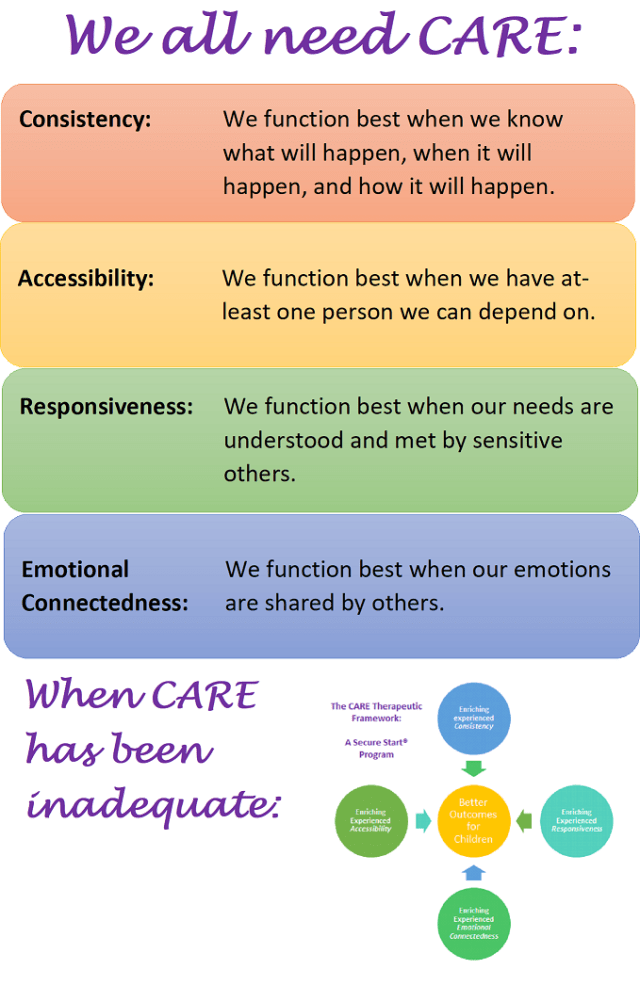
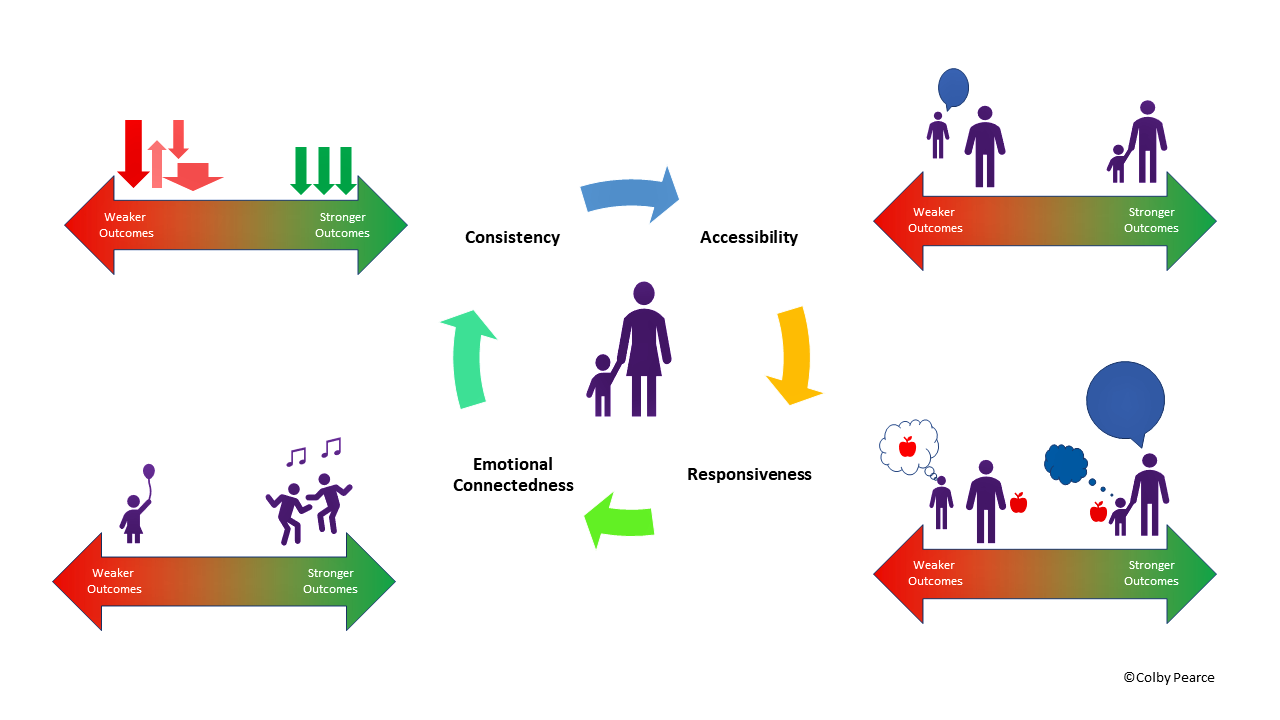
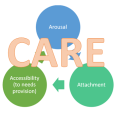
- Pearce Identified that carers must be experienced by the child as Consistent, Accessible Responsive and Emotionally connected. Hence his C.A.R.E. model:
C – Consistent -consistent care is where an action is consistently followed by a desired outcome.
A – Accessible care means the parent is present and available physically and emotionally to the growing child.
R – Responsive carers accurately interpret the child’s signals and directly address their needs
E – Emotionally connected carers “tune in” to the infant and reflect a similar emotion back.
(Tronick’s ‘still face’ experiments vividly demonstrate the distress experienced by youngsters when a previously playful parent adopts a ‘dead pan’ expression and stops engaging with the child)
- Early attachment experiences contribute to a child’s sense of self and self-worth. It also forms the basis for future relationships as, if children experience parents to be consistent, accessible, responsive and emotionally connected, they will develop emotional resilience in their engagement with the rest of their world.
Having established the basis for healthy attachment, Pearce goes on to consider how attachment can be disrupted through early childhood experiences of abuse, neglect and other trauma. He offers effective forms of treatment for attachment disorders.
This is an essential read for Social Workers, teachers, foster carers and residential care staff. It is available from Jessica Kingsley Publishers: http://www.jkp.com/uk/a-short-introduction-to-attachment-and-attachment-disorder-second-edition-34523.html
Lynne Peyton
(Lynne is a childcare expert, leadership coach and consultant to social welfare organisations. Lynne consults internationally. and is the author of Tackling Childhood Neglect: http://www.lynnepeyton.com/audiobook)
Originally published here: http://www.lynnepeyton.com/single-post/2017/04/19/CARERS-must-CARE-%E2%80%93-Lessons-on-attachment-from-Colby-Pearse
If you found the content of this article interesting and/or useful, please share it using the sharing buttons below.
Please subscribe to this blog to receive further articles when they become available. Click “Follow” in the side bar.
You can access more information about my programs by clicking the links below:
Triple-A Model of Therapeutic Care
The CARE Therapeutic Framework
Helping Children and Young People Realise their Potential
Another place way to connect with my work is to follow one or more of my pages on Facebook:
To Connect with me on LinkedIn or Twitter click below:
Posted in Book Reviews, Fostering
|
Tagged abuse, adoption, attachment, Attachment Disorder, child psychologist Adelaide, Education, foster care, health, kinship care, mental health, psychology, RAD, residential care, resilience, reviews, Social Care, Social Work, trauma
|
Leave a comment
Foster Carers report Model of Care Interesting and Helpful
The Health Information and Quality Authority (HIQA) is an independent authority established to drive high-quality and safe care for people using health and social care services in Ireland. HIQA monitors foster care services against the National Standards for Foster Care, published by the Department of Health and Children in 2003.
In September and October 2016 HIQA conducted an assessment of foster care services in Donegal, Ireland. This is what HIQA said about the implementation of the Triple-A Model of Therapeutic Care to foster carers in Donegal:
The area had also recently piloted training in a particular therapeutic model of care with 22 of their foster carers. This model focused on helping foster carers create a care environment where they were emotionally available to children in care in order to help them create healthy attachments based on trust. Foster carers who had completed the course told inspectors they found it interesting and helpful in their role as foster carers. Social workers received training in the model of care during the course of the inspection and there were plans to extend this training to all foster carers.
For the full report follow this link: https://www.hiqa.ie/system/files?file=inspectionreports/4393-foster%20care-donegal-23-September-2016.pdf
Posted in Adoption, Attachment, Fostering, Parenting, Trauma
|
Tagged adoption, development, foster care, foster care support, health, kinship care, mental health, Model of Care, psychology, residential care, Social Care, sport, therapeutic fostering
|
Leave a comment
Therapeutic Childcare – The CARE Approach
Earlier this year I set about revising and updating A Short Introduction to Attachment and Attachment Disorder. The second edition is available from December 2016. As part of the revision process I considered what we might mean when talking about therapeutic care of children. This is the CARE Model I came up with:
Be Consistent – Children develop and learn (including new ways of relating) best in a stable care environment where there is consistency in caregiver approach to the child’s care and management across caregivers and across time.
Be Accessible – Children benefit from an enriched experience that their carers are available to them. They learn this best when carers attend to them before the child has done anything to draw attention to themselves.
Be Responsive – Children benefit from an enriched experience that their inner world is understood and their needs will be responded to without them having to go to great lengths to make it so; either through behaviour that communicates internal states or inordinately demanding or deceptive behaviour to secure a response to basic needs (such as the need for attention, acceptance and physical sustenance). Communicating understanding of their inner world in words used by their caregiver and through proactive needs provision is vital for enriching the child’s experience and new learning about caregiver responsiveness.
Be Emotionally-Connected – Children benefit from the experience that their emotions are felt by their caregivers. Their experience of connection is enhanced and the foundations for empathy and self-regulation are promoted. Through their caregivers making an emotional connection with the child’s emotions and restoring calm themselves, the child will themselves be calmed, with the result that the child will to explore a range of emotions (thereby promoting emotional growth) and develop their own capacity for self-regulation of emotion.
For more information about the CARE model and the CARE approach, secure the revised and updated second edition of A Short Introduction to Attachment and Attachment Disorder, available December 2016.
Posted in AAA Caregiving, Adoption, Attachment, Fostering, Parenting
|
Tagged attachment, Attachment Disorder, child psychologist, child psychologist Adelaide, child trauma, foster care, fostercare, fostering, kinship care, mental health, parenting, psychology, residential care, resilience, therapeutic foster care, wellbeing
|
Leave a comment