What follows is a media release for the event at which I spoke on Thursday the 22nd of October in Castleblayney, Co. Monaghan, Ireland. The clip to the right is the article in The Northern Standard that appeared on 31/10/15.
PROACTIVE NEEDS PROVISION VITAL FOR RECOVERY FROM CHILD ABUSE
Preventing the abuse and neglect of children is one of the great imperatives of our time. Helping children who are victims of abuse and neglect to recover and lead happy and productive lives is just as important.
‘Few acts committed in anger or ignorance have such far-reaching negative consequences than the abuse and neglect of children’ says Australian Clinical Psychologist, Colby Pearce.
Also referred to as ‘Complex Developmental Trauma’, child abuse and neglect negatively affects children’s developmental trajectory. Too often the result is lifelong difficulties and deficient care of their own children.
‘A key aspect of preventing the abuse and neglect of future generations of children is helping their parents recover from their own abuse now, while they are still children themselves’, says Pearce. ‘In doing so we change the path of their lives and, potentially, those of their children’.
Pearce is the author of the Triple-A Model of Therapeutic Care, an approach to the care and management of children affected by abuse and neglect. Triple-A, for short, extends what we know and is widely practised in the care of children in out-of-home care.
‘Across twenty-years as a clinician working with children who have experienced abuse and neglect I have observed them to remain intensely preoccupied with controlling and managing their environment, including adults with whom they come into contact, even after they are placed in stable and loving homes. A recent survey we conducted of carers of children in out-of-home care supports this’, says Pearce.
‘Children recovering from abuse and neglect are often incredibly demanding and preoccupied with their needs. Too often, the result is the breakdown of both home and education placements, thus compounding the effects of their early trauma’.
Triple-A extends current thinking and practice to include consideration of what children learn about how to get their needs met while in an abusive and neglectful environment, and how to combat this through conventional approaches to the care of children.
‘Responding to the child’s efforts to achieve satisfaction of their needs teaches the child very little that is useful about the caregiver’s sensitivity and responsiveness. Too often, caregivers feel overwhelmed by the child’s enduring preoccupation with their needs and placements break down. Children achieve new learning that their needs are understood, important and will be responded to without them having to go to great lengths to make it so when their needs are addressed proactively; that is, before they ask’ says Pearce.
In Triple-A, there is an emphasis on conventional approaches to caregiving that are particularly useful in promoting recovery from abuse and neglect.
‘It is important that carers of children who have experienced abuse and neglect are offered advice that draws on their existing skills and practices. Only then will they feel like they have already been making a positive contribution to the recovery of the child or children in their care and continue to implement such practices in a way that further promotes recovery’, says Pearce.
Pearce will be sharing his ideas about promoting children’s recovery from abuse and neglect at the Castleblayney Wellbeing Centre on Thursday the 22nd of October 2015.
The Triple-A Model of Therapeutic Care is approved for implementation in Co. Donegal with the support of TUSLA (Child and Family Agency).
Colby Pearce is an Australian Clinical Psychologist and author of two books, including the bestseller A Short Introduction to Attachment and Attachment Disorder. For more information about Colby or to contact him visit: www.securestart.com.au.
The following is an excerpt from Carr, S. (2013). Attachment in Sport, Exercise and Wellness. Routledge: London and New York (pp 1-2)
Some months ago a graduate student came to my office visibly excited after reading the prologue section in Colby Pearce’s (2009) text A Short Introduction to Attachment and Attachment Disorder. The student felt that although he had been studying attachment theory for a number of years he was so intensely focused upon its numerous intricacies and nuances that he had failed to recognise the striking simplicity that underpins this complexity. With Pearce’s permission, I make no apologies for paraphrasing his excellent example below. I agree with my graduate student’s initial interpretation.
Pearce (2009) recites a story about three mice. The first mouse resided in a comfortable house that was furnished and supplied with modern conveniences. Inside the house was a button and a hole in the wall and the mouse was able to press the button to receive tasty food through the hole. The mechanism worked well and the mouse appreciated that when he was hungry he would be able to press the button and consistently receive his food. It was comforting to have this knowledge and the mouse liked the predictable nature of his button, only tending to press it when he really needed food.
In contrast, the second mouse (who lived in an identical house) had the misfortune of dealing with a faulty button mechanism. That is, pressing his button only resulted in food being delivered some of the time. There was no predictability to the button mechanism and on some occasions he would receive food immediately on pressing the button whereas on others he would be required to press it 10 or 20 times. At other times it seemed that no matter how often he pressed it nothing was ever going to happen. His distrust of the button led him to be preoccupied with pressing it, even when he was not actually hungry. He would press it many, many times in order to ensure he would have food when he did grow hungry. When the button was fixed he found it hard to trust that it was now in good working order and spent much time storing up food for a rainy day.
Finally, the third mouse lived in a house with a button that consistently failed to work. In short, he never received any food from his button. He quickly came to the understanding that access to food would require him to employ other means and had no belief in the utility of the button. Even when he moved home and found a house with an effectively functioning button his lack of faith in buttons persisted and he continued to find food the way he always had.
The above story highlights how attachment theory can be seen to be grounded in simple assumptions that retain remarkable logical sense even when talk of mice and food is substituted for young children, emotional care, and security. Pearce (2009) has cleverly recognised this in his prologue. However, although there are some simple logical principles at the core of attachment theory, the fact that Bowlby (1969/1982, 1973, 1980) required close to 1000 pages to articulate his ideas suggests that there are complexities, assumptions, and arguments that cannot be overlooked if one is to begin to develop a fuller understanding of Bowlby’s position. Furthermore, given that attachment theory has been intuitively appealing to researchers whose ideas are allied to contrasting paradigmatic approaches (e.g. Pearce’s example seems couched in behaviourist principles – but attachment theory also reflects ideas that resemble other schools of thought) and from various disciplines it is unsurprising that further methodological and conceptual intricacies have arisen as the ideas have been nurtured and developed according to the assumptions of differing schools of thought.
If you found the content of this article interesting and/or useful, please share it using the sharing buttons below.
Please subscribe to this blog to receive further articles when they become available.
Join 5,447 other subscribers
Follow the links below to my two new resources supporting consistency of care and effective communication between home and school for children recovering from a tough start to life:
By: Tara Hearne (Psychology Intern at Secure Start®) and Colby Pearce
Relational styles in children can be broken down into four main categories:
Secure
A child with a secure relational style has an established sense of trust in their primary caregivers and the world. They feel safe in being able to interact with others and explore their environment with their caregiver acting as a secure base. Children with a secure relational style may show distress at being left by their caregiver but on their caregivers return, are easily comforted and return quickly back to play and exploration. Secure children feel comfortable expressing their emotions and seek and accept comfort from their caregivers when feeling distressed. These children have a positive view of themselves and others.
Insecure-avoidant
A child with an insecure-avoidant relational style typically does not show overt signs of distress when left by their caregivers and will avoid contact on their return. They usually show no preference between their caregivers and strangers. Children with an insecure-avoidant relational style appear to be self-reliant and often prefer solitary play. Insecure-avoidant children typically do not seek out comfort when distressed and will usually resist comfort (avert their gaze or fail to return a hug) when it is offered. These children tend to have a positive view of themselves and a negative view of others.
Insecure-ambivalent
A child with an insecure-ambivalent relational style has a low threshold for distress while also anticipating that comfort will not be forthcoming. They are excessively clingy to their caregivers and upon separation show obvious distress. When their caregiver returns they are not easily comforted and become obsessed with them, oscillating between wanting closeness and feeling angry with their caregiver. Insecure-ambivalent children are often seen as demanding, clingy, immature, angry and easily overwhelmed by their emotions. These children tend to have a negative view of themselves and a positive view of others.
Disorganised
A child with a disorganised relational style often displays inconsistent, contradictory and varied behaviour in response to their caregivers. When reunited with their caregiver, they may greet them but with their gaze averted or by turning away straight after greeting them. They may seek out their caregiver to engage with or be comforted by them but disengage from them immediately after – in a push-pull (“I want you but I don’t want you”) method of interaction. Disorganised children allow their caregiver to hold them but with their limbs stiff or eyes averted. Externalising, disruptive and aggressive behaviours tend to be the predominately seen behaviour problems in children with a disorganised relational style. These children tend to have a negative view of themselves and others.
Relationship style prevalence and contributing factors for children with a disability
Studies have found that prevalence of secure relationship styles seen in children with a disability tend to be somewhat lower (50%) than for typically developing children (60%). It was also found that if children with a disability did not have a secure relationship style, it was most likely to be disorganised. This is seen at a rate about the same as that of typically developing children who have experiences early relational trauma or adverse childhood experiences (ACEs).
The higher rate of disorganised relational style seen in children with a disability is thought to be, in part, a function of stress. Due to physical and cognitive constraints, they have difficulties with everyday tasks and difficulties with judging and dealing with everyday situations. Given these difficulties, it is often the case that children with a disability experience themselves to have limited control over their life and individual circumstances, which can lead to feelings of incompetence and helplessness. In turn, this can cause the child to have a near constant feeling of stress.
Frequent and sustained stress can lead to an almost permanent state of activation of the biological stress response. Prolonged activation of the stress response leads to a depleted ability to cope with even low levels of irritation. This stress response reaction may contribute to the higher prevalence of disorganised relational styles seen in children with a disability. Furthermore, it helps to explain why the rates of disorganised relationships are similar to that of children who have experienced relational trauma – owing, in part, to over-activation of the stress response and sustained feelings of helplessness in both cases.
As well as a heightened stress response, children with a disability may have difficulties early in life with relational/social behaviours. They may be delayed in their ability to exhibit attachment-related behaviours such as smiling, approaching and vocalising, making it more difficult for caregivers to interpret the needs of the child. This can lead to less responsiveness from caregivers in a negative feedback loop – the less the child shows attachment related behaviours, the less the parent responds, then the less the child responds and so on it goes.
The increased level of care children with a disability need, coupled with the inability of the child to respond to interactions in a meaningful way, intensifies the stress felt by both child and caregiver. This, in turn, can negatively impact secure caregiver-child relationship development. In short, children with a disability behave differently to typically developing children; therefore, more is required of caregivers in regards to relationship development and maintenance. Therapeutic relationship enrichment can assist in promoting and enhancing the caregiver-child relationship. The Triple-A Model of Therapeutic Care and the CARE Therapeutic Framework offer simple, practical, back-to-basics care strategies intended to promote secure relational styles between all children and those who care for them.
If you found the information in this article useful, please share it using the sharing buttons below.
Please also subscribeto this blog to receive further ideas and guidance when it becomes available.
Join 5,447 other subscribers
Follow the links below to my two new resources supporting consistency of care and effective communication between home and school for children recovering from a tough start to life:
Bartholomew, K. (1990). Avoidance of intimacy: An attachment perspective. Journal of Social and Personal Relationships, 7, 147-178.
Brennan, K.A., Clark, C.L., & Shaver, P.R. (1998). Self report measurement of adult attachment.. In J. A. Simpson & W. S. Rholes (Eds.), Attachment Theory and Close Relationships (pp. 46-76). New York: Guilford Press. Janssen, C. G. C., Schuengel, C., & Stolk, J. (2002). Understanding challenging behaviour in people with severe and profound intellectual disability: A stress-attachment model. Journal of Intellectual Disability, 46(6), 445-453.
Malekpour, M. (2007). Effects of attachment on early and later development. The British Journal of Developmental Disabilities, 53(105), 81-95.
Schuengel, C., Schipper, J. C., Sterkenburg, P. S., & Kef, S. (2013). Attachment, intellectual disabilities and mental health: Research, assessment and intervention. Journal of Applied Research in Intellectual Disabilities, 26, 34-46.
Conventional behaviour management, as it is widely used in the care and management of children, incorporates three main techniques:
Reinforcement of wanted or desired behaviours;
Punishment of unwanted or undesirable behaviours; and
Extinction of unwanted or undesirable behaviours by ignoring or otherwise removing the intended outcome (reward/reinforcer) for such behaviours.
The psychological science behind these techniques comes from the Operant Conditioning Paradigm. Developed by academic psychologist B. F. Skinner in the 1930’s, the Operant Conditioning Paradigm asserts that a behaviour becomes part of an individual’s repertoire if in its action the individual receives some form of desired or desirable reward or achieves a desired outcome.
Think of a conventional school classroom. Children learn that in order to gain the attention and assistance of the teacher they must raise their hand. When they raise their hand they are rewarded with the teacher’s attention and assistance. Of course, during their early schooling children are told that this is the behaviour they must perform in order to gain the teacher’s attention and assistance. They are reminded to do so when they call out or seek the teacher’s attention and assistance by other, less desirable means. Children also see other children raise their hand and gain attention and assistance from the teacher (a.k.a. social learning). But what if the teacher did not respond to hands being raised or only responded sometimes? Would raising one’s hand become part of a child’s behavioural repertoire to gain the teacher’s attention and assistance?
The answer to this questions lies in the three main conditions under which an action was reinforced (or not) in the original operant conditioning experiments. In these experiments in the 1930’s rats and pigeons were placed in an experimental apparatus called a Skinner Box. The Skinner Box was a plain box with a lever or button and a chute. The chute was connected to a feed bottle located above the Skinner Box. The apparatus was set up to release a food reward (or not) via the chute in response to presses of the button or lever. The basic experiment involved seeing how well the animals learnt to press the button or lever under different reinforcement conditions. The reinforcement conditions were as follows:
Consistent (or Continuous) Reinforcement, whereby the animal received a food reward for every press of the button or lever;
Inconsistent Reinforcement, whereby the animal received a food reward sometimes but not others when they pressed the button or lever; and
No Reinforcement, whereby the animal never received a food reward for presses of the button or lever.
Animals in condition 1 soon learnt to press the button or lever in order to access a food reward. Once they had learnt this, these animals appeared to only press the button or lever when food was required.
Animals in condition 2 were slow to learn to press the button or lever to access a food reward. Once learnt, these animals pressed the bar or lever at a higher rate and with greater persistence than the animals in condition 1.
Animals in condition 3 soon lost interest in the button or lever and never learnt to access food by pressing the button or lever.
What has all this got to do with human children? Apart from remembering that we too are animals, think of the infant’s acquisition of spoken language. The infant babbles and occasionally makes a noise that approximates a word. Perhaps, in imitation of what they hear from their mother-figure, that noise is “mu” or “ma”. The response of the mother-figure is typically delight and the bestowing of attention on the infant. The infant is rewarded for uttering “mu” or “ma” and, repeated consistently enough, the infant learns to secure their mother-figure’s attention and delight by saying “mu” or “ma”. Such is the beginning of language acquisition.
So, in terms of behaviour management, children learn new, wanted and desired behaviours most quickly, and only perform such behaviours when required or it is desirable to do so, when the behaviour is consistently reinforced/rewarded. Where the behaviour is reinforced inconsistently, the children are slow to learn and, when they do, they are prone to engaging in the behaviour with high rate and great persistence, which can be a problem. If it is never rewarded/reinforced, they never learn.
Punishment works differently. Punishment involves substituting the desirable reinforcer/reward for something undesirable for a behaviour that has already gone through an operant conditioning process. In further research Skinner delivered an electric shock to rats instead of the food reward. Referred to as aversive conditioning, the rats in these experiments soon stopped pressing the lever. However, in subsequent research Skinner was also able to demonstrate that the rats experienced a significant fear response as a result of being shocked for presses of the lever. In humans, fear impairs learning and can precipitate undesirable behaviours associated with the fight-flight-freeze response, thereby negating the benefits of punishment. In addition, punishment is less effective at stopping an unwanted or undesired behaviour when it is delivered inconsistently.
Ignoring the unwanted or undesirable behaviour that has already gone through a conditioning process, also called extinction, is the third behaviour management technique referred to above. In operant conditioning terms, it involves taking away the reward/reinforcer. In further research involving rats and pigeons that had learnt to press the button or lever under conditions of either consistent or inconsistent reinforcement, the food reward was taken away. What happened next is, from my perspective, one of the most interesting and least widely known aspects of the operant conditioning paradigm. As you might expect, the rats and pigeon’s who originally received a food reward for each and every press of the button or lever were quick to learn that conditions had changed and soon stopped pressing the button or lever when the behaviour was no longer reinforced. In contrast, the rats and pigeons whose behaviour developed under inconsistent reinforcement conditions were slow to learn that conditions had changed and continued to press the button or lever with a high rate and great persistence.
In behaviour management terms, extinction works best when the unwanted or undesirable behaviour was originally rewarded/reinforced on a consistent basis and when the reward/reinforcer is taken away completely. Extinction is less successful when the unwanted or undesirable behaviour was rewarded/reinforced on an inconsistent basis. The child is slow to learn that conditions have changed and will continue to display the unwanted or undesirable behaviour at a high rate and great persistence, giving the impression that extinction is not working.
What is worse, if you cannot ignore (or remove the reinforcer) or punish the unwanted or undesirable behaviour consistently, the child and their behaviour is on an inconsistent reinforcement paradigm; meaning that they will continue to perform the unwanted or undesirable behaviour in anticipation of it being rewarded/reinforced at least some of the time.
Behaviour management is further complicated by the fact that, for many children, their unwanted/undesirable behaviours developed under conditions of inconsistent reinforcement; as is the case in children raised in chaotic households or where abuse and neglect are a feature. These latter children might view punishment and extinction as desired outcomes of their behaviour, though abused and neglected children are also more likely to exhibit undesirable behaviours associated with activation of the fight-flight-freeze response when they are punished or denied access to a desired outcome.
Adults in a caregiving role with children cannot rely solely on conventional behaviour management to address all unwanted or undesirable behaviours. Fortunately, there are other, effective ways to promote positive behaviour in children. These are the subject of much of my written work and the programs referenced below.
If you found the information in this article useful, please share it using the sharing buttons below.
Please also subscribe to this blog to receive further ideas and guidance when it becomes available.
Follow the links below to my two new resources supporting consistency of care and effective communication between home and school for children recovering from a tough start to life:
A great deal of scientific and social endeavour is expended on preventing suicide. Few losses evoke emotions in others as much as a person’s death by their own hand.
A person’s suicide evokes predictable questions: Why did they not confide in someone? Why did they not ask for help? Why did their feel so alone?
The suicide of a young person is especially poignant.
Twenty-five years ago there was a spike in media attention on the purported role of music in suicide among teens. Much speculation centred on the possible contribution of heavy metal music to teen suicide.
Against this backdrop of media interest, a small group of researchers in Adelaide, South Australia, were studying the role of music preference as an indicator of vulnerability to suicide among teens. This research, which was published in 1993 in the Journal of the American Academy of Child and Adolescent Psychiatry, could not and did not allocate a causative role to certain music preferences in teen suicidal behaviour. Rather, what the research showed was that teens who acknowledged unconventional music preferences, such as teenage girls who acknowledged a preference for hard rock and heavy metal music, were more likely to also acknowledge having engaged in suicidal behaviour than those with more conventional preferences.
Certain types of music do not necessarily cause teens to resort to suicide. Rather, music preference may be seen to reflect how connected an individual feels to mainstream interests, ideals and values. Connection to the mainstream plays an important role in regulating emotions and behaviours. When a teen feels disconnected from the mainstream they are at-risk of feeling isolated and alone and of resorting to unconventional behaviours that are not socially-sanctioned to resolve personal difficulties. They may even form new groups or subcultures with other lonely, isolated and disenfranchised individuals, where the behaviour of the new group is not regulated by conventional ideals and standards of behaviour.
Such is what occurs with suicide.
Suicide among teens can be prevented.
Suicide among teens can be prevented by all of us taking active steps to connect with those who are lonely and isolated; by taking the time to engage with them and see the world through their eyes; to communicate understanding of their experiences – their thoughts, their feelings, their interests.
Only then will they feel understood.
Only then will they feel like a valid person.
Only then will they feel connected to something bigger than themselves.
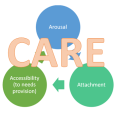
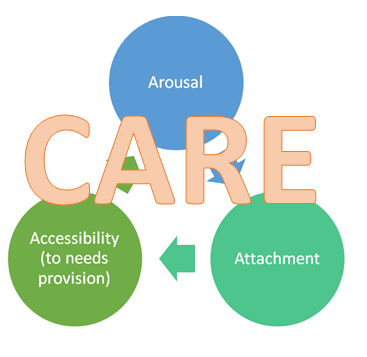
Attachment (science of relationships and social-emotional development)
Arousal (psychophysiology of emotion and behaviour activations systems – a.k.a. “Neurobiology of Trauma”)
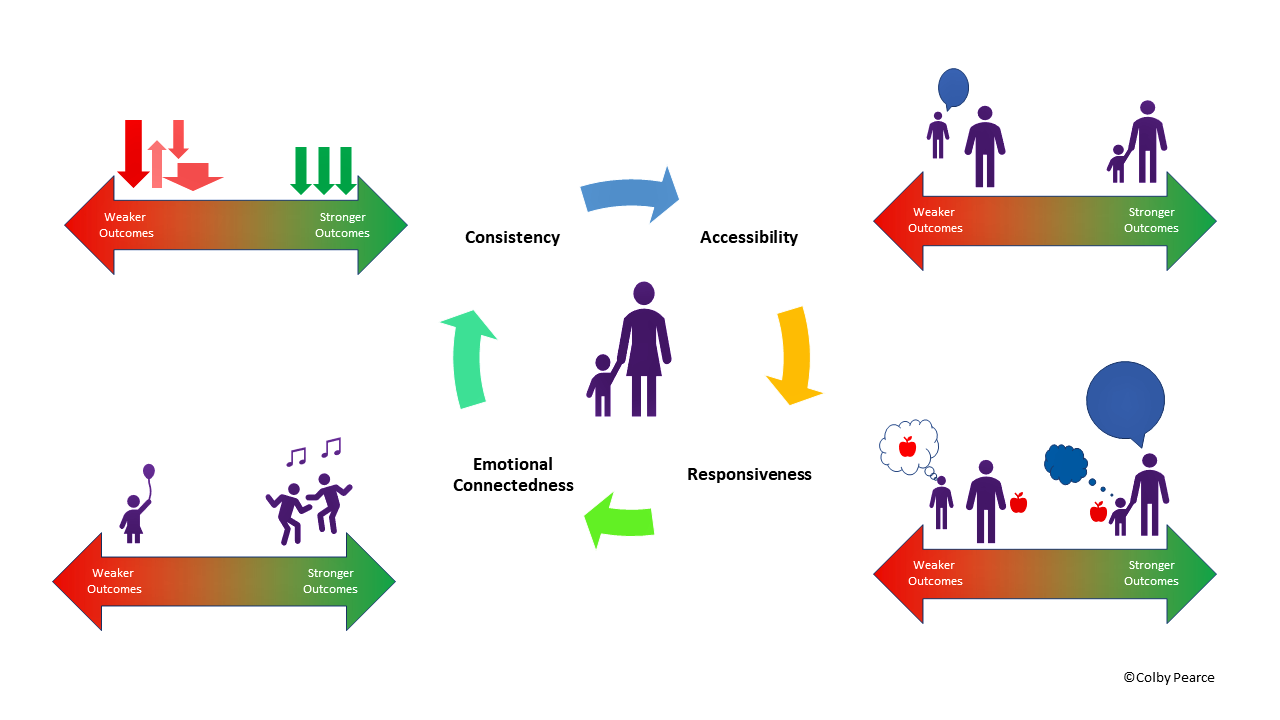
Accessibility to needs provision (science of human behaviour).
The Triple-A Model of Therapeutic Care represents an integration of twenty-five years of endeavour as an applied researcher, clinician, teacher and writer by author and Clinical Psychologist, Colby Pearce.
The Triple-A Model of Therapeutic Care is a step-by-step approach that:
Offers children experiences that support the promotion of secure attachment, thereby restoring the foundations for a happy and successful life after experienced abuse and neglect.
Offers children experiences that promote feelings of safety in relationships to reduce anxiety proneness and promote new learning and the development of brain structures responsible for thoughtful consideration, planning and effective action.
Offers children experiences that facilitate new learning that their needs are understood and important and will be met reliably and predictably through conventional care.
The Triple-A Model of Therapeutic Care is concerned with carer wellbeing and incorporates information and strategies for preventing vicarious trauma (a.k.a. compassion fatigue) among carers of children recovering from abuse and neglect.
The Triple-A Model of Therapeutic Care incorporates a built-in evaluation methodology. Ongoing evaluation shows that implementation of the Triple-A Model of Therapeutic Care results in targeted changes in caregiving behaviour. Children to whom the Triple-A Model of Therapeutic Care is delivered show evidence of:
Improved attachment security (they increase their independent play, reflecting an emergent secure base);
Reduced arousal (they sleep better, they waken happier, they have fewer emotional outbursts and their outbursts are of shorter duration); and
Reduced preoccupation with their needs (they are less demanding/coercive/ preoccupied with needs/wishes).
A limited international release of the caregiver handbook for the Triple-A Model of Therapeutic Care is available now for download to your PC or laptop. The Limited Release Handbook for the Triple-A Model of Therapeutic Care is reasonably priced at $30:00 (AUD) and can be accessed internationally (please check exchange rates in your own currency). Upon payment you will receive via download to your PC or laptop a personalised PDF of the handbook.
For more information about Triple-A, contact the author, Colby Pearce, atcolby@securestart.com.au
For more about Colby’s contribution to international thinking about attachment, resilience, mental health and recovery from child abuse and neglect, please refer to the publication list below.
Allison, S., Pearce, C., Martin, G., Miller, K., & Long, R. (1995). Parental Influence, Pessimism, and Adolescent Suicide. Archives of Suicide Research, 1 : 229-242.
Allison, S., Powrie, R., Pearce, C., & Martin, G. (1995). Continuing Medical Education in Marital and Family Therapy: A Survey of South Australian Psychiatrists. Australian and New Zealand Journal of Psychiatry, 29 : 638-644
Martin, G., Rozanes, P., Pearce, C.M., & Allison, S. (1995). Adolescent Suicide, Depression and Family Dysfunction. Acta Psychiatrica Scandinavica, 92 : 336-344.
Martin, G., Clarke, M., & Pearce, C.M.. (1993). Adolescent Suicide: Music Preference as an Indicator of Vulnerability. Journal of the American Academy of Child and Adolescent Psychiatry, 32 : 530-535.
[1] The findings of this article formed the basis of the assessment process in the video Youth Suicide: Recognising the Signs, produced by the Child Health Foundation as part of a nation-wide education program for GP’s.
I am fascinated by videos such as these, of otherwise untamed species of animal developing a special bond with humans. I am particularly interested when, as in the case of the video below, the member of the otherwise untamed species could be very dangerous to the human.
I ask that you watch this video and ask yourself the following questions:
What kind of care would the man have given to the lion to inspire such affection?
Would he have loved and nurtured her or would he have punished her by taking away food and play time and locking her in a smaller enclosure or cage when she did the ‘wrong’ thing?
What would this lion do for the man that was in her power to do?
I believe that it is the relationship you have with children that is the most powerful source of influence you have over their behaviour, as well as their wellbeing and adjustment.
They may act in response to a need that requires satisfaction.
They may act because the way their brain developed impairs their capacity to think before they act in the presence of a trigger (stimulus).
If we accept the truth that people do not act for no reason, then we must similarly accept that when we punish a child for their actions without making any effort to try to understand why they did what they did, we are essentially communicating to them that their thoughts, feelings, needs and biological characteristics are unimportant or invalid. Repeated often enough, the child develops the belief that they are unimportant and invalid.
The consequences of invalidation include behavioural problems, emotional problems, preoccupations with needs and a lack of regard for the impact of one’s behaviour on others.
We can avoid perpetuating maladaptive behaviour in children by responding with understanding and gently teaching them a different way.
What follows is an allegory that forms part of how I help young people understand parental care and protection and reframe “they no longer trust me” narratives following a traumatic event.
This is a story about a little dog who lived with a family much like yours and mine.
The family of the little dog lived in a conventional house on a conventional block in a conventional street.
The family was devoted to the little dog and it to them.
The little dog enjoyed freedom of movement inside and outside of the family home and never strayed from the property. Such was the trust of the owners of the little dog, the gate to the property was typically left open.
One day a neighbour’s dog strayed into the property where the little dog lived, cornering it in the front yard. The neighbour’s dog was large and aggressive. Frightened, for the first time in its life the little dog ran from the property of its owners. It was some hours before the little dog was found by a kindly stranger and returned to its family.
Thereafter, for a time, the owners of the little dog kept the gate to their property closed; not because they did not trust the little dog, but because they wanted to ensure that the neighbour’s dog did not enter their yard again.
Disclaimer: While great care is taken to ensure that the advice on this site is widely applicable and based on sound psychological science, it may not suit the individual circumstances of all visitors. If you have any concerns about applicability to your circumstances, please consult a qualified professional near to you.
Join 5,447 other subscribers
Colby Pearce
Search this site
Supporting consistent Therapeutic Caregiving
Companion App for Therapeutic Classrooms and alignment with home.
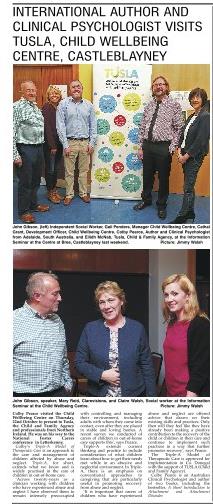 What follows is a media release for the event at which I spoke on Thursday the 22nd of October in Castleblayney, Co. Monaghan, Ireland. The clip to the right is the article in The Northern Standard that appeared on 31/10/15.