Punishment without understanding equals invalidation

People do not act for no reason.

They may act in response to an idea.

They may act in response to an emotion.

They may act in response to a need that requires satisfaction.

They may act because the way their brain developed impairs their capacity to think before they act in the presence of a trigger (stimulus).

If we accept the truth that people do not act for no reason, then we must similarly accept that when we punish a child for their actions without making any effort to try to understand why they did what they did, we are essentially communicating to them that their thoughts, feelings, needs and biological characteristics are unimportant or invalid.

Repeated often enough, the child develops the belief that they are unimportant and invalid.

The consequences of invalidation include behavioural problems, emotional problems, preoccupations with needs and a lack of regard for the impact of one’s behaviour on others.

We can avoid perpetuating maladaptive behaviour in children by responding with understanding and gently teaching them a different way.

Posted in AAA Caregiving, Children's Behaviour, Parenting, Wellbeing | Tagged , , , , , , , , , , , , | 2 Comments

Kindness is magic

Children form significant, lifelong memories of their interactions with the various adults who enter their lives, including their parents, grandparents, aunts and uncles, teachers and so on. Those memories, and the experiences from which they derive, shape the beliefs children hold with respect to themselves, others and the world in which they live. They also shape their behaviour.

The way adults treat any generation of children shapes the way those children will, in turn, treat the next generation when they are adults. It follows that if we are seeking to create a more gentle, humanistic world we adults need to pause and reflect on how we interact with the current generation of children.

Yesterday, I was returning to the Melbourne CBD on an over crowded tram after a day at the Australian Formula One Grand Prix. People were packed into the tram like sardines in a can. Shoulder-to-shoulder they stood in the aisles, swaying and brushing against each other with every jerk and bump. In this environment of uncomfortable levels of physical closeness to strangers eye-contact is minimal and conversation, when it exists, is brief and muted.

So it was that I could clearly hear in the carriage behind me a young girl of primary school age initiate a conversation with a complete stranger standing adjacent to her on the tram. The child had apparently noticed that this stranger had spoken with a heavy accent and had summoned the courage to inquire after its origin. The stranger, who I later observed to be an exotic-looking young woman, responded that her accent was Spanish. The child advised the young woman that she was learning Spanish. What followed over almost one hour was a child maintaining an animated and enthusiastic conversation about learning Spanish, to which the young woman responded with acceptance, warmth, patience and corresponding enthusiasm.

As a psychologist who has interacted with children over a long career I could not help but be impressed, and touched, by the manner in which the young woman engaged with the child. It left me sure that this child would remember fondly the day she interacted with a real-life Spanish-speaking adult, apart from her teacher. I thought immediately of what might be the legacy of this interaction for the child, and what had been the young woman’s own experiences of relating to adults when she was a child that had resulted in her warm, accepting and caring manner towards a previously unknown child.

#KindnessIsMagic

Posted in Parenting, Resilience, Wellbeing | Tagged , , , , , , , , | 1 Comment

Wellness, Wellbeing and Resilience in Children

Decades of research has identified three factors that play a key role in children’s resilience. These three factors are:

  • Individual factors (i.e. characteristics of the individual)
  • Relationship/social factors (i.e. characteristics of their relationships)
  • Environmental factors (i.e. characteristics of their environment).

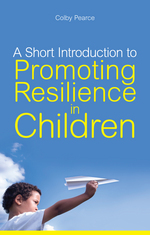
Colby Pearce ResilienceIn A Short Introduction to Promoting Resilience in Children Colby draws on his extensive knowledge of psychology to present a model of care and management that accounts for each factor that has been implicated in children’s resilience, incorporating:

  • Attachment (Relationships/Social)
  • Arousal (Individual)
  • Accessibility to needs provision (Environmental).

Attachment influences the beliefs a child has about self (including beliefs about personal competence), others (including their availability and preparedness to provide support), and the world (including beliefs about safety).

Arousal refers to the level of activation of the child’s nervous system. Arousal influences how well children perform in daily tasks and opportunities to experience a sense of competence and mastery.

Accessibility to needs provision influences exploration and opportunities to learn new skills.

A Short Introduction to Promoting Resilience in Children contains practical strategies for achieving:

  • optimal attachment beliefs;
  • optimal arousal for best performance; and
  • secure exploration of the child’s inner capabilities and outer world.

For more information and to buy the book, click on the cover image to the right.

Posted in AAA Caregiving, Resilience, Schools, Wellbeing | Tagged , , , , , , , , , , | Leave a comment

Colby Pearce Online

Dear Followers and Visitors to this site,

I have been asked a number of times whether I provide online consultations and webinars in my areas of specialty and interest. Well, I wish to advise that I am willing and gearing up to do so. Please visit my Secure Start website for more information, or click here and here. I look forward to hearing from you.

Colby.

Posted in AAA Caregiving, Adoption, Attachment, Children's Behaviour, Fostering, Parenting, Resilience, Therapy, Trauma, Uncategorized, Wellbeing | Tagged , , , , , | Leave a comment

Assessing Suicide Risk

Youth suicide remains a major public health concern of our time. Few things are more tragic than a young life cut short. Compounding the tragedy of youth suicide is the fact that suicide among young people is a permanent solution to impermanent difficulties or circumstances. And, it is preventable.

Identification of those young people who are at risk of making a suicide attempt is the key to prevention.

In 1994, Colby’s article Predicting Suicide Attempts Among Adolescents was published in prominent Psychiatry periodical of the time,  Acta Psychiatrica Scandinavica.The article reports on the findings of a study of suicidal behaviour among Adelaide teens. The article examines the utility of an assessment methodology based on the teens’ acknowledgement of other behaviours in the spectrum of suicidality; including suicide thoughts, suicide plans, suicide threats and deliberate self-harm.

A key finding of the study was that it is possible to identify suicide attempters with a high degree of accuracy and non-attempters with a moderate degree of accuracy using a scoring methodology based on the young person’s answer to four simple questions about suicide thoughts, plans and threats, and deliberate self-harm.

Though long overlooked by public health organisations in this country, such is the worth of the assessment methodology reported in this article that it has recently been chosen for inclusion in the American Psychological Society’s PsycTESTS database.

If you are concerned that a young person you know may be at-risk of making a suicide attempt, support them to consult their general medical practitioner as soon as possible. The GP can conduct a preliminary assessment of suicide risk and refer on to a mental health specialist for a more comprehensive risk evaluation where they consider this to be necessary.

If you are a health practitioner or organisation and want to know more about the assessment methodology contained in Predicting Suicide Attempts Among Adolescents, please do not hesitate to get in touch with Colby at colby@securestart.com.au.

Posted in Wellbeing, Youth Suicide | Tagged , , , , , , , , , , , | Leave a comment

Reparative Attachment Therapy

Reparative Attachment Therapy is the name used to refer to Colby’s therapeutic approach when treating children who have experienced the devastating effects of abuse, neglect, family violence and loss during their early developmental years.

Colby Pearce Attachment National Psychology ExamKey elements of Colby’s approach appear in his 2009 publication,A Short Introduction to Attachment and Attachment Disorder(London; Jessica Kingsley Publishers). The description of Colby’s approach, as it appears in this book, relates to the context in which Reparative Attachment Therapy is practised and the establishment and maintenance of the all-important therapeutic relationship or alliance.


Repairing Attachments CompressedA more detailed description of Colby’s approach was published in December 2012 in the British Association of Counselling and Psychotherapy’s periodical, Children and Young People. Titled Repairing Attachments, this article is a good starting point to learn more about specific approaches and techniques employed by Colby when practising Reparative Attachment Therapy.


BACP Hand CompressedIf you want to learn more about Colby’s therapeutic approach, he is available for individual supervision and the provision of training workshops. To arrange supervision or training for you and/or your staff, please contact us or email Colby directly at colby@securestart.com.au.

Posted in AAA Caregiving, Adoption, Attachment, Fostering, Therapy, Trauma | Tagged , , , , , , , , , , , , , , , , | Leave a comment

Triple-A Model of Therapeutic Care

The Triple-A Model of Therapeutic Care is an evidence-based approach to the care of children who have experienced complex developmental trauma.

The Model was developed by Secure Start Principal Clinical Psychologist, Colby Pearce, and represents an integration of knowledge and experience gathered over more than twenty years as a researcher and practitioner in child and adolescent mental health and child protection.

Colby is known internationally for being able to translate complex theory and knowledge into accessible and practical guidelines of care. In evidence of this, why not read a couple of articles written by Colby that appear on this site.

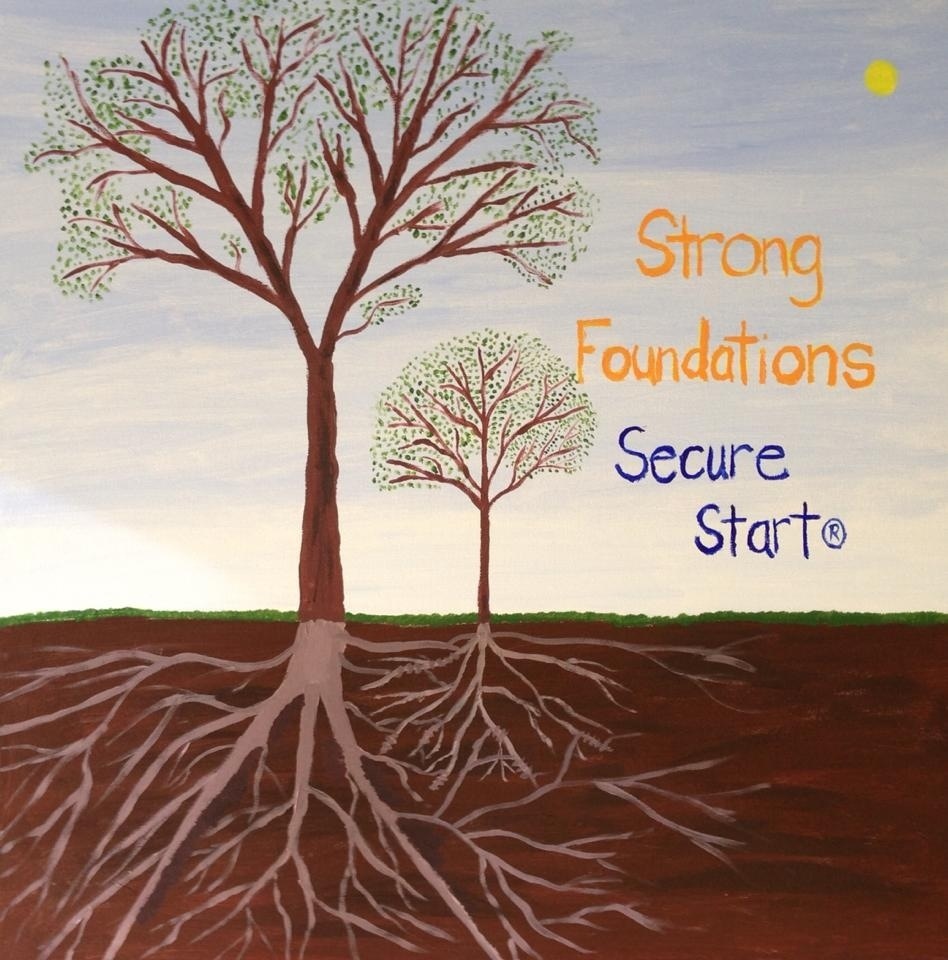
Unlike other models that focus on one or two aspects of psychological functioning, the Triple-A Model of Therapeutic Care is a tripartite model that accounts for the impact of complex developmental trauma in three key areas of psychological functioning:

  • Colby Pearce Attachment National Psychology ExamAttachment (science of relationships and social-emotional development)
  • Arousal (psychophysiology of emotion and behaviour activations systems – a.k.a. “Neurobiology of Trauma”)
  • Accessibility (science of human behaviour)

First described in 2009 in Colby’s bestselling title A Short Introduction to Attachment and Attachment Disorder (London: Jessica Kingsley Publishers), the Triple-A Model of Therapeutic Care was published after expert peer review in 2010 in the British Psychological Society’s periodical Educational and Child Psychology, as part of a Special Issue on Attachment.

Colby Pearce ResilienceIn 2011, the Triple-A Model of Therapeutic Care was successfully applied to the topic of parenting to promote resilience in children in Colby’s follow-up book, A Short Introduction to Promoting Resilience in Children (London: Jessica Kingsley Publishers); thus substantiating Colby’s view that the Triple A Model of Therapeutic Care is more than simply an approach to the care of children who have experienced the devastating effects of abuse, neglect, family violence and loss. It is a valid, evidence-based approach to the therapeutic care of all children.

The Triple-A Model of Therapeutic Care offers a comprehensive approach to the therapeutic care of children who have experienced early trauma, incorporating evidence-based strategies and the rationale for them.  

For more information, contact me using the form below.

← Back

Thank you for your response. ✨

Warning
Warning
Warning
Warning

Warning.

Join 5,452 other subscribers

Follow the links below to my two new resources supporting consistency of care and effective communication between home and school for children recovering from a tough start to life:

Click here for more information and to access our resource for carers who are supporting children who are recovering from a tough start to life.
Click here for more information and to access our new resource for teachers who are managing children who are recovering from a tough start to life.
Posted in AAA Caregiving, Adoption, Attachment, Fostering, Parenting, Trauma | Tagged , , , , , , , , , , , | Leave a comment

In order to be heard we first need to listen

I think a lot about the concept of validation; and its antithesis, invalidation. In psychological terms, validation incorporates the experience that our thoughts, feelings, perspectives and intentions are understood, accepted and respected by significant others. Conversely, invalidation incorporates the experience that our thoughts, feelings, perspectives and intentions are not understood, accepted and respected by significant others. People who predominantly experience validation of their thoughts, feelings, perspectives and intentions form the belief that they themselves are acceptable; that is, valid. I am often likening validation to an inoculation against depression. Those who do not experience validation on a regular and consistent basis form the belief that they are unacceptable; that is, invalid. Invalidation has a destructive effect on the mental health and wellbeing of people of all ages; particularly children, where the destructive effects of invalidation can be lifelong.

Validation and invalidation are reciprocal processes. We are all more positively disposed towards the thoughts, feelings, perspectives and intentions of those whom we experience as being understanding, accepting and respecting of our own. Conversely, we are less well disposed towards those whom we experience as not understanding, accepting and respecting us. We are less likely to share with these people or listen to their stories. They, in turn, are less likely to listen to us and share with us. Invalidation ends meaningful communication and destroys relationships.

Central to validation is the experience of being heard. We are more likely to be heard when those from whom we are seeking understanding, acceptance and respect have the experience that we have heard them. This is the truth of the old adage “in order to be heard we first need to listen”.

For our own sakes and the sake of all we come into contact with, we need to get better at listening, understanding, accepting and respecting. Only then can we expect to be heard. Only then can we experience validation and its benefits.

Posted in Favourites, Therapy, Wellbeing | Tagged , , , , , , | Leave a comment

Adopting a balanced view

This short article first appeared in the Blog for The Adoption Social on 21/1/14. I am grateful to the administrators of that site for their interest in my work and my views regarding the care of children.

20130804-180027.jpgI was born in January, which is the height of summer here in Adelaide, Australia. As such, I have always thought of myself as a “summer baby” and considered that this is why I enjoy the warmer months as opposed to the cooler months. I have a lifelong aversion to feeling cold and for many, many years I felt below my best during winter. I have questioned many people about this and have discovered that most people prefer either the warmer months or the cooler months. Many of them are just not happy until their preferred season returns.

About three years ago, and with the emergence of joint aches and pains during the colder months, I had the thought that it was a bit of nonsense really to consider myself a “summer baby” and defer happiness until it was warm again. I have always been a keen gardener and have a large hills garden. Looking after my garden is an act of looking after my self. Water is an issue as it is scarce and expensive, my garden is large and summer is hot (As I write this it is the fifth consecutive day of over 40C). So, I bought some rainwater tanks and now I pray for as much ‘bad’ weather as possible during the cooler months. I check the weather radar each day and feel let down if forecast wet and wintry weather blows south or north. I still have my aches and pains and look forward to the warmer months when they trouble me less, but I also look forward to cooler, wetter months now as it is a boon for my efforts to maintain a magnificent garden. And the garden? Well, with the additional water supply it has never looked better.

What has all this got to do with looking after children; particularly those children who experienced significant adversity in the first days, weeks, months and years of their precious lives? Well, it has to do with how we perceive them and the effects of this; both in terms of our own experience of caring for them and their experience of being cared for by us.

I am particularly interested in the idea of “self-fulfilling-prophecies”. In Psychology, these take the following form. I have a thought. My thought induces an emotion. My emotion activates a behavioural response. My behavioural response precipitates a reaction in others. The reaction of others often confirms my original thought.

Let’s try one. Thought: “nobody loves me”. A common feeling associated with this thought: hostility. Common behavioural responses to feelings of hostility: withdrawal and/or aggression. A common reaction to withdrawal and aggression: admonishments. An inevitable result: confirmation of the original thought.

Lets try another. He is damaged by his early experiences. I feel badly for him. I try to heal him. He keeps pushing me away. He is obviously damaged.

And, another: He is such a good artist. I am so proud of him. I support and encourage his interest in art. His skills develop and he is often affirmed for his artistic achievements. He is such a good artist!

Children who have experienced significant adversity at the beginning of their life are commonly referred to as “traumatised”. There is much literature about how early trauma impacts the developing child, including their acquisition of skills and abilities, their emotions, their relationships with others and even their brain. This literature focuses on the damage early trauma does and there is a risk that we, their caregivers, see these children as damaged.

One of my favourite allegories is the one that the author Paulo Coelho tells in his book, The Zahir. Coelho tells the story of two fire-fighters who take a break from fire fighting. One has a clean face and the other has a dirty, sooty face. As they are resting beside a stream, one of the fire-fighters washes his face. The question is posed as to which of the fire-fighters washed his face. The answer is the one whose face was clean, because he looked at the other and thought he was dirty.

The idea of the looking-glass-self (Cooley, 1902), whereby a person’s self-concept is tied to their experience of how others view them, has pervaded my life and my practice since I stumbled across the concept as a university student. Empirical studies have shown that the self-concept of children, in particular, is shaped by their experience of how others view them. In my work, this has created a tension between acknowledging the ill-effects of early trauma and encouraging a more helpful focus among those who interact with so-called ‘traumatised children’ in a caregiving role.

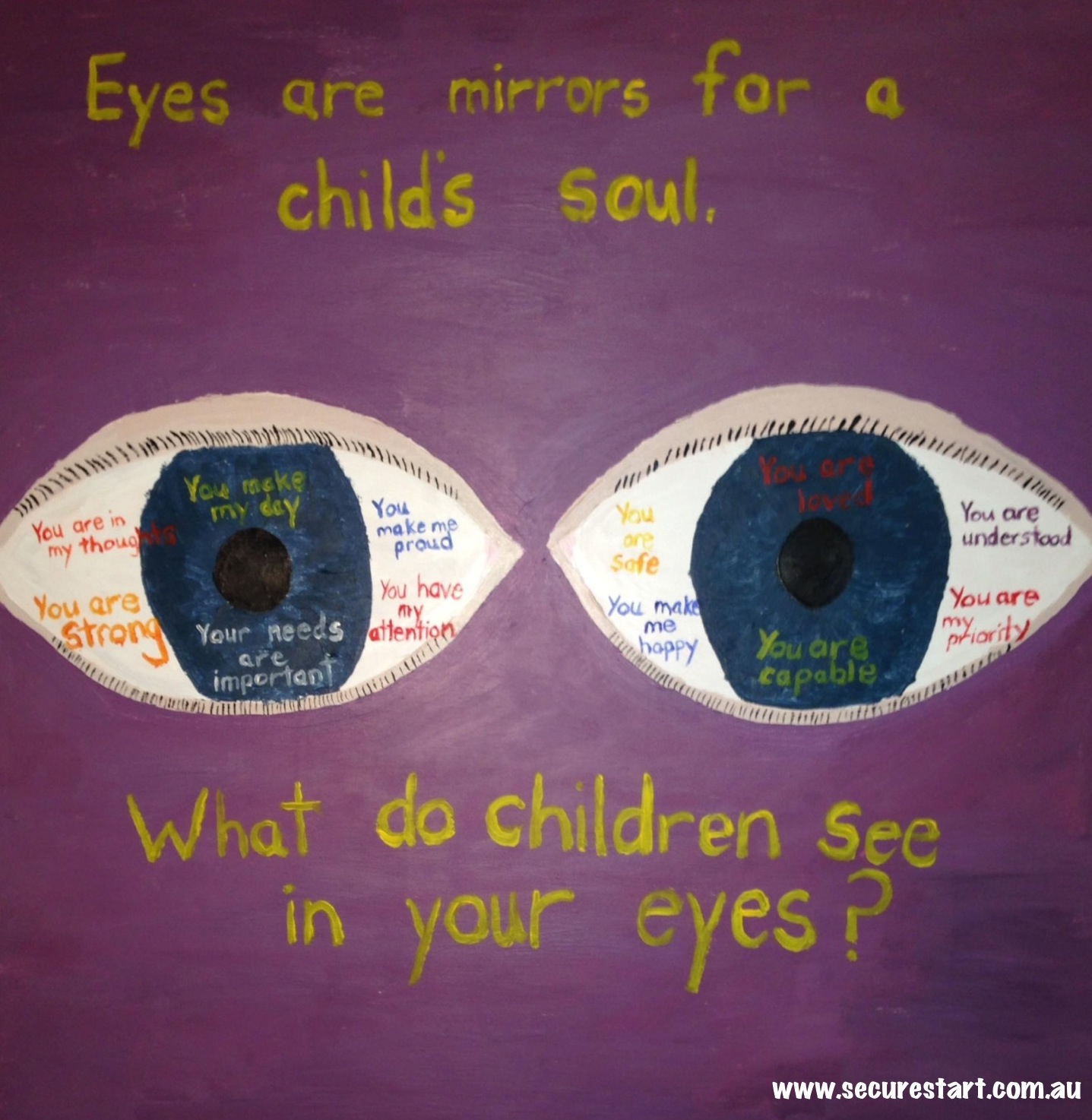
EyesI am just as fallible as the next person, and I do not have all the answers. But as a professional who interacts with these children and their caregivers on a daily basis I strive to find a balance between acknowledging and addressing the ill-effects of early trauma and promoting a more helpful perception of these children. I strive to present opportunities to these children for them to experience themselves as good, lovable and capable; to experience me and other adults in their lives as interested in them, as caring towards them and as delighting in their company; as well as experiences that the world is a safe place where their needs are satisfied. I strive to enhance their experience of living and relating, rather than dwelling on repairing the damage that was done to them. Most of all, I see precious little humans whose potential is still yet to be discovered.

Eyes are mirrors for a child’s soul. What do children see in your eyes?


References

Coelho, P (2005), The Zahir. London. Harper Collins

Cooley, C.H. (1902). Human Nature and the Social Order. New York. NY: Scribner

Publishers

Posted in AAA Caregiving, Adoption, Attachment, Fostering, Parenting, Trauma, Wellbeing | Tagged , , , , , , , , , , , , , | 1 Comment

2013 in review

The WordPress.com stats helper monkeys prepared a 2013 annual report for this blog.

Here’s an excerpt:

The concert hall at the Sydney Opera House holds 2,700 people. This blog was viewed about 15,000 times in 2013. If it were a concert at Sydney Opera House, it would take about 6 sold-out performances for that many people to see it.

Click here to see the complete report.

Posted in Uncategorized | Leave a comment